José Andrade
Colombian graphic designer, illustrator and game dev 👽✏️✨

José Andrade
Colombian graphic designer, illustrator and game dev 👽✏️✨

Hi, I'm José! A Colombian graphic designer, illustrator and game dev passionate about storytelling across mediums. With experience in creative quality, UI/UX, animation, and digital marketing, I thrive at the intersection of art and interactivity.My work often draws inspiration from my own Colombian heritage, cozy aesthetics, and narrative-driven design. Whether I’m building a town, illustrating a story, or refining a digital experience, my goal is always the same: to craft worlds that feel meaningful, welcoming, and alive.

José Andrade
Colombian graphic designer, illustrator and game dev 👽✏️✨
Quality Assurance Analyst and Graphic Designer with experience in global agencies such as Publicis Groupe and Design Pickle, as well as a strong background in freelance international projects. Specialized in Creative QA, graphic design, illustration, and workflow optimization, ensuring brand consistency and creative excellence across LATAM and global campaigns, with a proven track record of delivering 3000+ monthly assets and leading QA across 15+ countries.SKILLS
■Creative & Design Tools: Adobe Creative Suite (Illustrator, Photoshop, InDesign, After Effects), Figma, illustration, UI/UX
■Quality Assurance & Workflow: Creative QA, Graphic Quality Control, Copy Review, Creative X, Workflow Optimization
■Project Management & Remote Tools: Slack, Microsoft Teams, Asana, Trello, Jira, Notion, ClickUp
■Office & Productivity: Microsoft Office (Word, Excel, PowerPoint), Google Suite (Docs, Sheets, Slides, Drive)
■Languages: Spanish (Native), English (C1 Advanced); French (B2); English–Spanish TranslationEXPERIENCE
■ Creative QA Analyst
Publicis Production (Publicis Groupe) - Bogotá, COL
SINCE MAY 2025■Creative Quality Specialist
Design Pickle, Scottsdale, USA (Remote)
JUN 2023 - MAY 2025■Graphic Designer
Branditt - Bogotá, COL
JUL 2022 - JUN 2023■Illustrator and Graphic Designer
Freelance work for international clients in Canada, the U.S., and LATAM.
SINCE JUN 2017EDUCATION
■Specialization/Postgraduate Diploma in Design Pedagogy
National University of Colombia (Universidad Nacional de Colombia)
FEB 2024 - FEB 2025■Bachelor’s Degree in Graphic Design
National University of Colombia (Universidad Nacional de Colombia)
JUN 2017- FEB 2022■Diploma in Scientific Illustration
National University of Colombia (Universidad Nacional de Colombia)
JUN 2024- SEP 2024■Courses in UI/UX Design and Graphic Design
AUG 2021- OCT 2021
California Institute of the Arts (CalArts), Online (Coursera)AWARDS AND ACHIEVEMENTS
■Pickle’s Choice Award (2023, 2025) - Design Pickle■Latinx in Gaming Grant Winner (2023) - Latinx in Gaming

José Andrade
Colombian graphic designer, illustrator and game dev 👽✏️✨
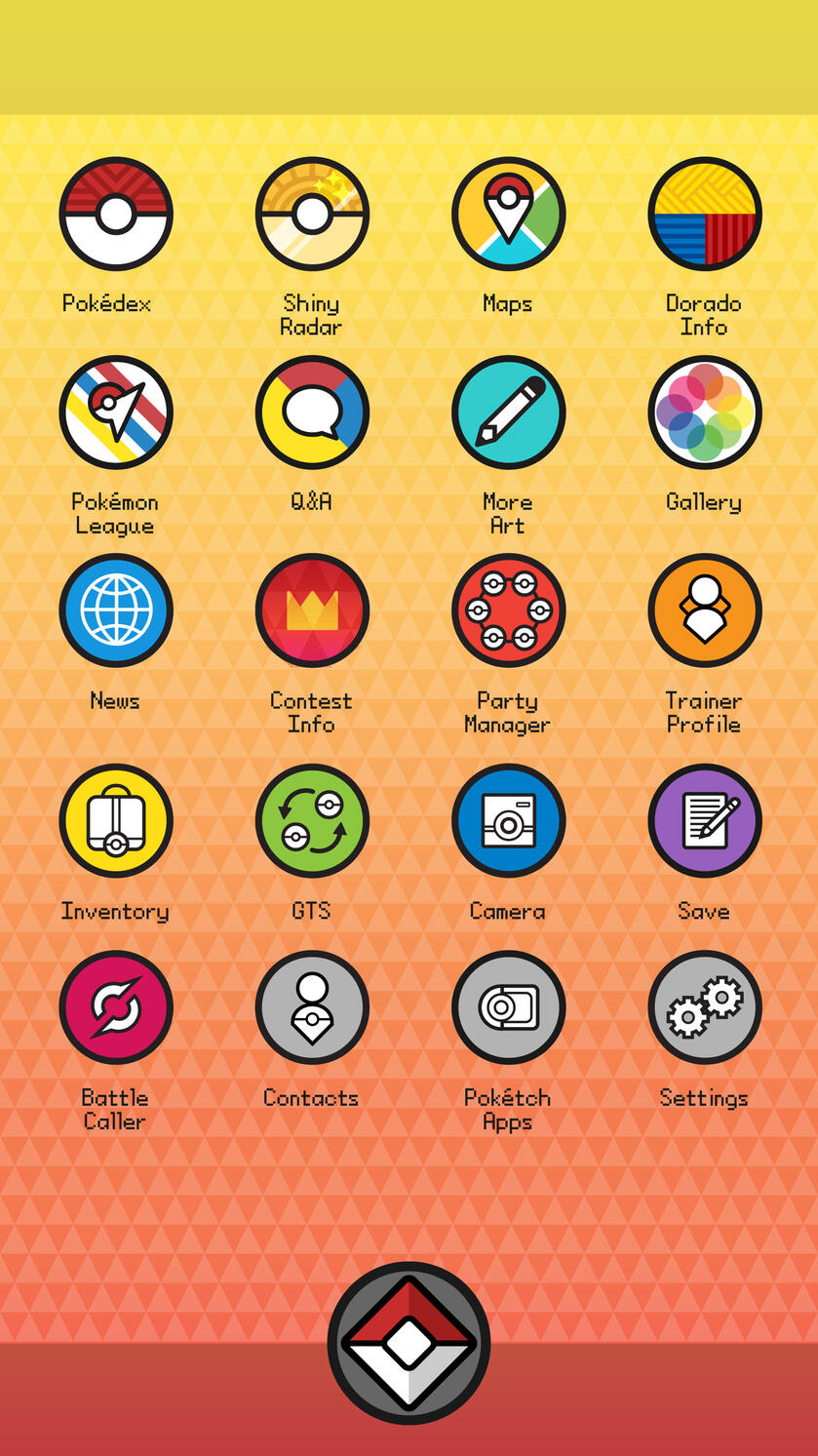
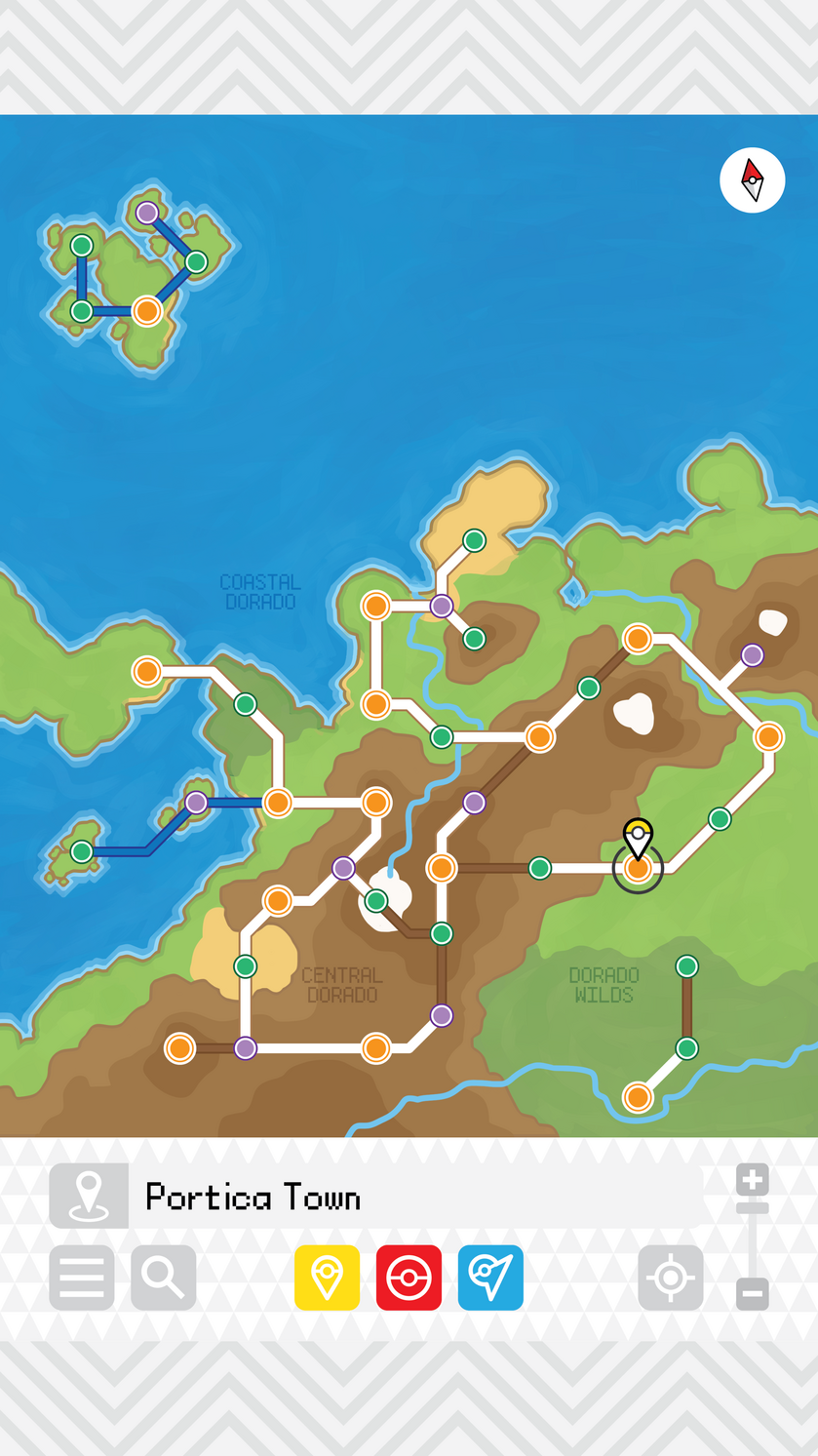
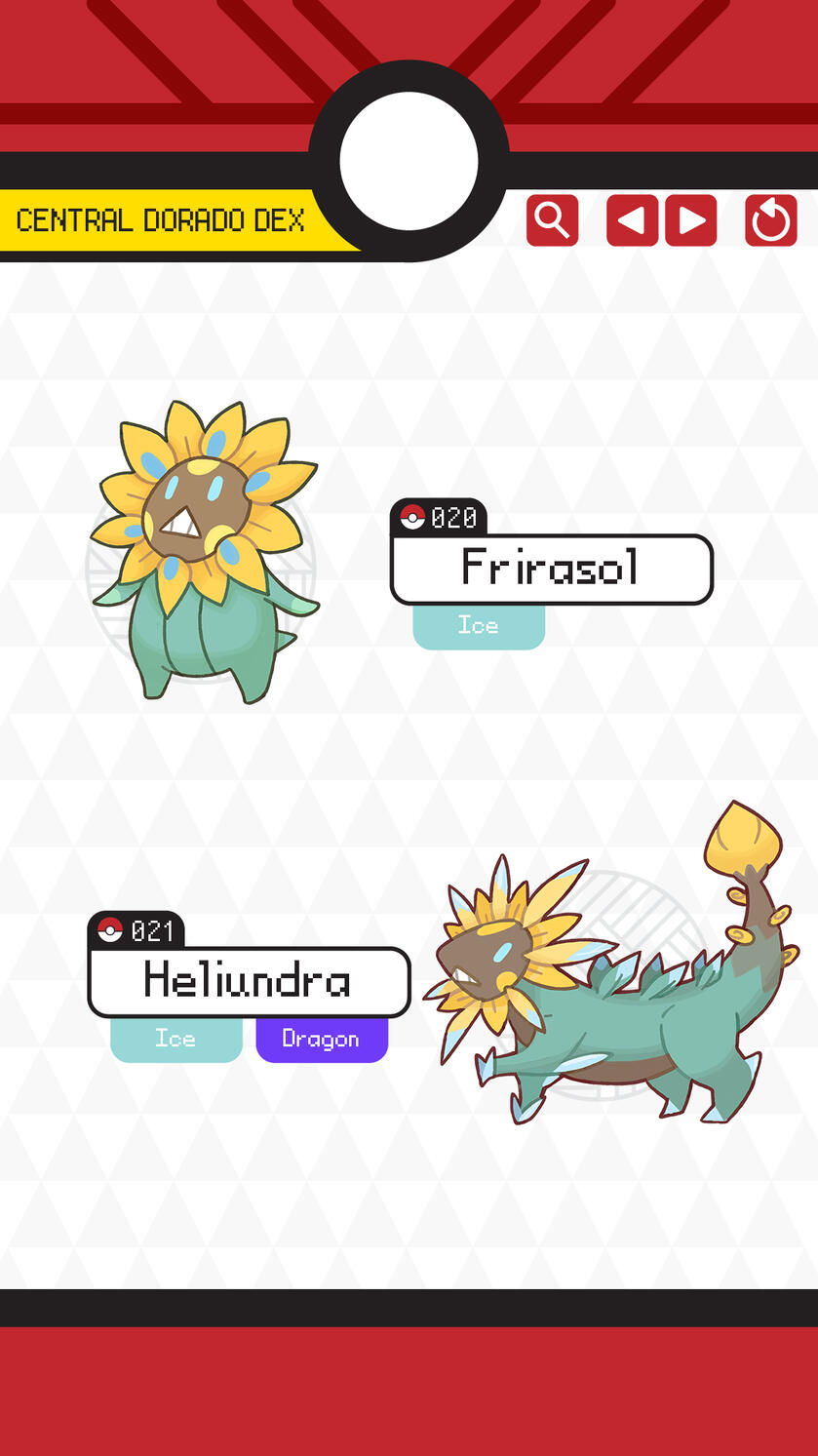
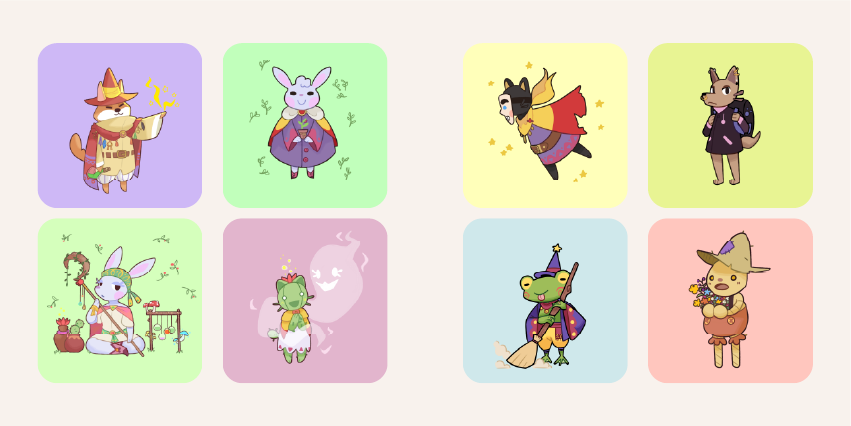
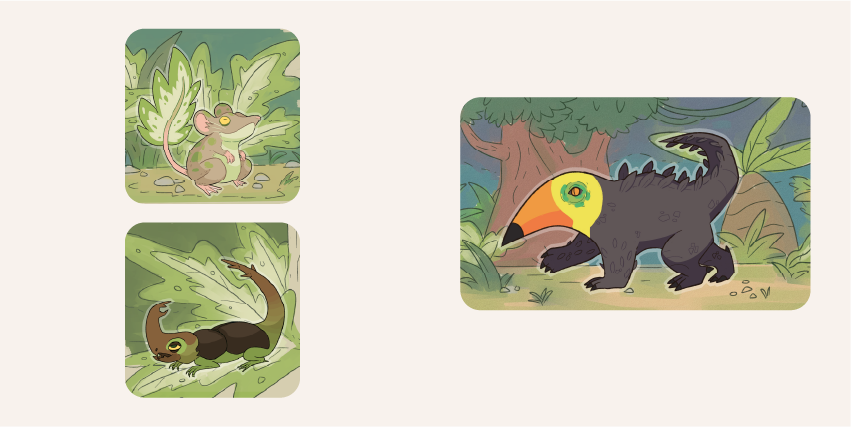
The Dorado Dex (2018-2019) was a creature design exercise where I created Pokémon-like creatures inspired by Colombia’s fauna, flora, and folklore. The project included 86 original creatures along with additional graphic assets.
The project built a following of over 1,000 people and reached thousands across other social media platforms such as Facebook and Tumblr.
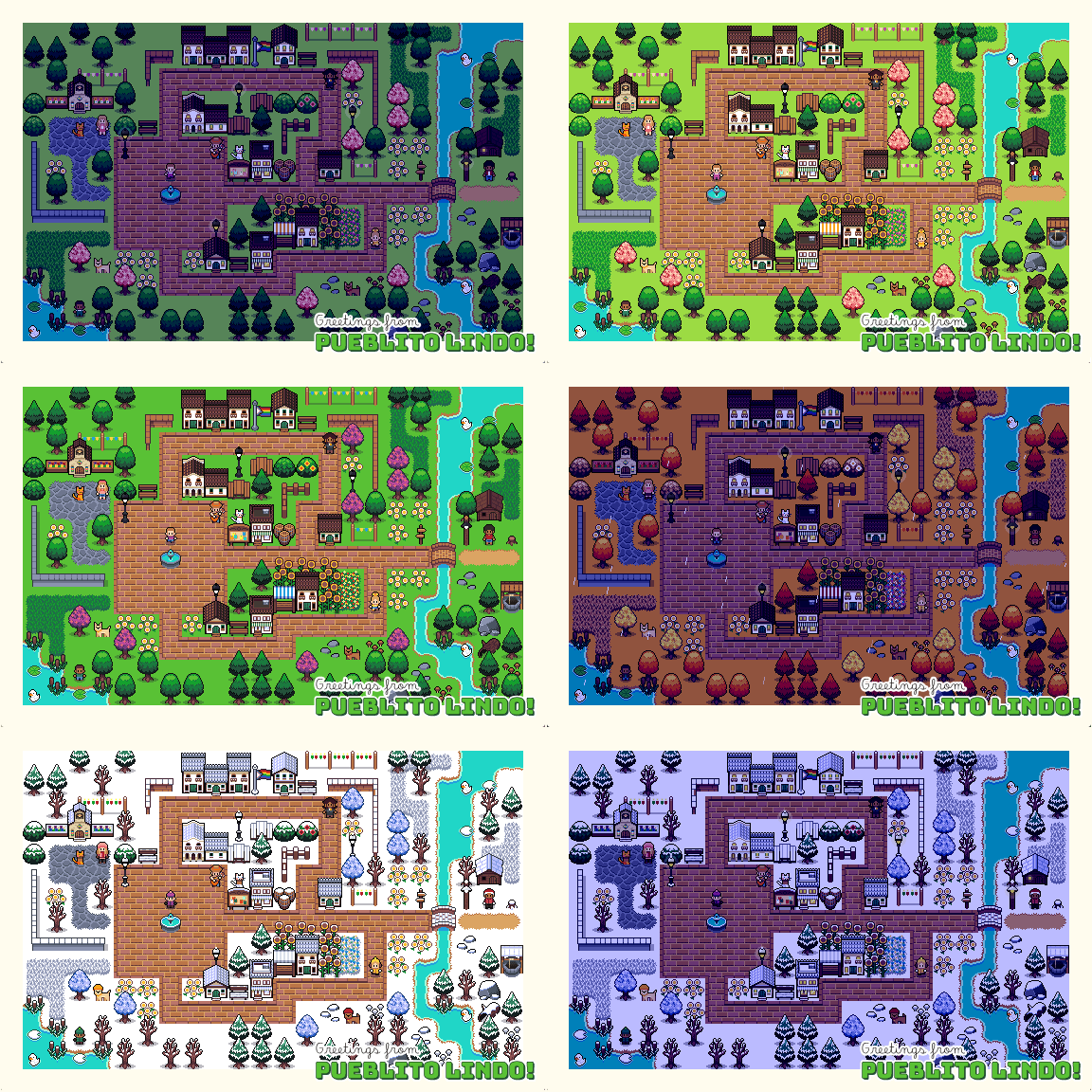
Pueblito Lindo is a cozy town builder where you can design your own little village without worrying about resources or goals.

José Andrade
Colombian graphic designer, illustrator and game dev 👽✏️✨

José Andrade
Colombian graphic designer, illustrator and game dev 👽✏️✨

José Andrade
Colombian graphic designer, illustrator and game dev 👽✏️✨
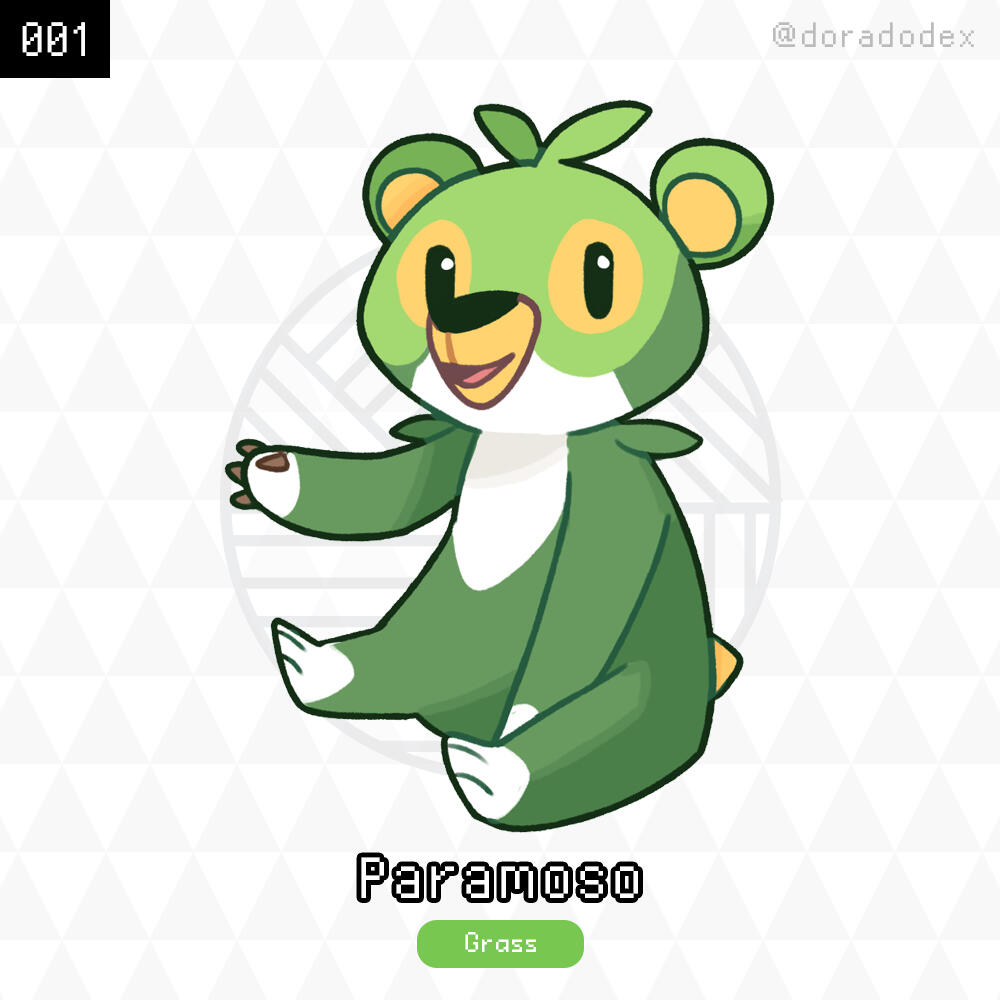
001
PARAMOSO
GrassIt's said that even from a young age it can climb the highest trees. It is very shy and cautious around humans.ORIGIN + ETYMOLOGY
Paramoso is based on an Andean Bear (also known as an Spectacled bear).
"Paramoso" comes from 'páramo' (a type of alpine tundra located in the northern Andes) and 'oso' (bear).
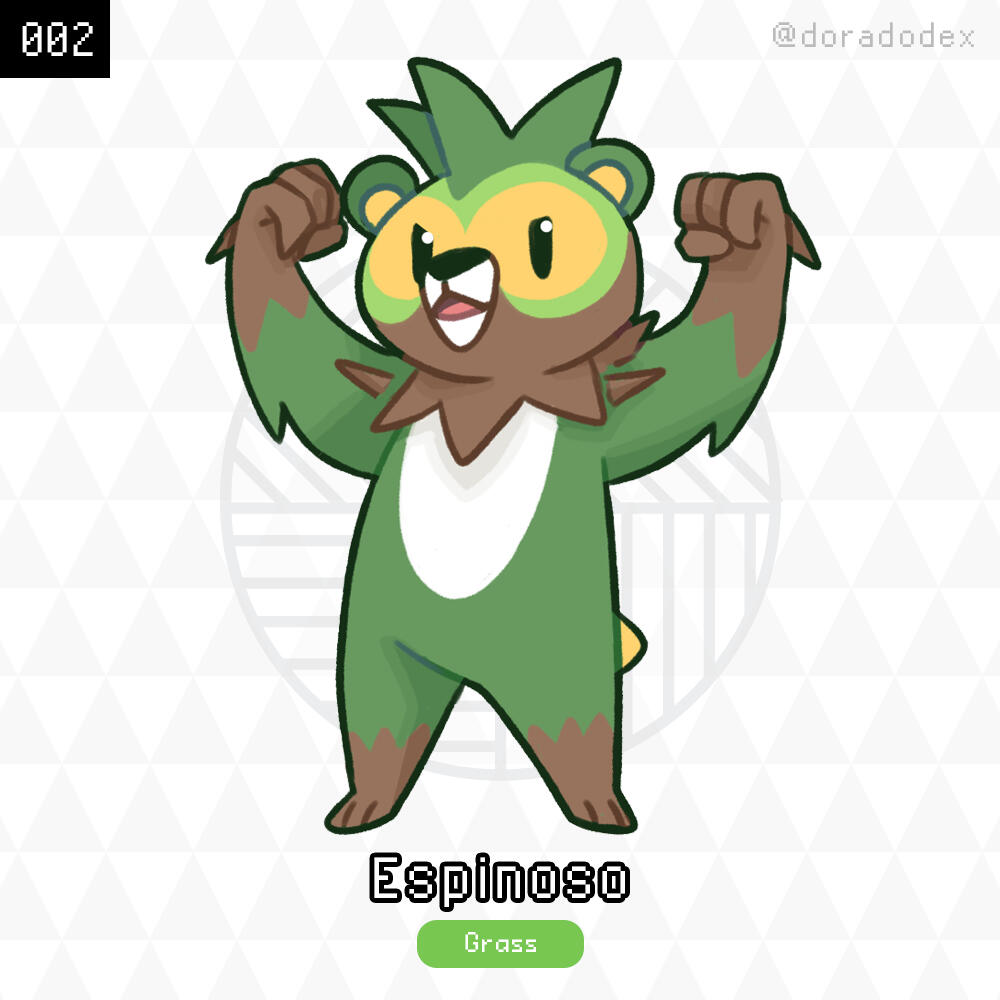
002
ESPINOSO
GrassEspinoso always gets excited during battle and loves to show off for its trainer. Its fur is incredibly prickly and rough.ORIGIN + ETYMOLOGY
Espinoso is based on an Andean bear.
"Espinoso" is a combination of 'espina' (thorn), espeletia (genus of the frailejón) and 'oso' (bear).
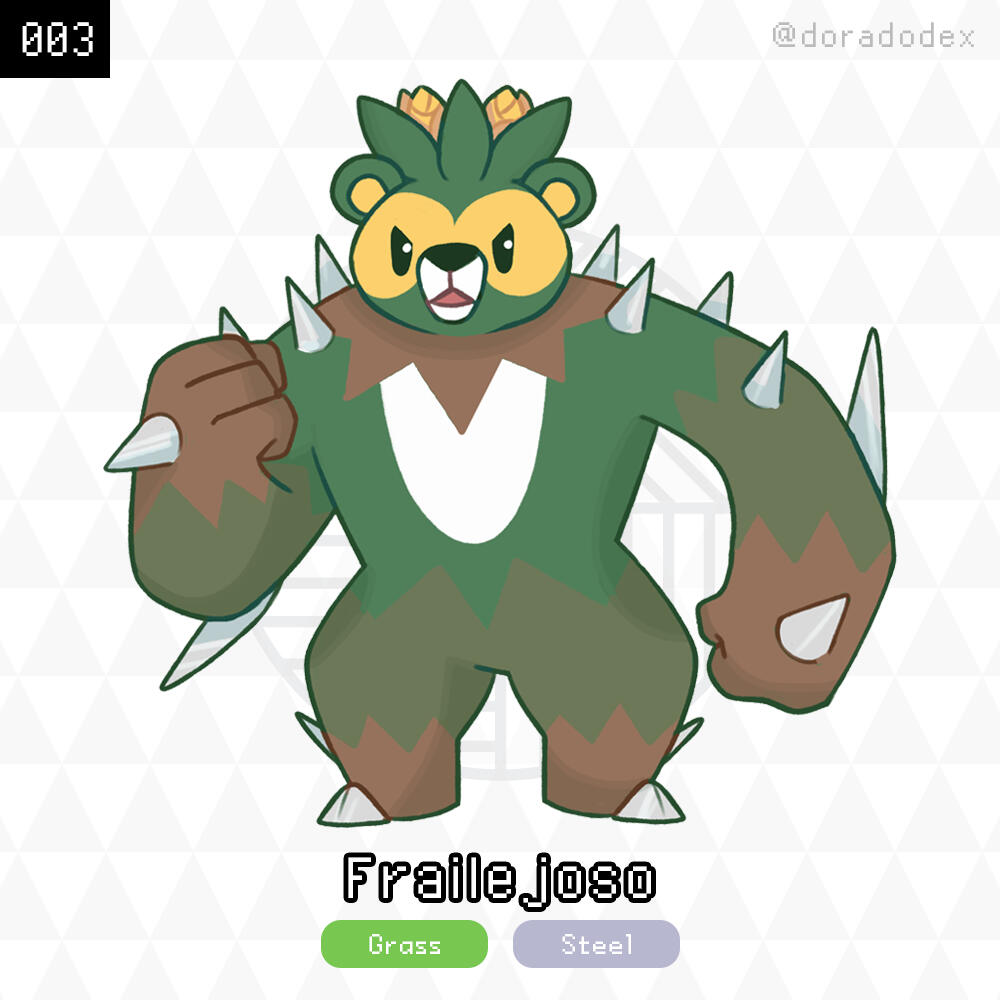
003
FRAILEJOSO
Grass/SteelFrailejoso is known as the guardian of the forest, it fiercely protects the smaller creatures that it shares the woods with from predators and human intervention.ORIGIN + ETYMOLOGY
Frailejoso is based on an Andean Bear and a frailejón.
"Frailejoso" is a combination of 'frailejón' and 'oso' (bear).
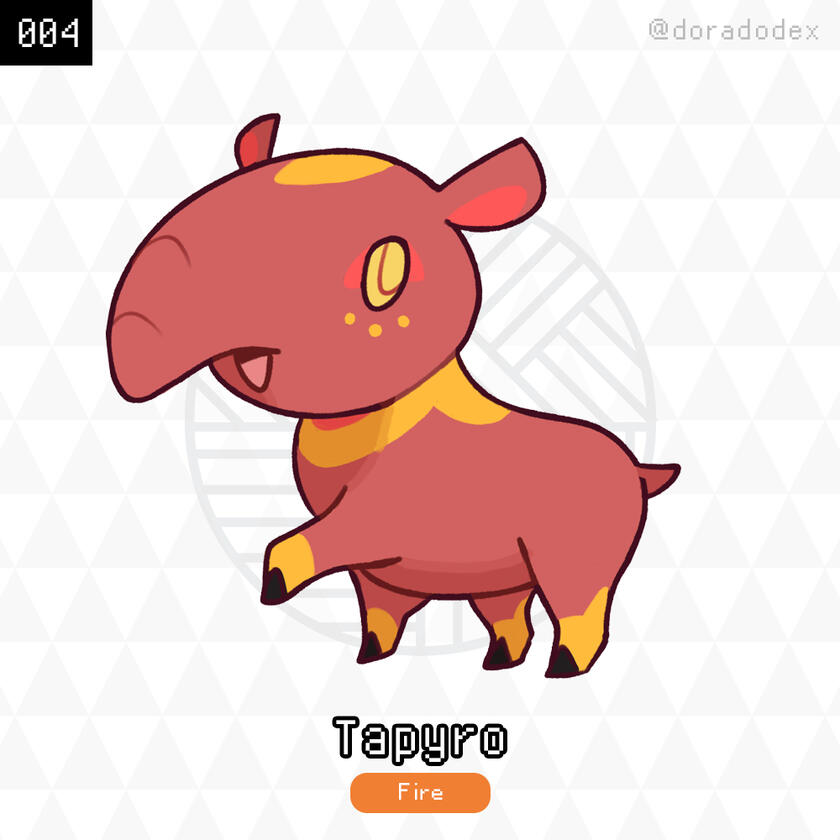
004
TAPYRO
FireIts high body temperature allows it to survive the extreme colds of the Dorado mountain range. It is very friendly and playful.ORIGIN + ETYMOLOGY
Tapyro is based on the mountain tapir or Andean tapir. "Tapyro" is a combination of 'tapir' and 'pyro'.
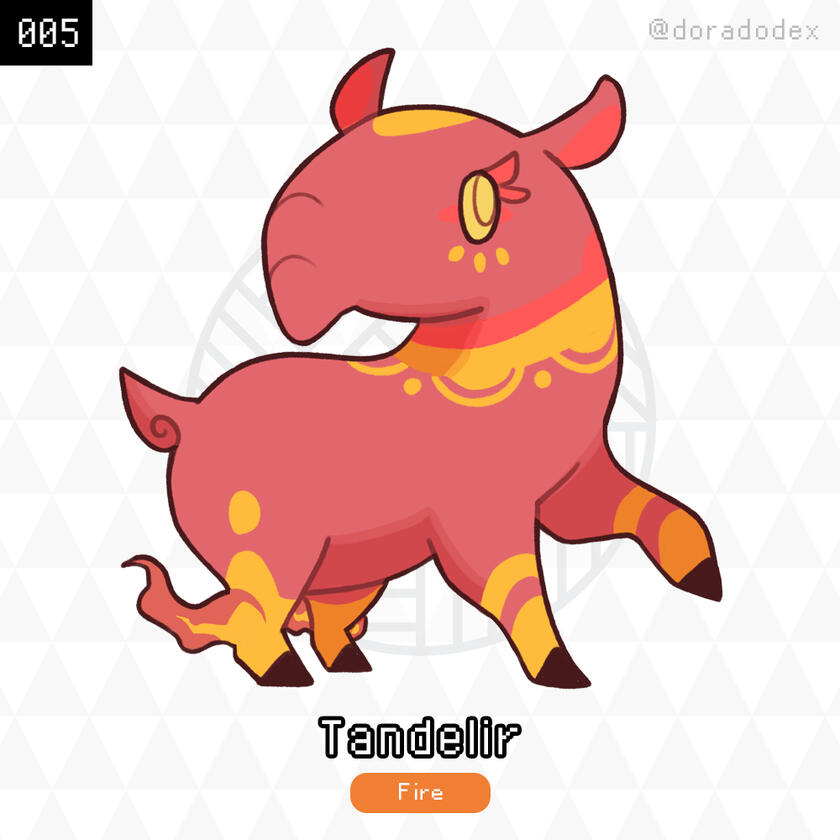
005
TANDELIR
FireIts movements are not very graceful despite what its appearance might suggest. Tandelir is popular with children in the Dorado Wilds and it's an excellent domestic companion.ORIGIN + ETYMOLOGY
Tandelir is based on a mountain tapir or Andean tapir.
"Tandelir" is a combination of 'tapir' and 'candela' (flame).
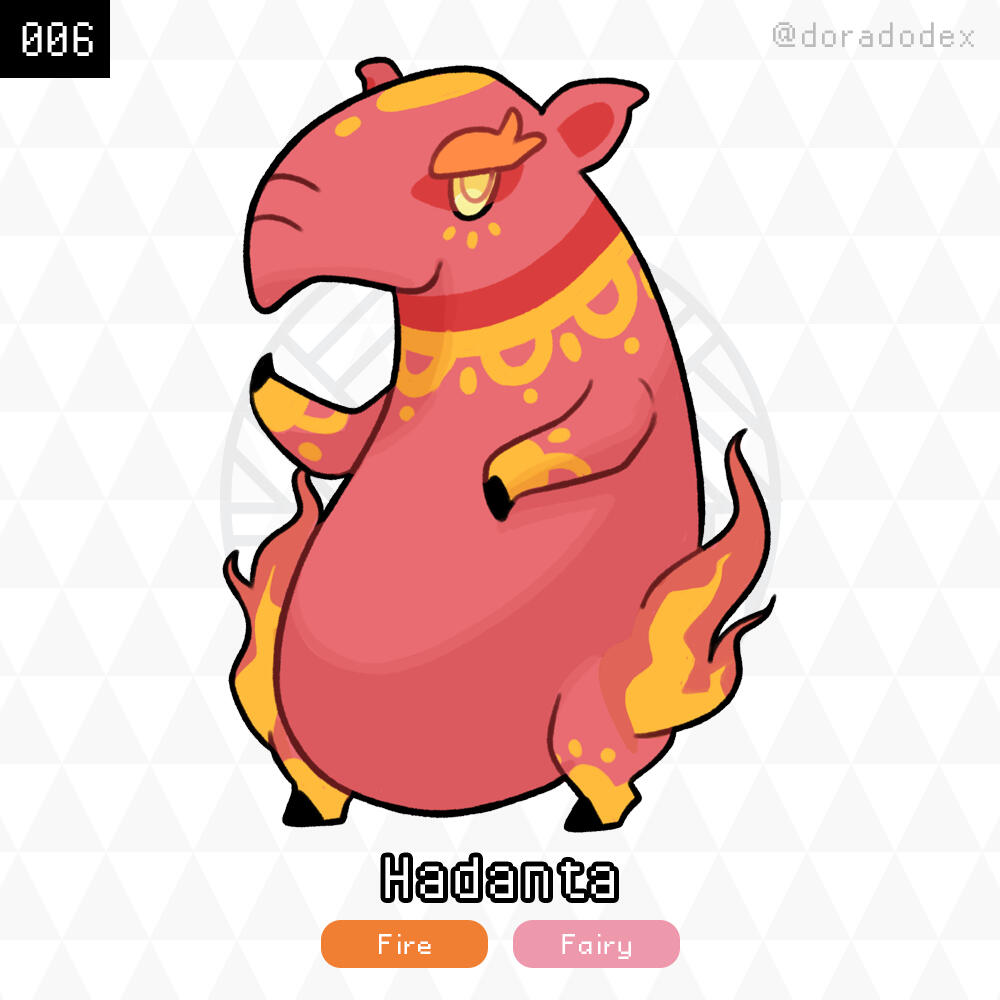
006
HADANTA
Fire/FairyIts body exudes a lovely aroma that attracts smaller creatures to it, it protects these creatures as if they were its own children.ORIGIN + ETYMOLOGY
Hadanta is based on a mountain tapir or Andean tapir.
"Hadanta" is a combination of 'hada' (fairy) and 'danta' (another name for a tapir).
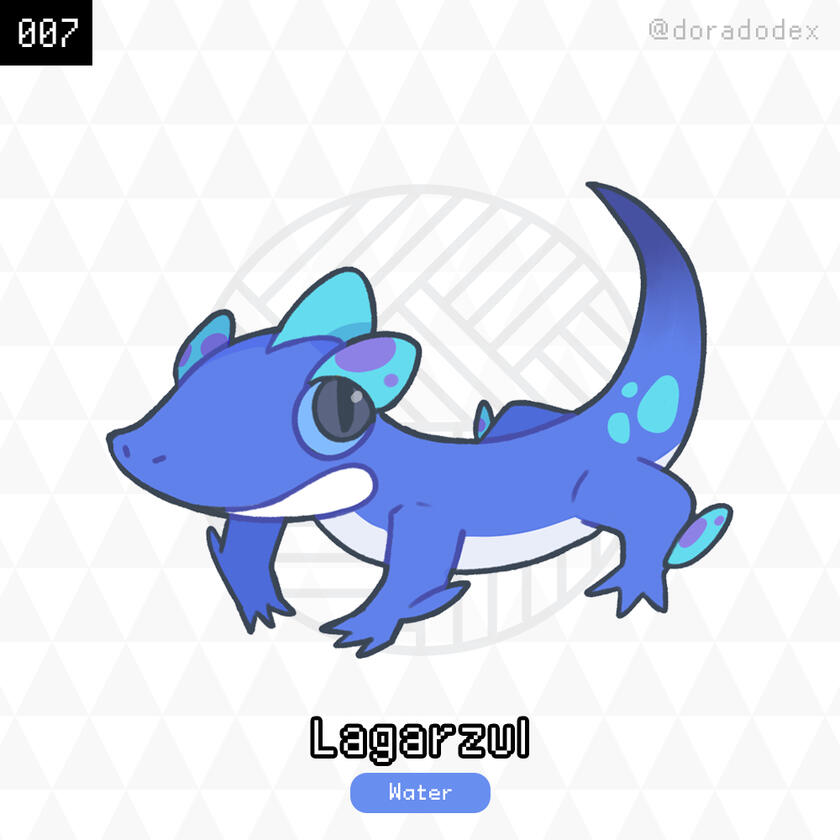
007
LAGARZUL
WaterThis evasive pokémon is rarely seen in the wild, experts say it uses its blue scales to camouflage in and out of the water. It's an excellent swimmer.ORIGIN + ETYMOLOGY
Lagarzul is based on a Blue Anole, a light blue lizard endemic to the Island of Gorgona in the Colombian Pacific.
"Lagarzul" is a combination of 'lagarto' (lizard) and 'azul' (blue).
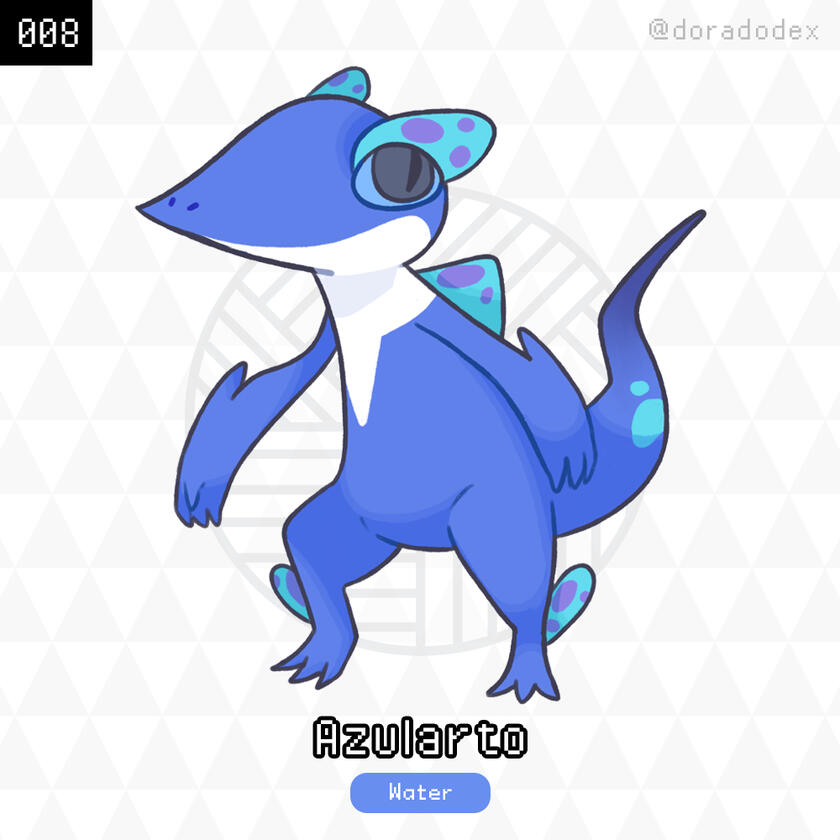
008
AZULARTO
WaterAzularto's fins allow it to swim at incredible speeds, it's a master of camouflage both in land and underwater.ORIGIN + ETYMOLOGY
Azularto is based on a Blue Anole and a Mandarin fish.
"Azularto" is a combination of 'azul' (blue) and 'lagarto' (lizard).
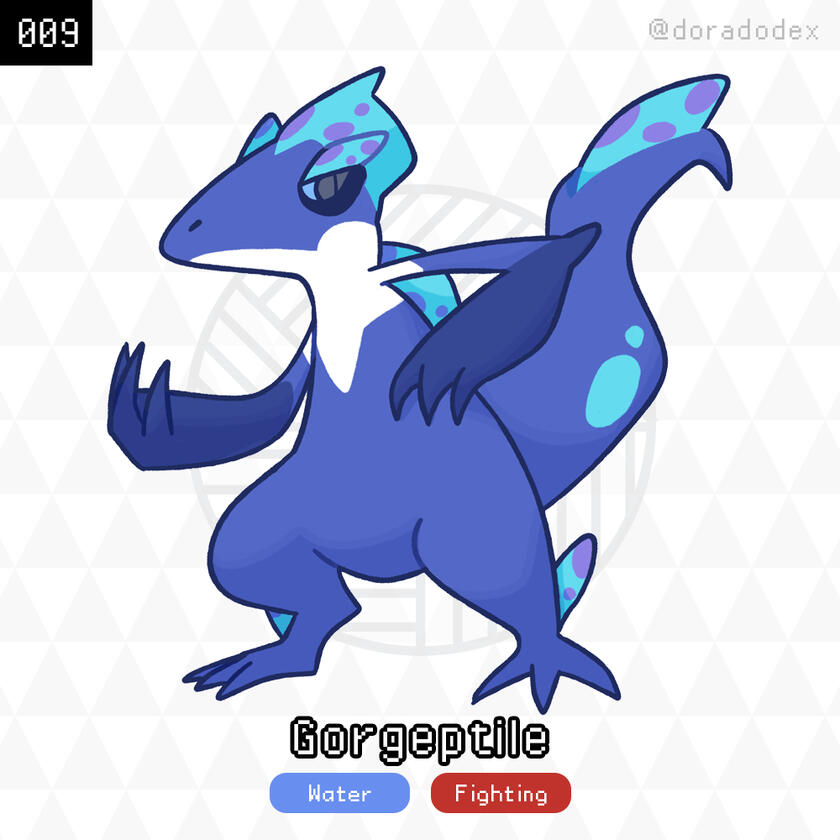
009
GORGEPTILE
Water/FightingGorgeptile’s movements are fast and sharp, it can cut through anything in an instant.ORIGIN + ETYMOLOGY
Gorgeptile is based on a Blue Anole and a Mandarin fish.
"Gorgeptil" is a combination of 'Gorgona' (Island that the blue anole is endemic to) and ‘reptile’.
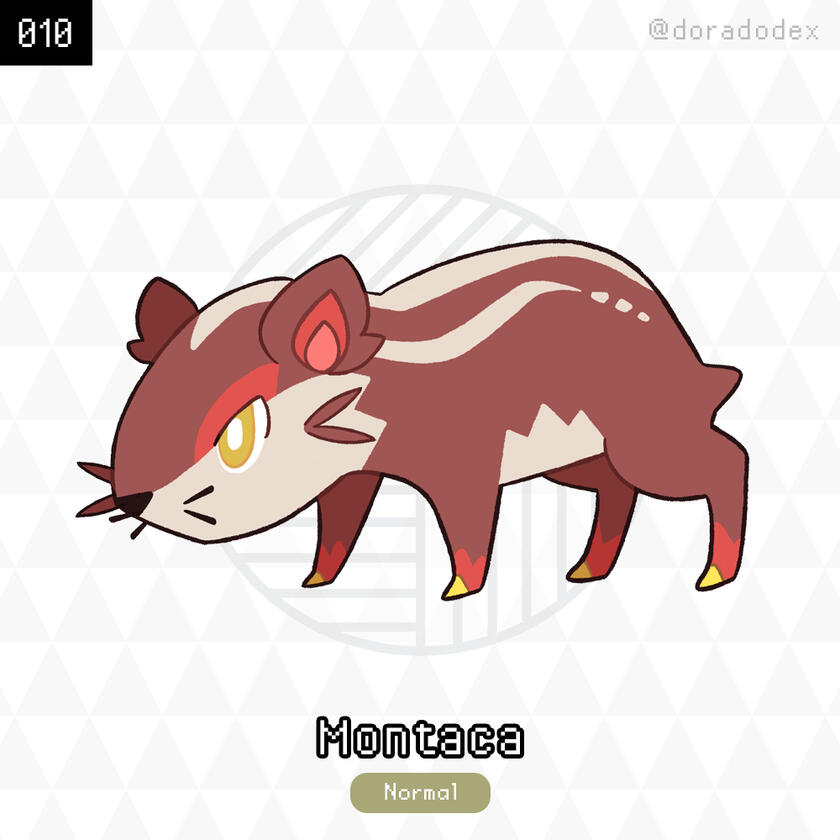
010
MONTACA
NormalMontaca are seen as easy prey by bigger creatures, because of this they tend to only come out in groups at night to look for berries.ORIGIN + ETYMOLOGY
Montaca is based on a mountain paca.
"Montaca" is a combination of ‘montaña’ (mountain) and ‘paca’.
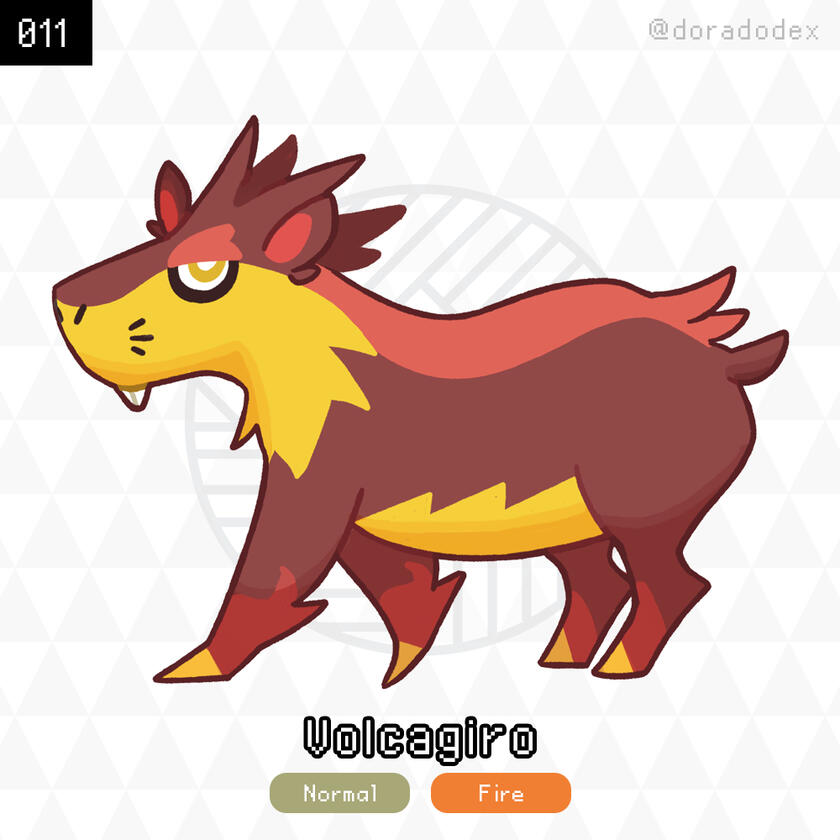
011
VOLCAGIRO
Normal/FireVolcagiro are very protective creatures, both towards their offspring and their trainers. They often risk their own life in order to protect young Montaca from predators.ORIGIN + ETYMOLOGY
Volcaguiro is based on a capybara.
"Volcaguiro" is a combination of ‘volcano’ and ‘chigüiro’ (another name for a capybara).
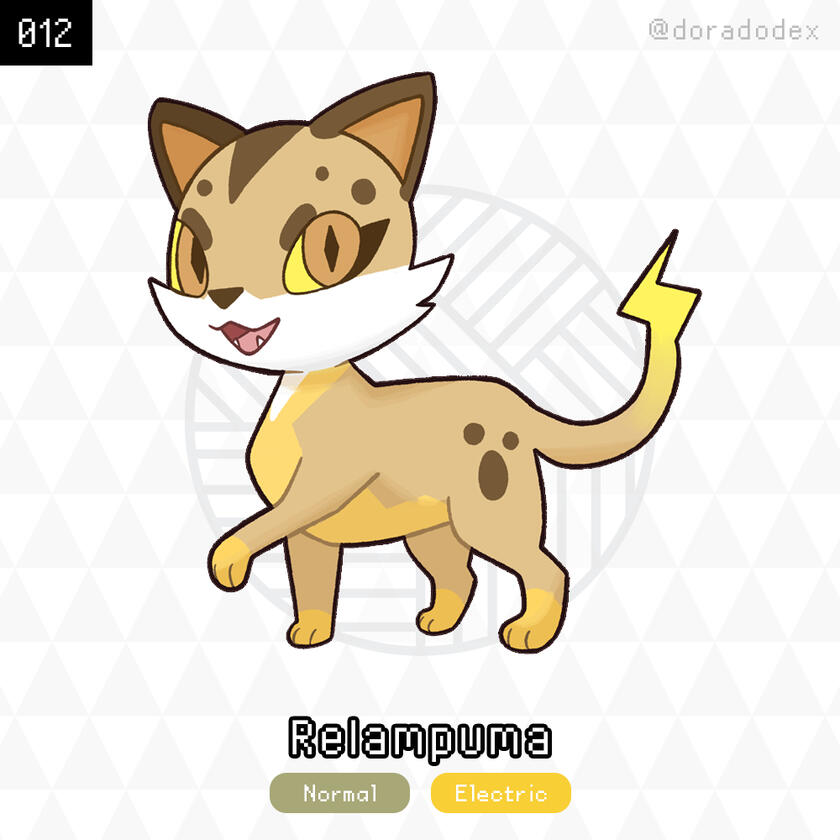
012
RELAMPUMA
Normal/ElectricRelampuma learn to hunt from a very young age, their tails release a powerful electric charge that stuns their prey and makes it easier to hunt.ORIGIN + ETYMOLOGY
Relampuma is based on various big felines from South America such as the Andean mountain cat, pumas and jaguars.
"Relampuma" is a combination of ‘relampago’ (lightning) and ‘puma’.
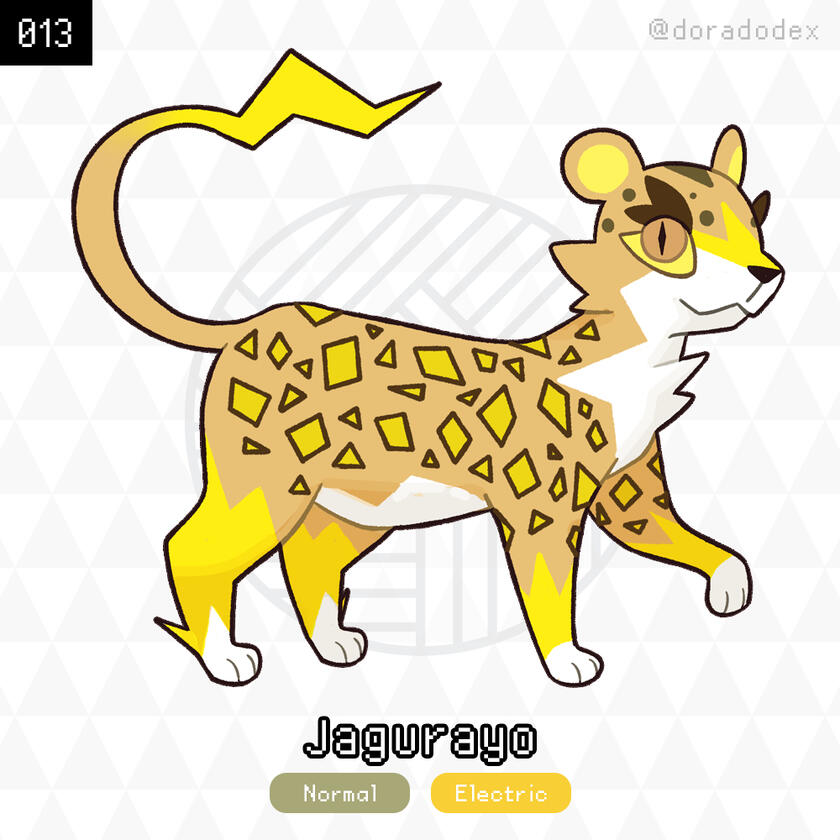
013
JAGURAYO
Normal/ElectricJagurayo is known as the most dangerous and fierce predator in Dorado. Their roars are often confused with the sound of thunder.ORIGIN + ETYMOLOGY
Jagurayo is based on various big felines from South America, more specifically a jaguar. "Jagurayo" is a combination of ‘jaguar’ and 'rayo' (thunder).
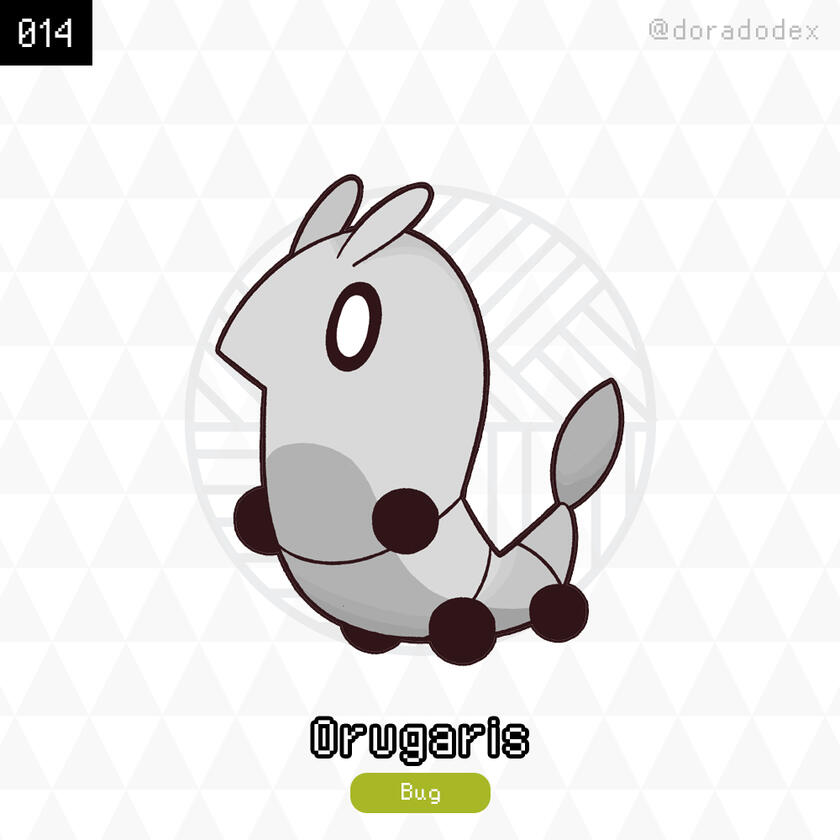
014
ORUGARIS
BugOrugaris feeds itself from flower petals. This diet helps it create a colorful thread that’s used in clothing all around Dorado.ORIGIN + ETYMOLOGY
Orugaris is based on various butterfly larvae and silkworms.
“Orugaris” is a combination of ‘oruga’ (caterpillar) and gris (gray).
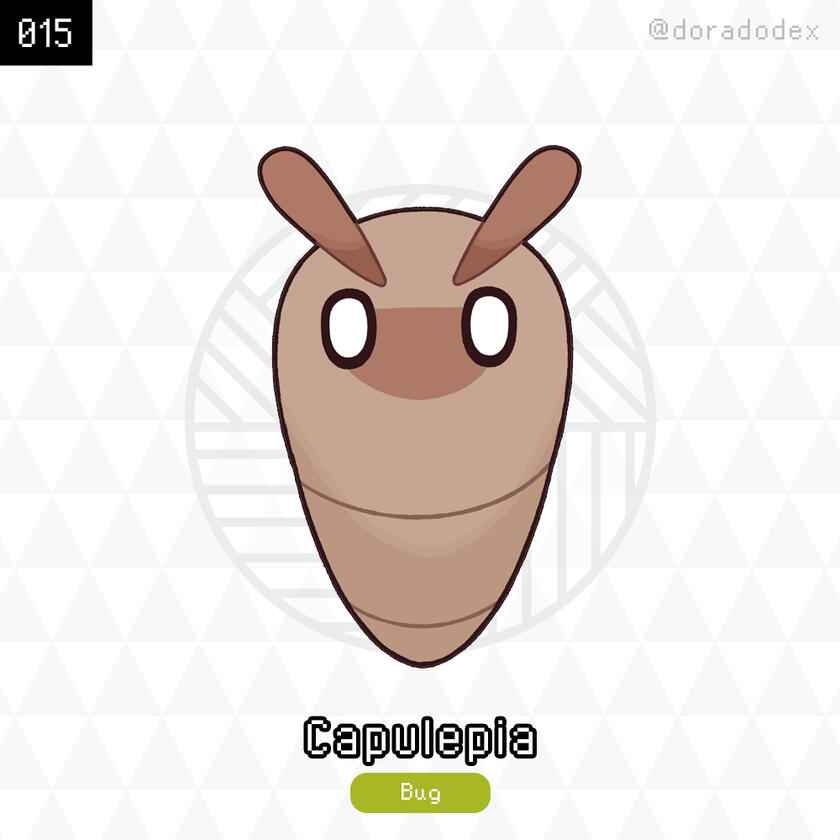
015
CAPULEPIA
BugIt’s often confused with coffee beans due to its coloration and distinct coffee-like aroma.ORIGIN + ETYMOLOGY
Capulepia is inspired by various cocoons and coffee beans.
“Capulepia” is a combination of ‘capullo’ (cocoon) and ‘sepia’.
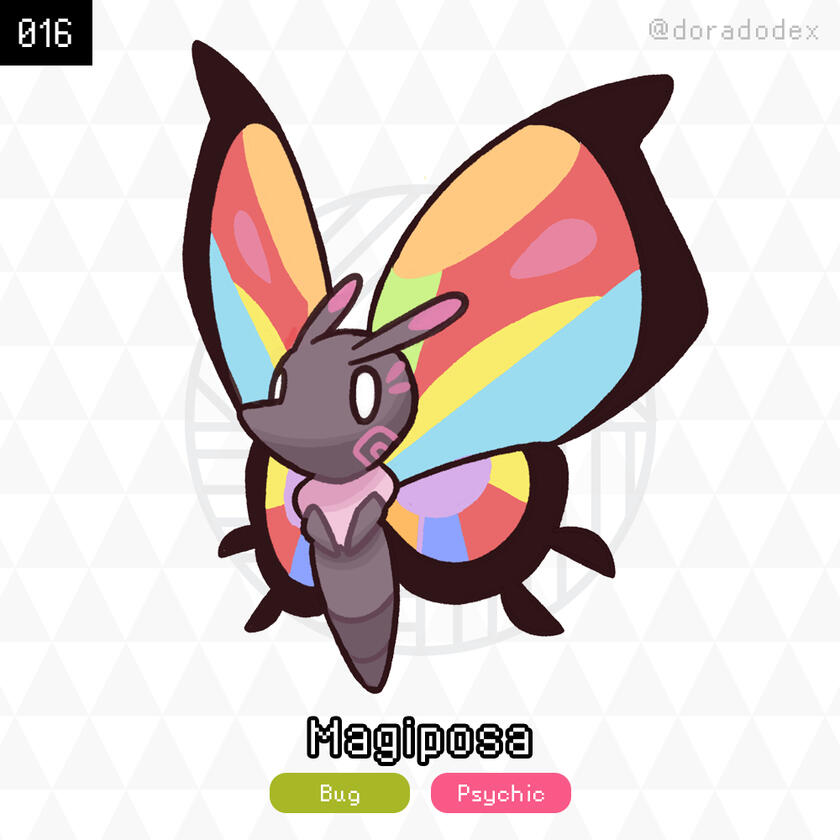
016
MAGIPOSA
Bug/PsychicMagiposa uses the sunlight and its translucent wings to create colorful, kaleidoscope-like effects to entertain others.ORIGIN + ETYMOLOGY
Magiposa is inspired by various butterflies endemic to Colombia and also the concept of ‘magic realism’.
“Magiposa” is a combination of ‘magia’ (magic) and ‘mariposa’ (butterfly).
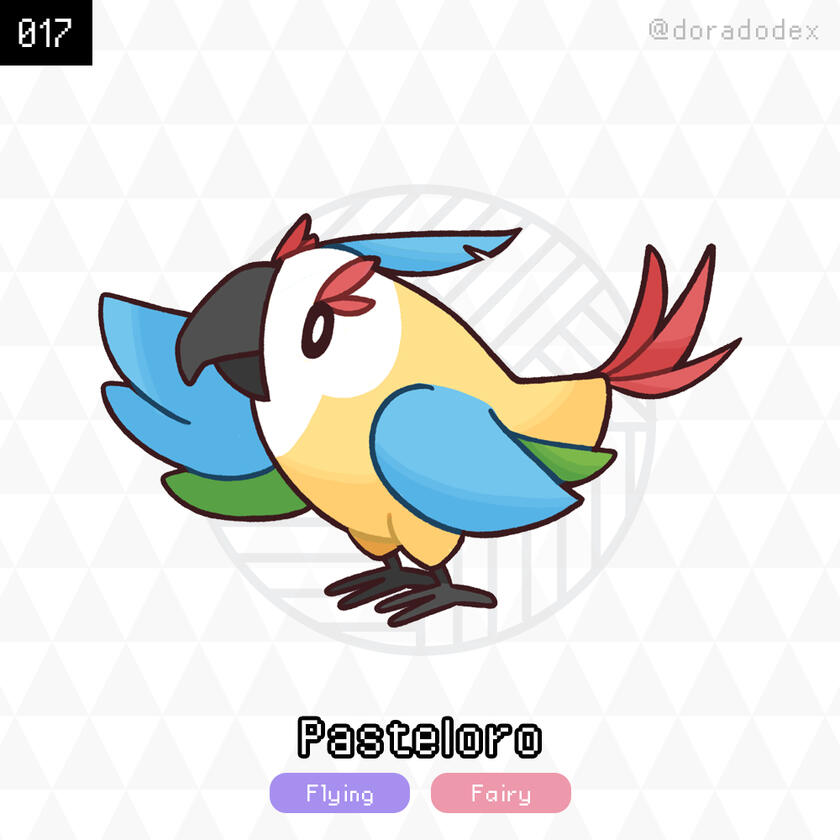
017
PASTELORO
Flying /FairyPasteloro can replicate human speech, it loves to make songs out of words it’s learned. It’s a popular Pokémon in households all around Dorado.ORIGIN + ETYMOLOGY
Pasteloro is inspired by various parrot species.
“Pasteloro” is a combination of ‘pastel’ and ‘loro’ (parrot).
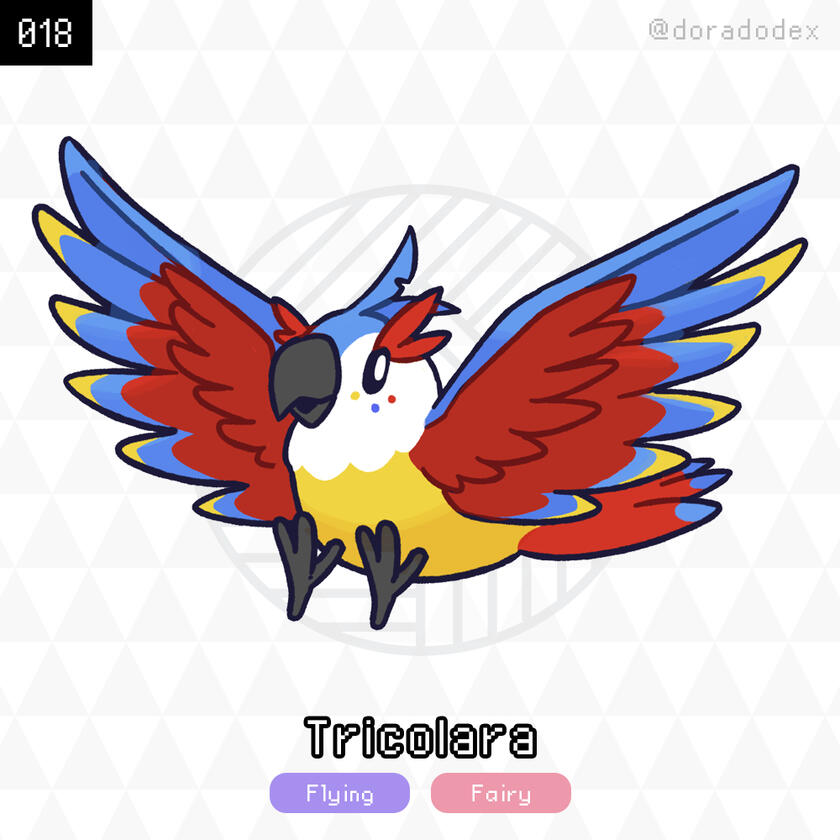
018
TRICOLARA
Flying /FairyTricolara get attached to their trainers incredibly fast, they are said to stay with them until their deaths.ORIGIN + ETYMOLOGY
Tricolara is inspired by various macaw species, specifically the ‘Ara chloropterus’ or red-and-green macaw.
“Tricolara” is a combination of ‘tricolor’ and ‘ara’ (genus of macaws).
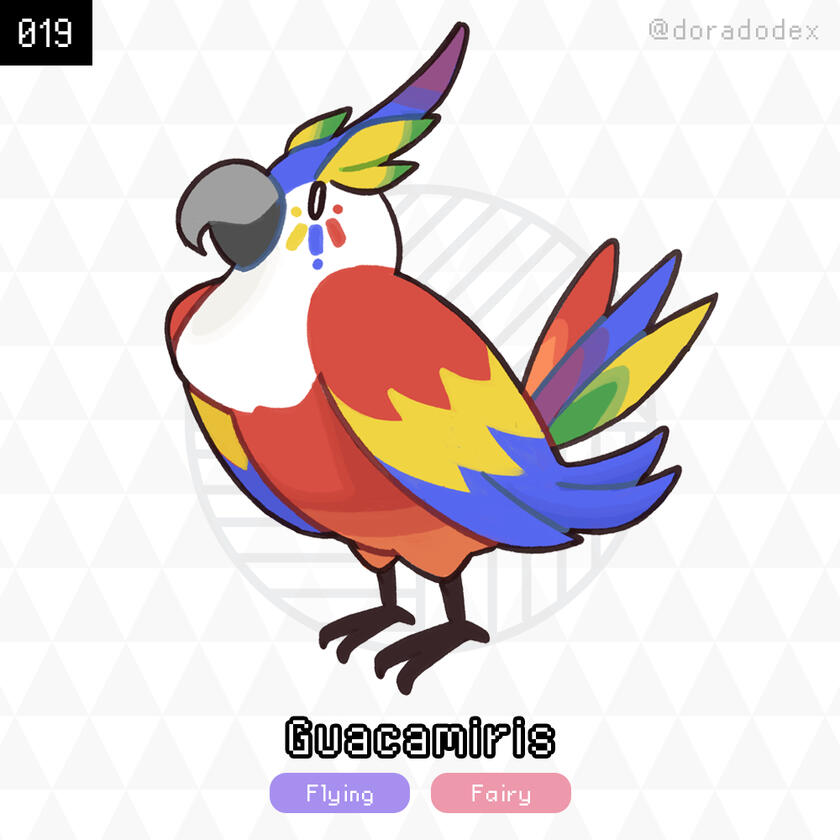
019
GUACAMIRIS
Flying /FairyWriters use their multicolored feathers as quills because of the rush of creativity it gives them, they’re said to have helped in writing “Cien Años de una Muerte Anunciada en Tiempos del Cólera”.ORIGIN + ETYMOLOGY
Guacamiris is inspired by various macaw species, specifically the ‘Ara macao’ or scarlet macaw.
“Guacamiris” is a combination of ‘guacamaya’ (macaw) and ‘iris’ (from arcoiris/rainbow).
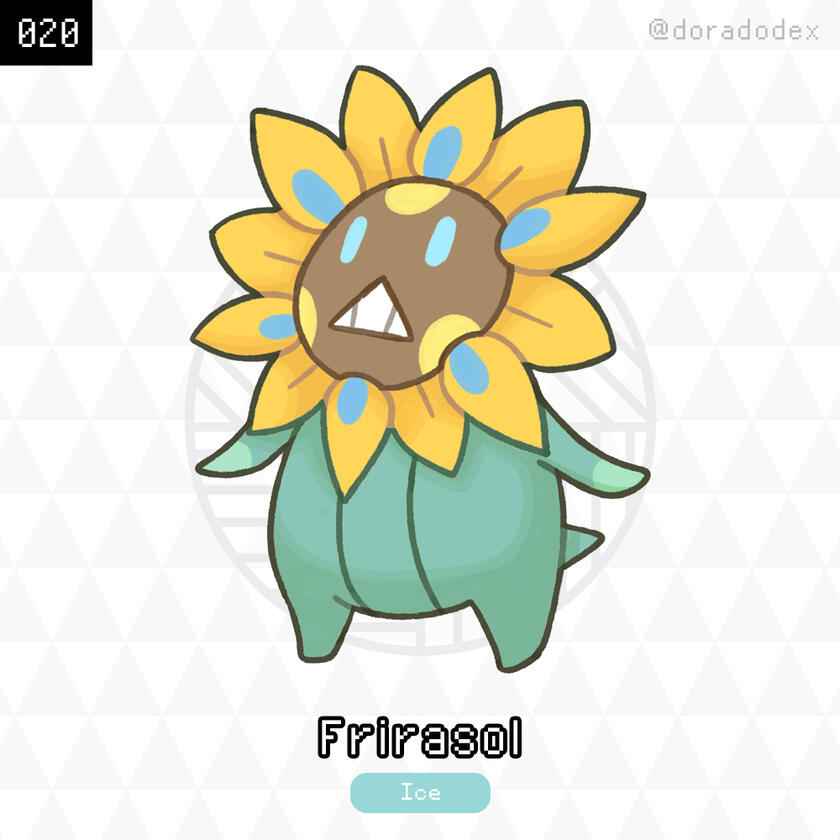
020
FRIRASOL
IceThe scales around its face helps it disguise as a flower in the alpine tundras of Dorado. During the day, Frirasol is always facing the sun in an attempt to warm up its freezing body.ORIGIN + ETYMOLOGY
Frirasol is inspired by the frailejón, a type of subshrub in the sunflower family, that is native to Colombia, Venezuela and Ecuador.
“Frirasol” is a combination of ‘frío’ (cold) and ‘girasol’ (sunflower).
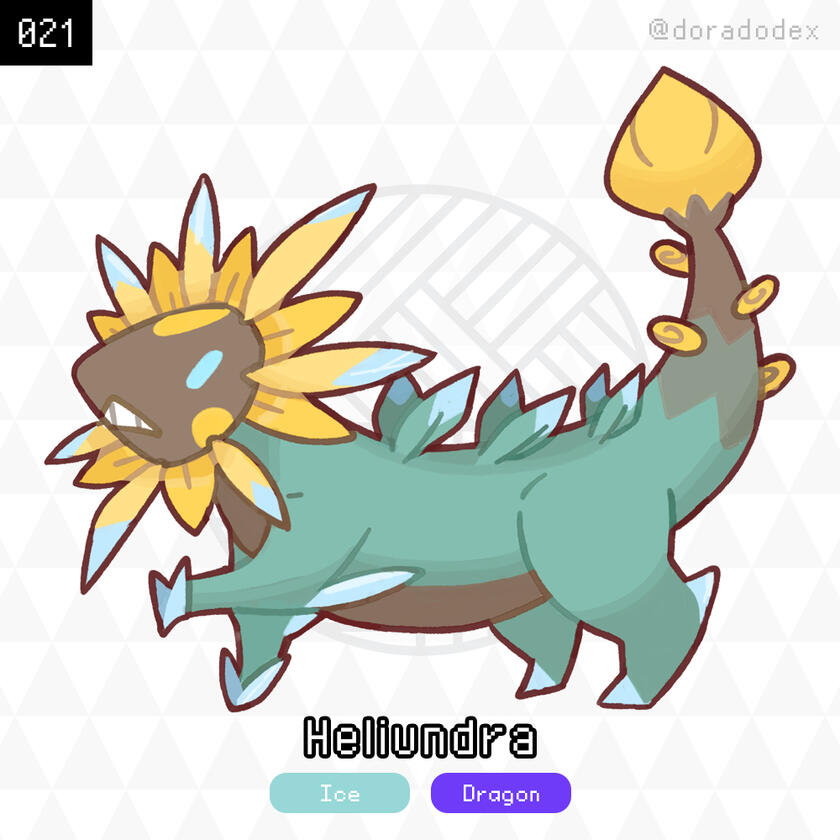
021
HELIUNDRA
Ice/DragonWhen Heliundra walks, it generates frost that eventually thaws and goes into the water deposits of the Dorado alpine tundras. It is very elusive and rarely seen in the wild.ORIGIN + ETYMOLOGY
Heliundra is inspired by the frailejón, a type of subshrub in the sunflower family, that is native to Colombia, Venezuela and Ecuador.
“Heliundra” is a combination of ‘helianthus’ (genus of the sunflower) and ‘tundra’.
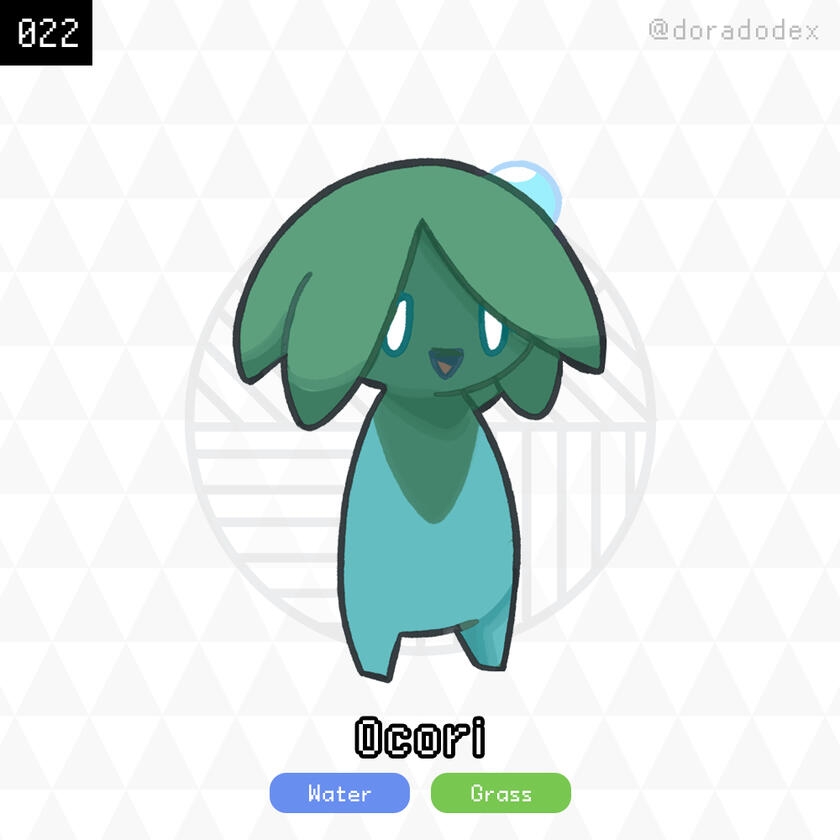
022
OCORI
Water/GrassOcori lives near lakes and rivers and can be seen dancing in the early hours of the morning, it’s said that this is the cause of morning dew.ORIGIN + ETYMOLOGY
Ocori is inspired by morning dew and the process of guttation.
“Ocori” is an anagram of rocio (dew).
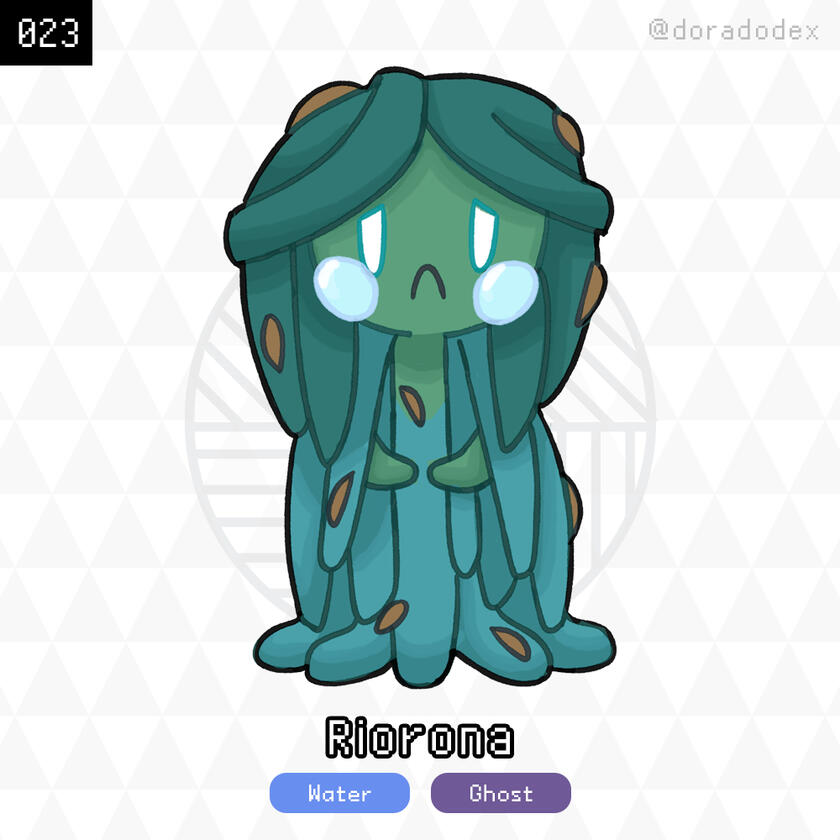
023
RIORONA
Water/GhostRiorona’s cries are often heard near rivers or lakes late at night; these cries are said to be irresistible to children and legends say that once a child follows the weeping cries of a Riorona they’re never seen again.EVOLUTION
It evolves from an Ocori that leveled up while surfing on a river or a lake.ORIGIN + ETYMOLOGY
Riorona is inspired by the legend of La Llorona.
“Riorona” is a combination of ‘río’ (river) and ‘La Llorona’.
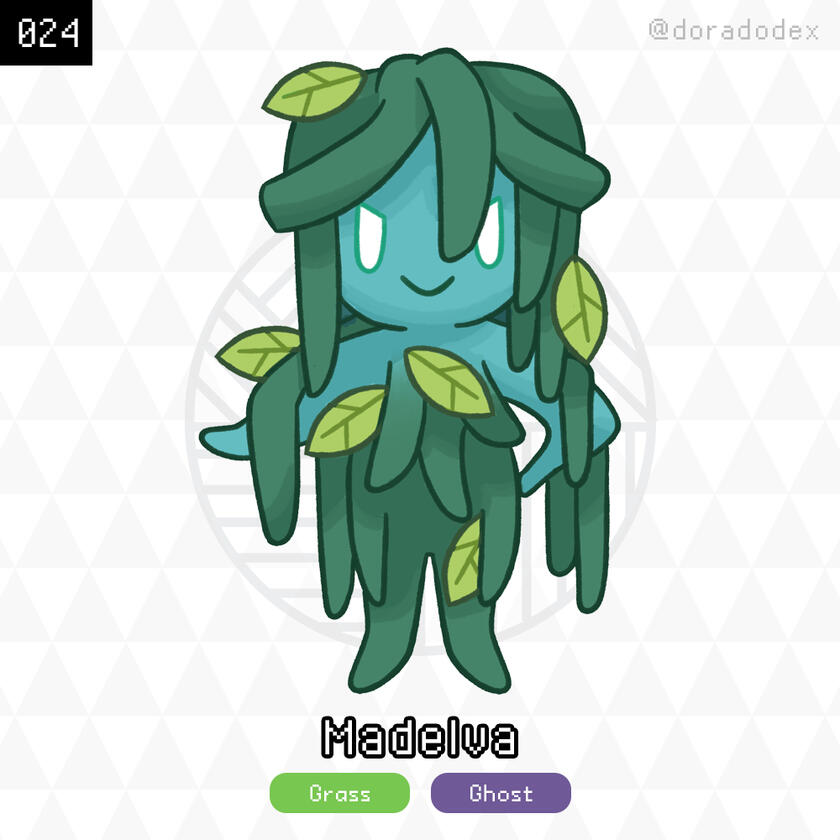
024
MADELVA
Grass/GhostMadelva inhabits the deep forests and jungles of the Dorado region and serves as its guardian. They are very territorial and are said to violently attack humans who disturb the peace of their land, they have a special hatred for lumberjacks.EVOLUTION
It evolves from an Ocori that leveled up in a forest or jungle.ORIGIN + ETYMOLOGY
Madelva is inspired by the legend of La Madremonte.
“Madelva” is a combination of ‘Madremonte’ and ‘selva’ (jungle).
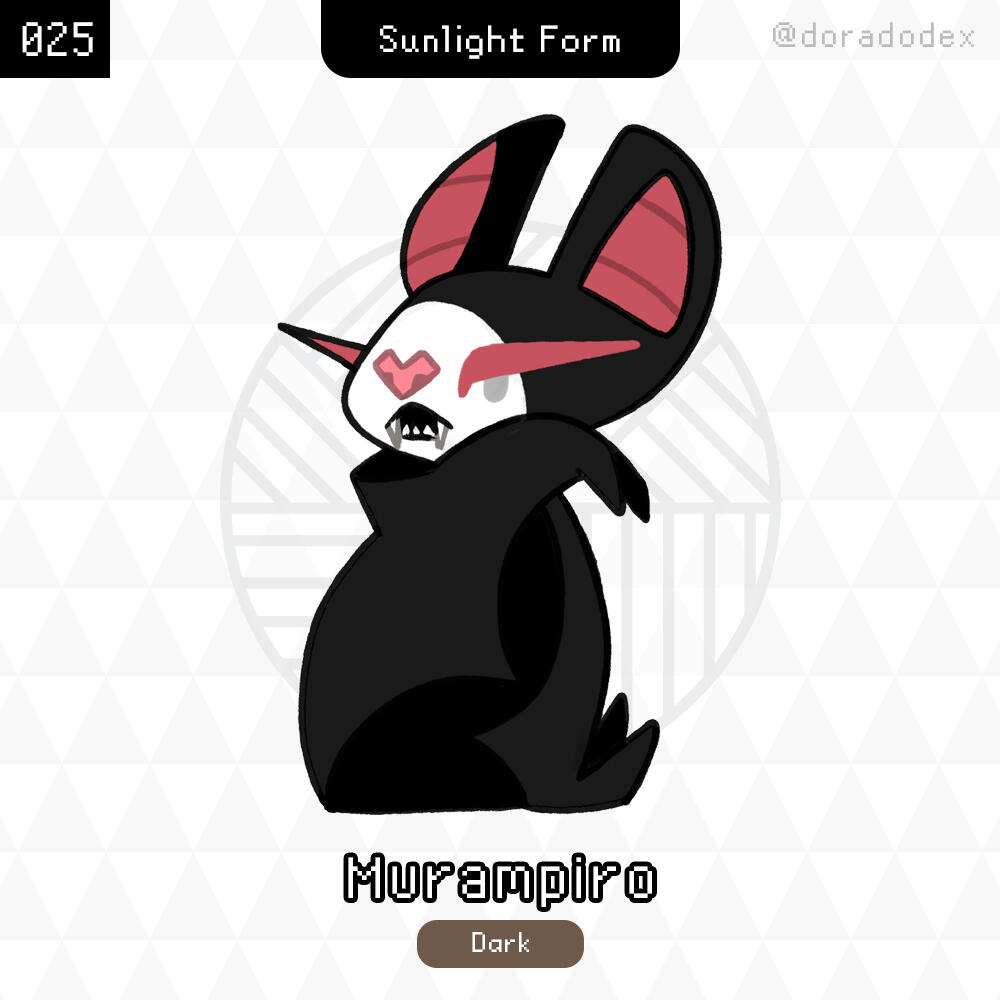
025
MURAMPIRO (Sunlight Form)
DarkThis cave dwelling bat pokémon is unable to fly. People say hordes of Murampiro attack humans while crossing caves to suck their blood, but in reality, they eat only berries.When exposed to sunlight, Murampiro is blinded by the sun. While on this form it has bigger ears to help it navigate its surroundings, even though it prefers to not move around too much.ORIGIN + ETYMOLOGY
Murampiro is inspired by various bat species and traditional depictions of vampires.
“Murampiro” is a combination of ‘murcielago’ (bat) and ‘vampiro’ (vampire).
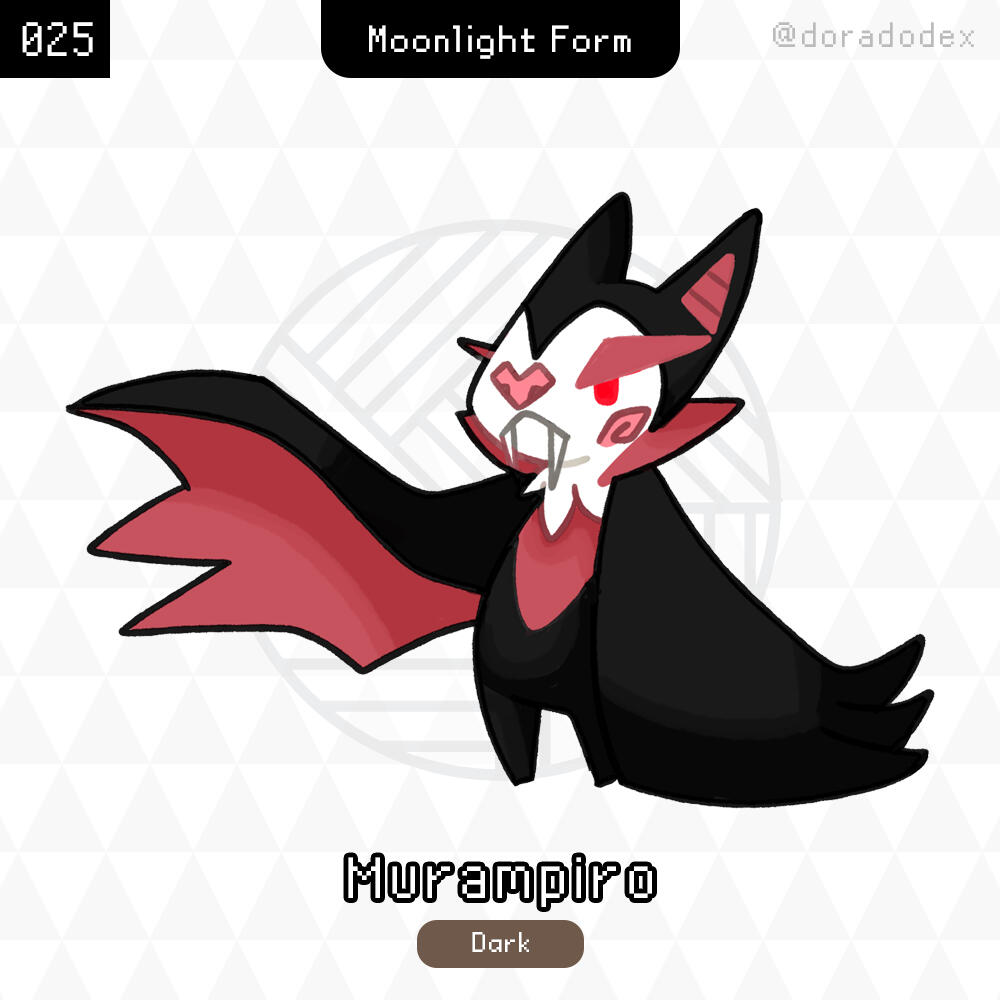
025
MURAMPIRO (Moonlight Form)
DarkThis cave dwelling bat pokémon is unable to fly. People say hordes of Murampiro attack humans while crossing caves to suck their blood, but in reality, they eat only berries.Murampiro is more active at night-time, it’s wing-like arms and its pointy fangs allow it to attack fast and sharply. It has a lust for battle.ORIGIN + ETYMOLOGY
Murampiro is inspired by various bat species and traditional depictions of vampires.
“Murampiro” is a combination of ‘murcielago’ (bat) and ‘vampiro’ (vampire).
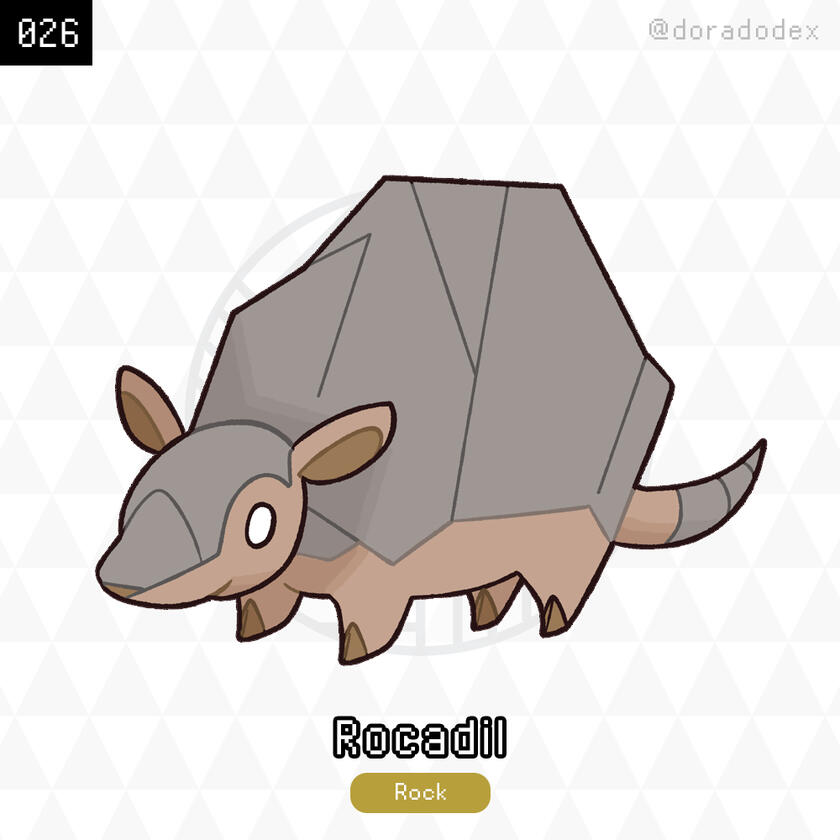
026
ROCADIL
RockRocadil uses its shell to hide itself from predators. It’s been seen using its drill-like tail to dig tunnels underground.ORIGIN + ETYMOLOGY
Rocadil is based on armadillos.
“Rocadil” is a combination of ‘roca’ (rock) and ‘armadillo’.
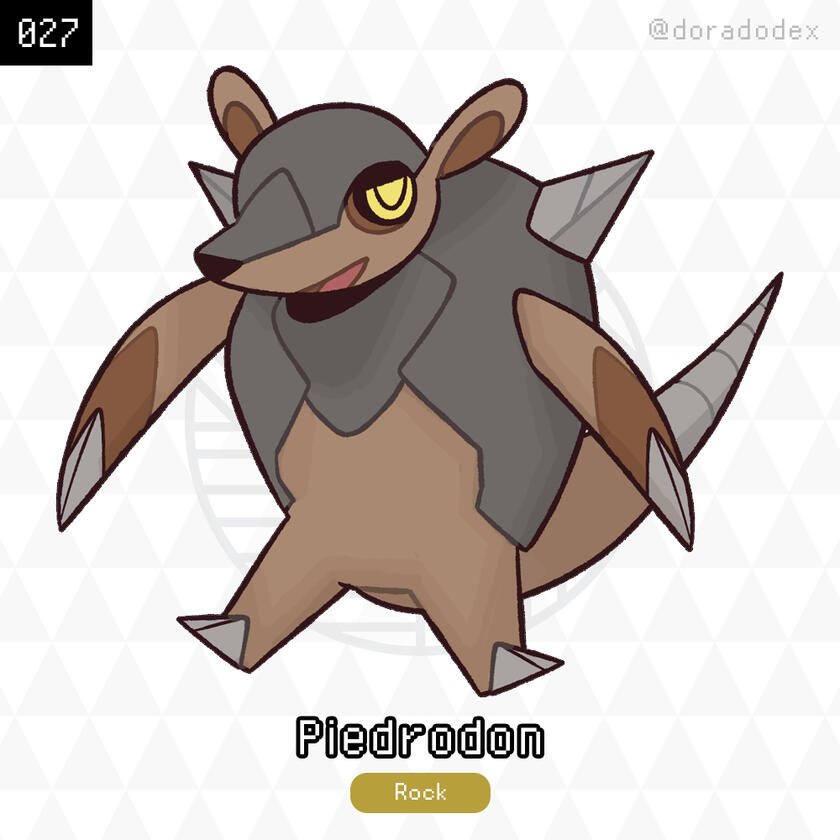
027
PIEDRODON
RockPiedrodon spends most of its day digging burrows in caves and fields all around Dorado. It’s said there’s a big underground cave system that goes from Cape Gold to Puerto Guerrero made by Piedrodon over the course of centuries.ORIGIN + ETYMOLOGY
Piedrodon is based on armadillos, more specifically the Giant Armadillo, native to South America.
“Piedrodon” is a combination of ‘piedra’ (stone) and ‘priodontes’ (genus of the giant armadillo).
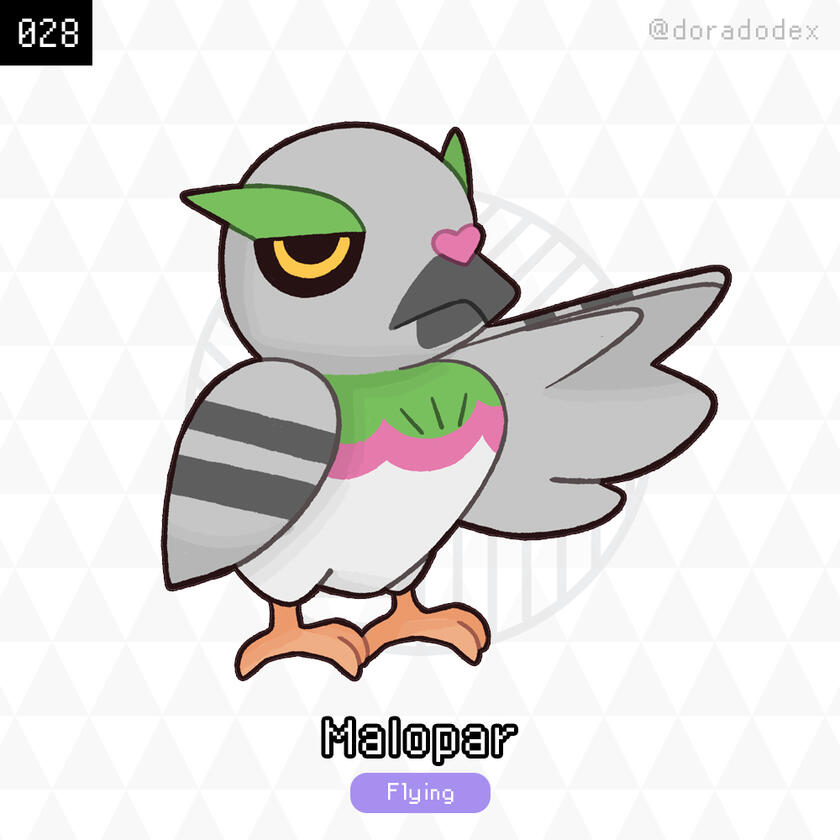
028
MALOPAR
FlyingMalopar usually gather outside restaurants and other public places where people gather to attack them and steal their food.ORIGIN + ETYMOLOGY
Malopar is based on the pigeons of Bogotá. Evil, opportunists, gluttons.
“Malopar” is a combination and anagram of ‘paloma’ (pigeon) and ‘malo’ (bad/evil).
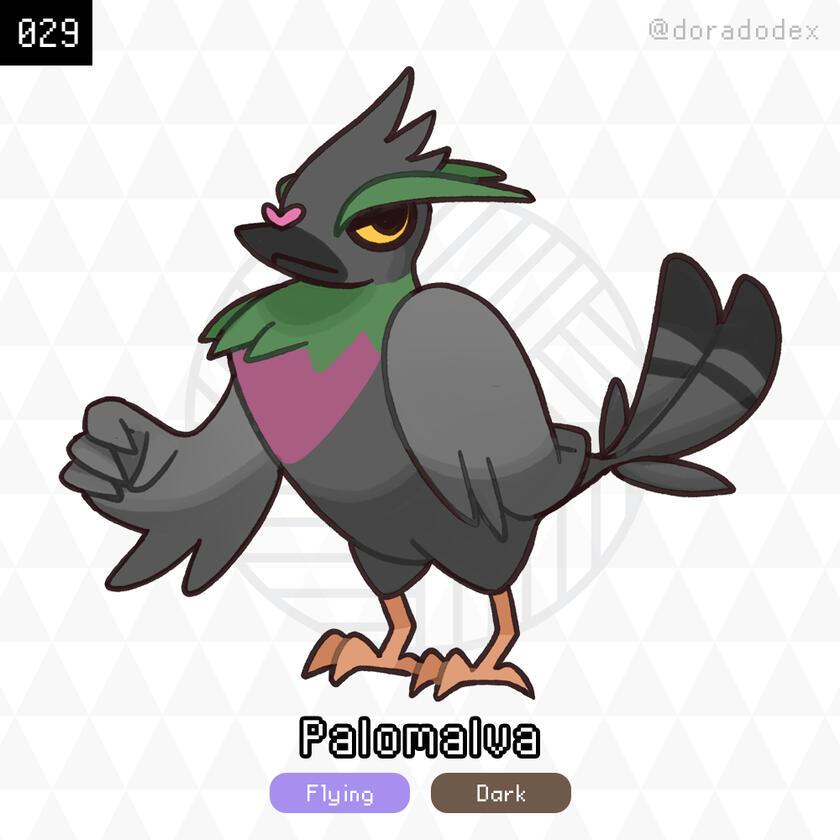
029
PALOMALVA
Flying/DarkThere's been increasing reports in Santafé of wild Palomalva cornering people in dark alleys and stealing their money.ORIGIN + ETYMOLOGY
Palomalva is based on the pigeons of Bogotá. Evil, opportunists, gluttons.
“Palomalva” is a combination of ‘paloma’ (pigeon) and ‘malvada’ (evil).
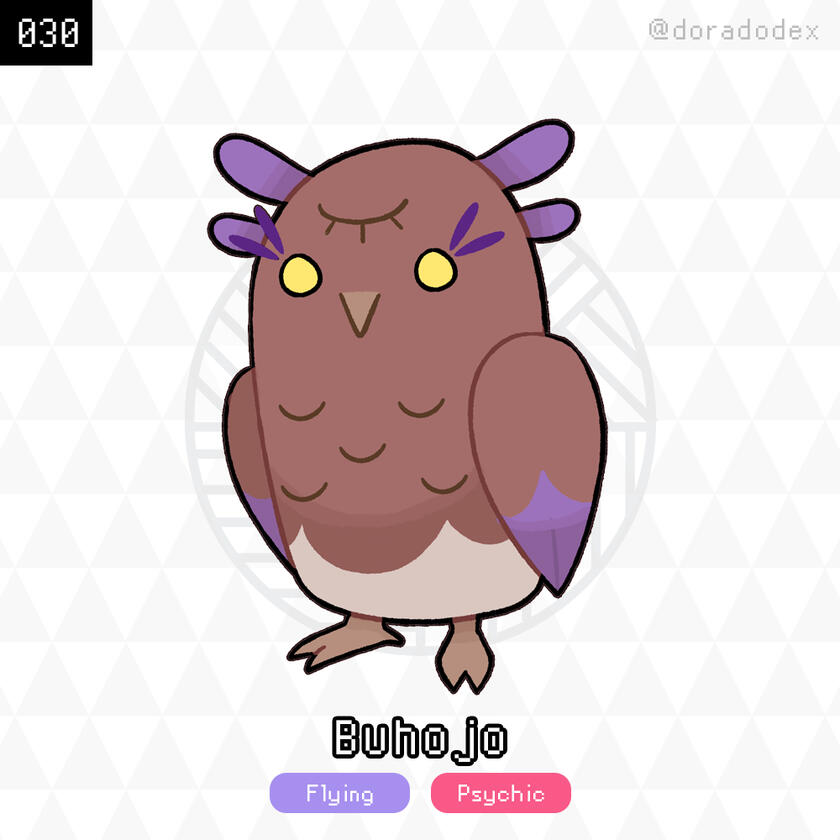
030
BUHOJO
Flying/PsychicScientist are unsure if Buhojo can see through the feathers in the shape of eyes on its chest. It can go months without blinking or sleeping.ORIGIN + ETYMOLOGY
Buhojo is based on owls.
“Buhojo” is a combination of ‘buho’ (owl) and ‘ojo’ (eye).
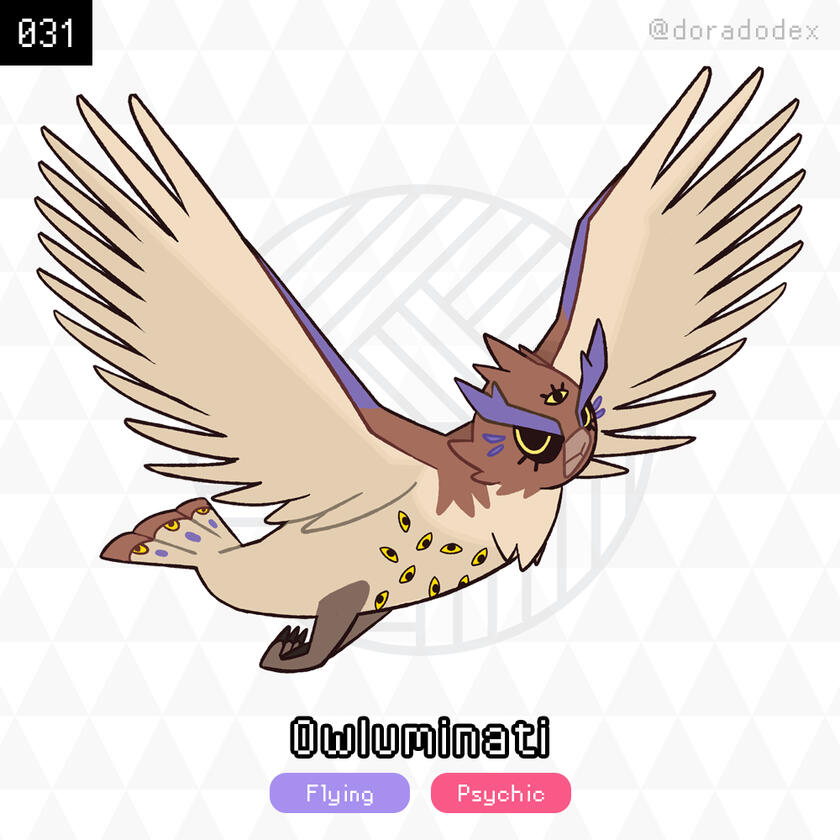
031
OWLUMINATI
Flying/PsychicOwluminati sees everything, Owluminati is watching.ORIGIN + ETYMOLOGY
Owluminati was made for the sake of that pun.
“Owluminati” is a combination of ‘owl’ and Illuminati.
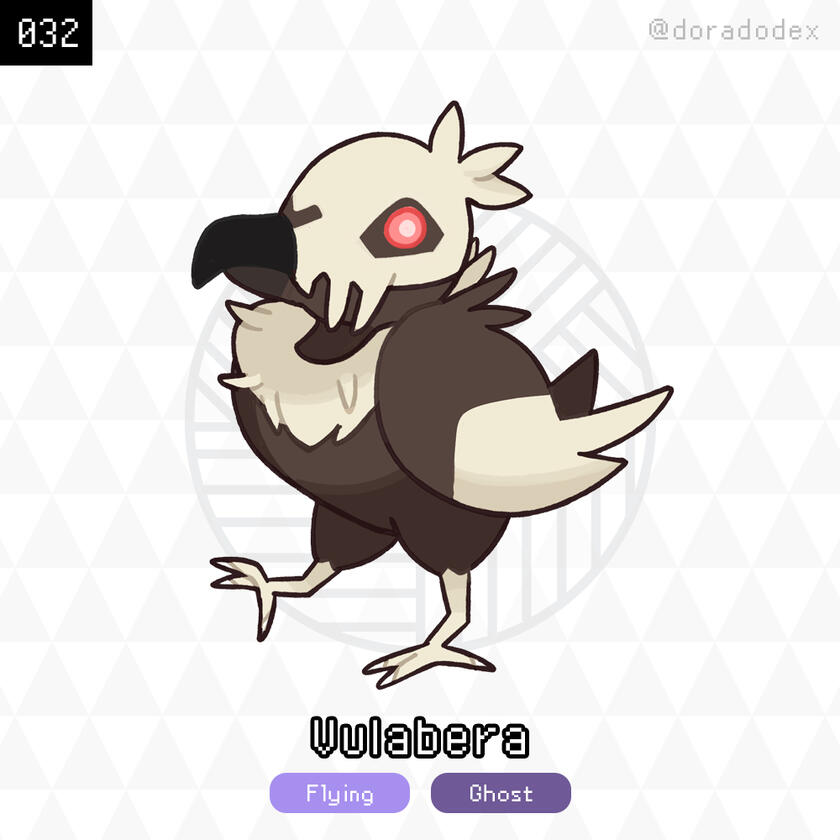
032
VULABERA
Flying/GhostThe white feathers on Vulabera’s body are as heavy as bone and because of this it has trouble flying. Vulabera is seen as an omen of death, often gathering outside hospital windows.ORIGIN + ETYMOLOGY
Vulabera is inspired by an Andean vulture (or a condor) the national bird of Colombia.
“Vulabera” is a combination of ‘vulture’ and ‘calavera’ (skull).
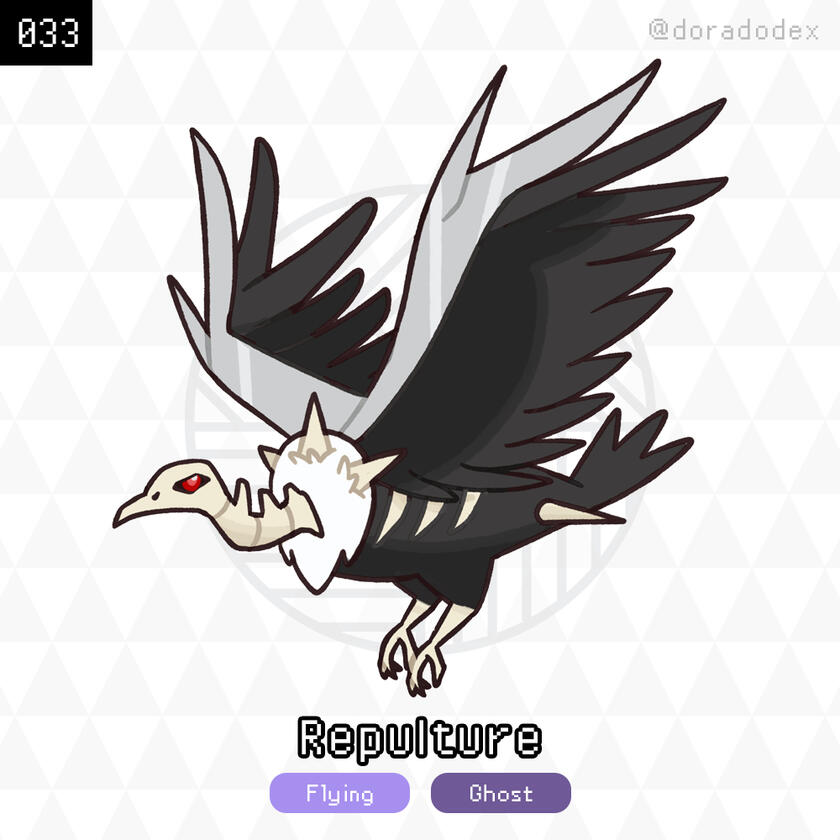
033
REPULTURE
Flying /GhostRepulture uses its wings as a scythe, it brings death whenever it flies. Its body smells rotten and a black blood-like ooze drips from its feathers.ORIGIN + ETYMOLOGY
Repulture is inspired by Andean vulture, the national bird of Colombia.
“Repulture” is a combination of ‘repulsive’ and ‘vulture’.
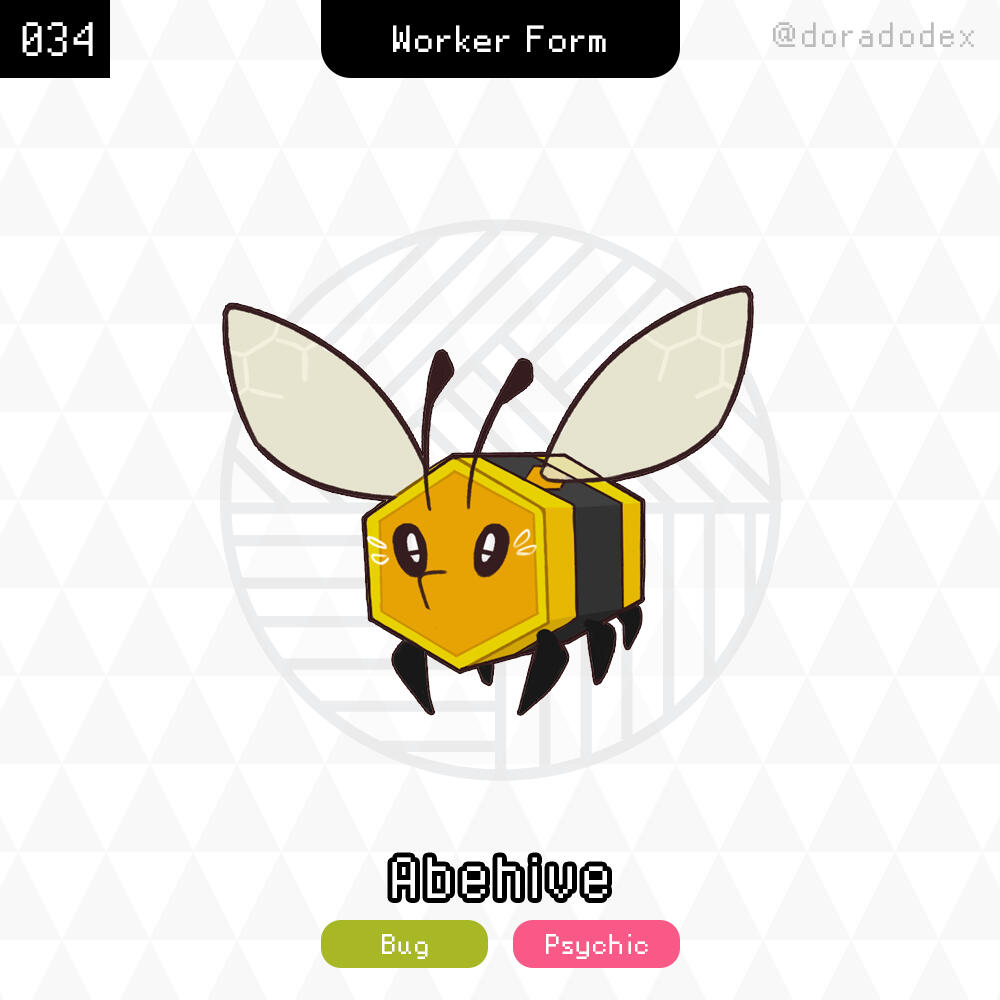
034
ABEHIVE (Worker Form)
Bug/PsychicUsually seen around flower fields, this pokémon tends to keep to itself and its hive. They won’t attack unless provoked.Abehive workers can collect honey for days without getting exhausted. They have a strong psychic connection to the rest of their hive.ORIGIN + ETYMOLOGY
Abehive is inspired by bees and the concept of a hive mind.
“Abehive” is a combination of ‘abeja’ (bee) and ‘hive’, while also saying ’a beehive’.
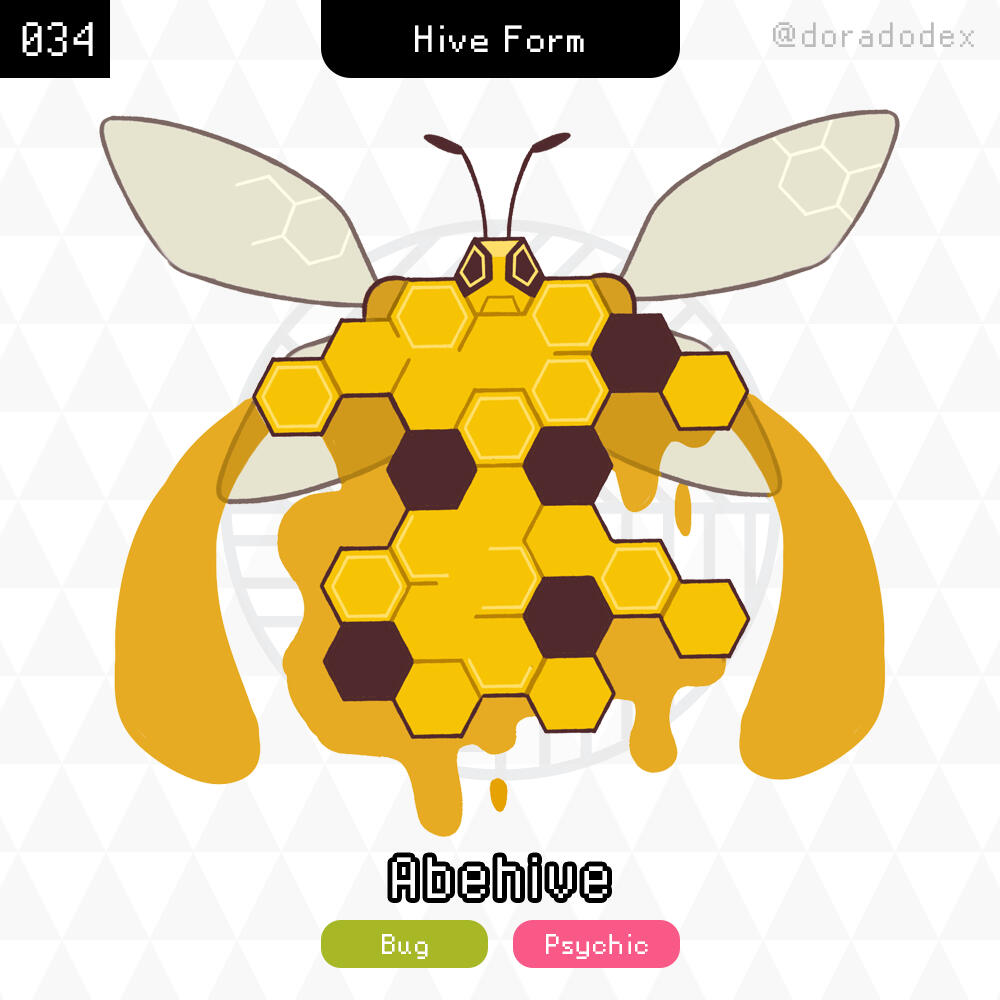
034
ABEHIVE (Hive Form)
Bug/PsychicUsually seen around flower fields, this pokémon tends to keep to itself and its hive. They won’t attack unless provoked.The honey dripping from hive form Abehive is said to have strong hallucinogenic properties.ORIGIN + ETYMOLOGY
Abehive is inspired by bees and the concept of a hive mind.
“Abehive” is a combination of ‘abeja’ (bee) and ‘hive’, while also saying ’a beehive’.
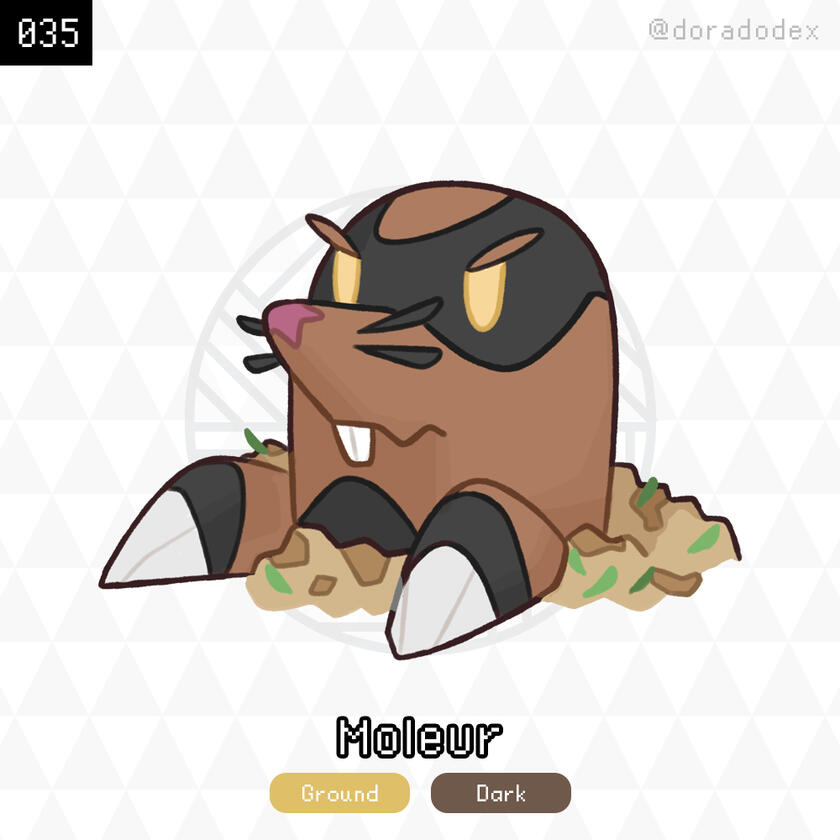
035
MOLEUR
Ground/DarkMoleur's favorite crop are potatoes, they hide underground and steal farmers crops. Farmers sometimes train them to sabotage neighboring farms.ORIGIN + ETYMOLOGY
Moleur is based on moles.
“Moleur” is a combination of ‘mole’ and ‘voleur’ (thief).
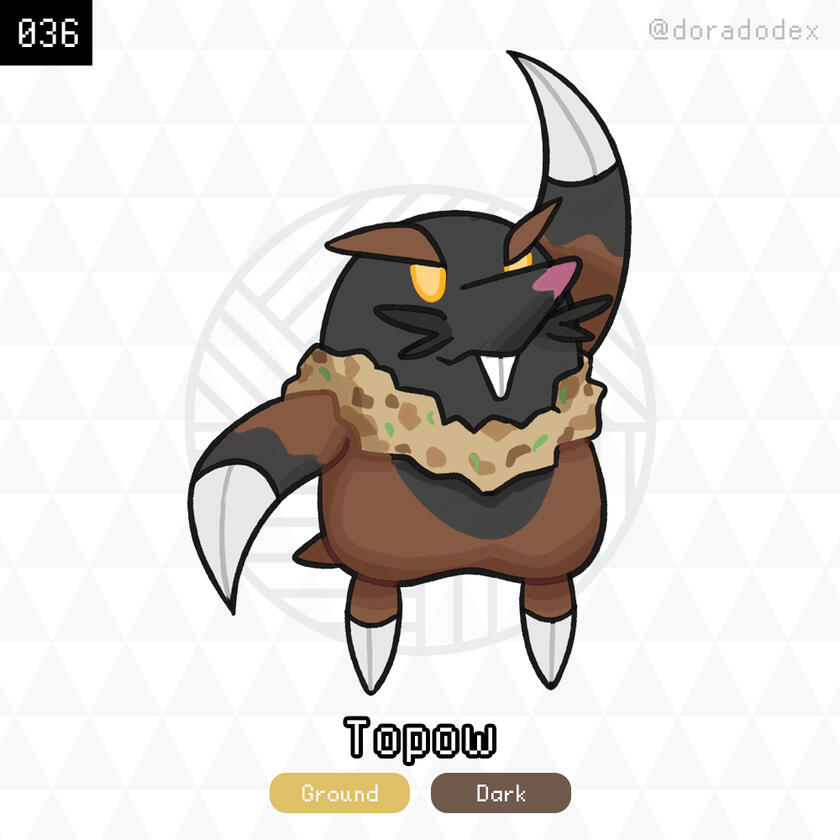
036
TOPOW
Ground/DarkTopow is known for punching its way through the ground and destroying fields. The fur around its neck closely resembles dirt.ORIGIN + ETYMOLOGY
Topow is based on moles.
“Topow” is a combination of ‘topo’ (mole) and ‘pow!’ (onomatopoeia for a blow or explosion).
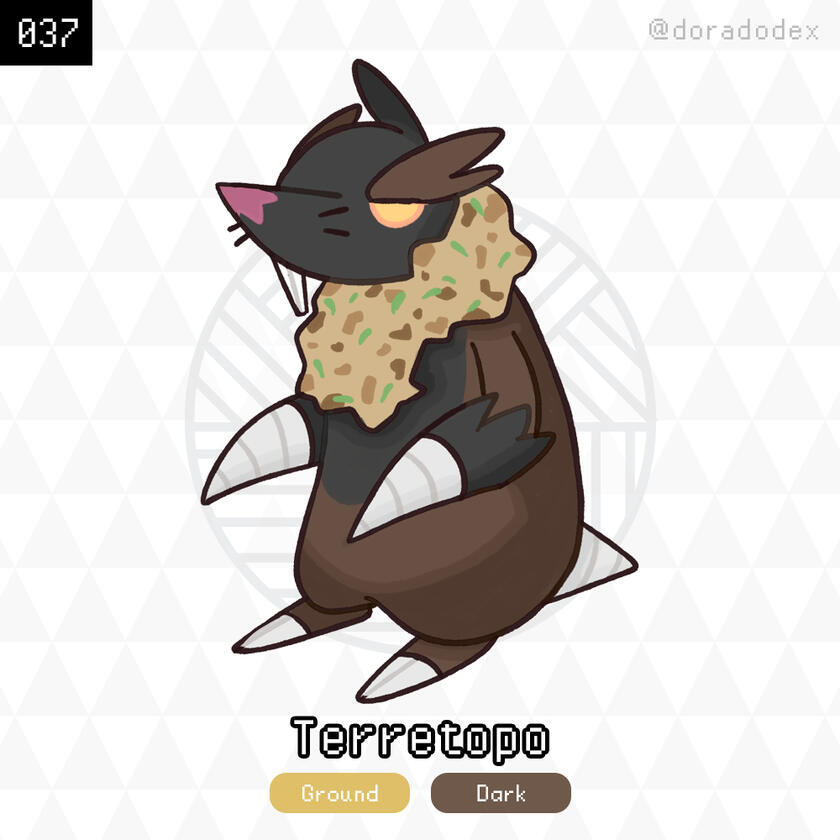
037
TERRETOPO
Ground/DarkTerretopo is known to create small localized earthquakes with its drill-like claws when it feels threatened.ORIGIN + ETYMOLOGY
Terretopo is based on moles and drills.
“Terretopo” is a combination of ‘terremoto’ (earthquake), ‘terror’ and ‘topo’ (mole).
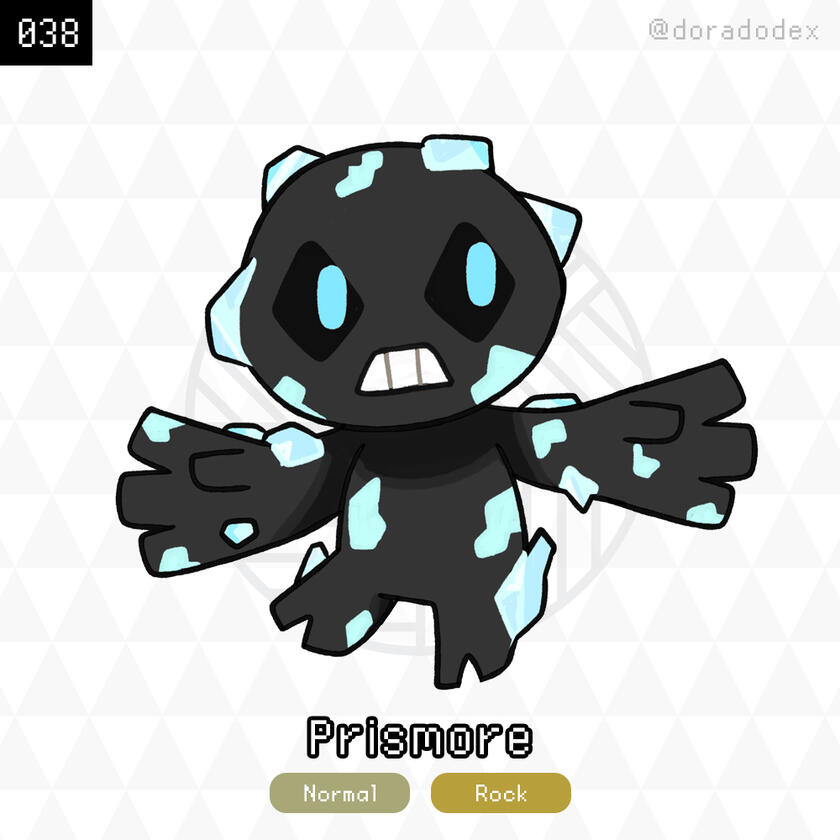
038
PRISMORE
Normal/RockPrismore feeds itself from crystals and precious gems found in Prism Cave. It evolves by consuming the energy from the various elemental evolutionary stones.ORIGIN + ETYMOLOGY
Prism is based on geodes and crystals.
“Prismore” is a combination of ‘prism’ and ‘more’.
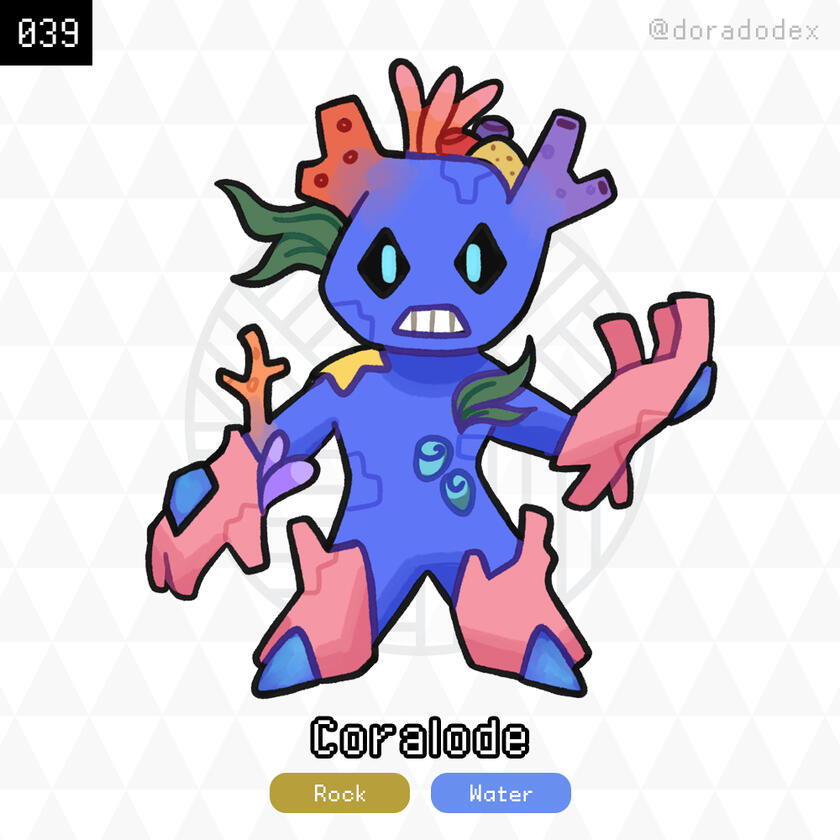
039
CORALODE
Rock/WaterThey stand in the bottom of the ocean and serve as a home to smaller creatures. Its signature move “Coral Uppercut” is a water type equivalent of the elemental punches (Fire, Ice and Thunder Punch).EVOLUTION
Coralode evolves when a Prismore is exposed to a Water Stone.ORIGIN + ETYMOLOGY
Coralode is based on coral reefs.
“Coralode” is a combination of ‘coral’ and the suffix ‘-ode’ meaning ‘like’, making its name mean “coral-like”.
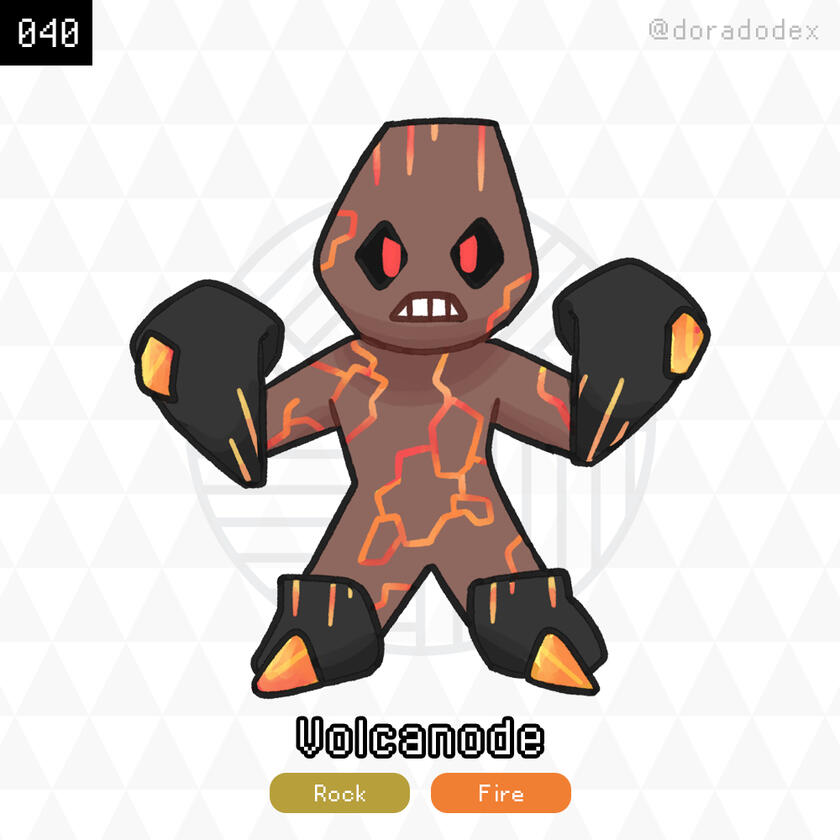
40
VOLCANODE
Rock/FireVolcanode’s body temperature exceeds 1,000 degrees, but when it’s angry it can go up to 2,200 degrees. It’s an excellent companion for the winter months.EVOLUTION
Volcanode evolves when a Prismore is exposed to a Fire Stone.ORIGIN + ETYMOLOGY
Volcanode is based on volcanos and obsidian rocks.
“Volcanode” is a combination of ‘volcano’ and the suffix ‘-ode’ meaning ‘like’, making its name mean “volcano-like”.
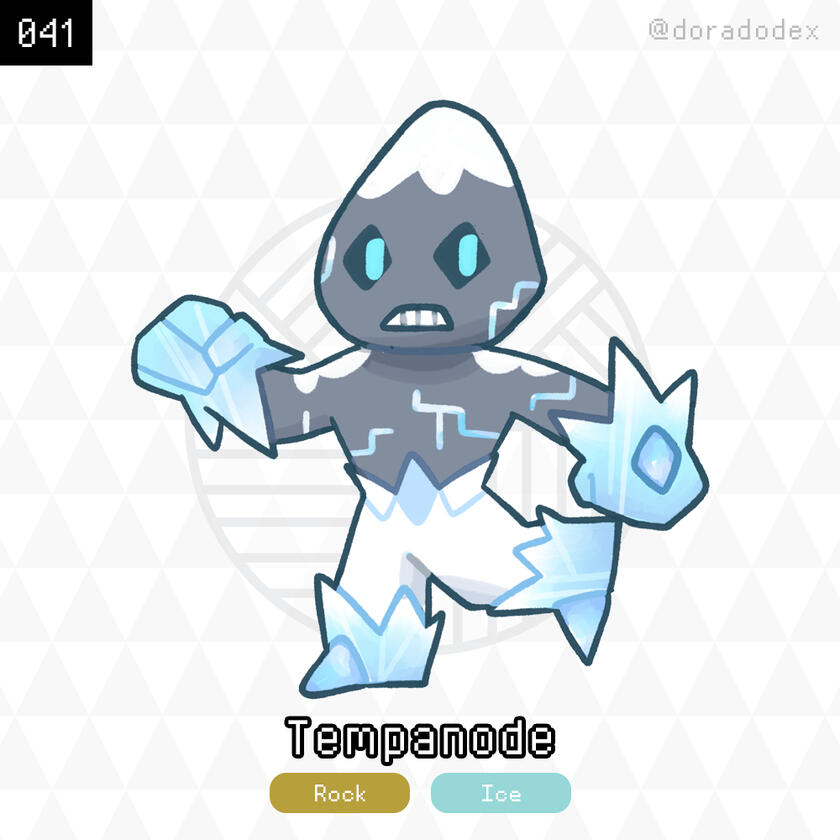
041
TEMPANODE
Rock/IceTempanode is used in coastal and generally hot cities as a substitute for AC units.EVOLUTION
Tempanode evolves when a Prismore is exposed to an Ice Stone.ORIGIN + ETYMOLOGY
Tempanode is based on icebergs and snowy peaks.
“Tempanode” is a combination of ‘tempano’ (from ‘tempano de hielo’, another name for an iceberg) and the suffix ‘-ode’ meaning ‘like’, making its name mean “iceberg-like”.
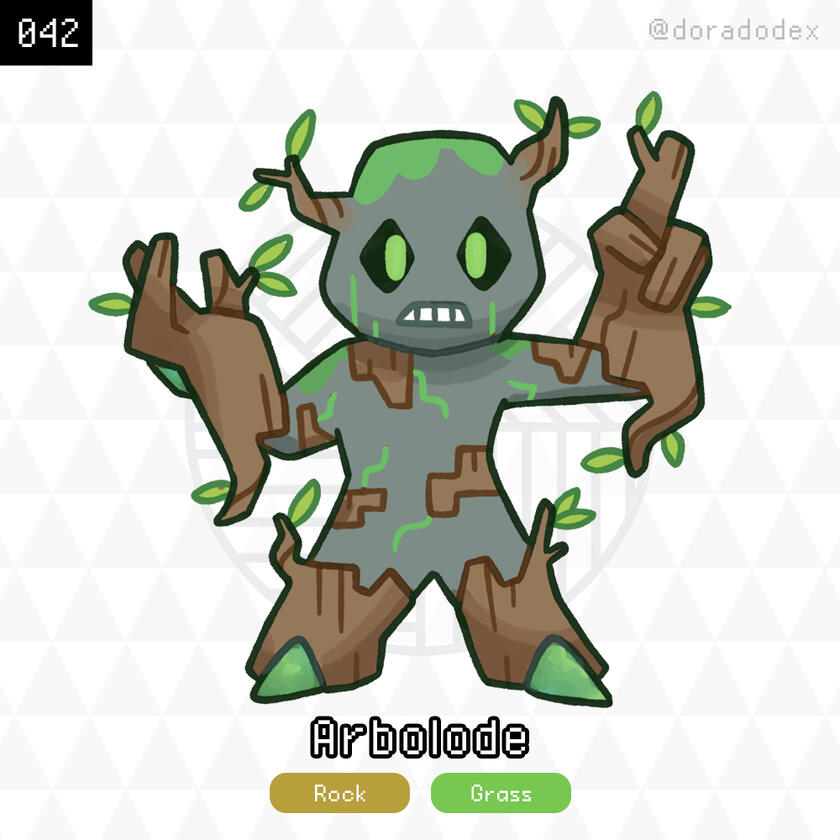
042
ARBOLODE
Rock/GrassIt stands still so that birds rest on its branch-like fingers. Its signature move "Bark Jab" is a grass type equivalent of the elemental punches (Fire, Ice and Thunder Punch).EVOLUTION
Arbolode evolves when a Prismore is exposed to a Leaf Stone.ORIGIN + ETYMOLOGY
Arbolode is based on petrified trees and the moss stone from Pokémon games.
“Arbolode” is a combination of ‘árbol’ (tree) and the suffix ‘-ode’ meaning 'like', making its name "tree-like".
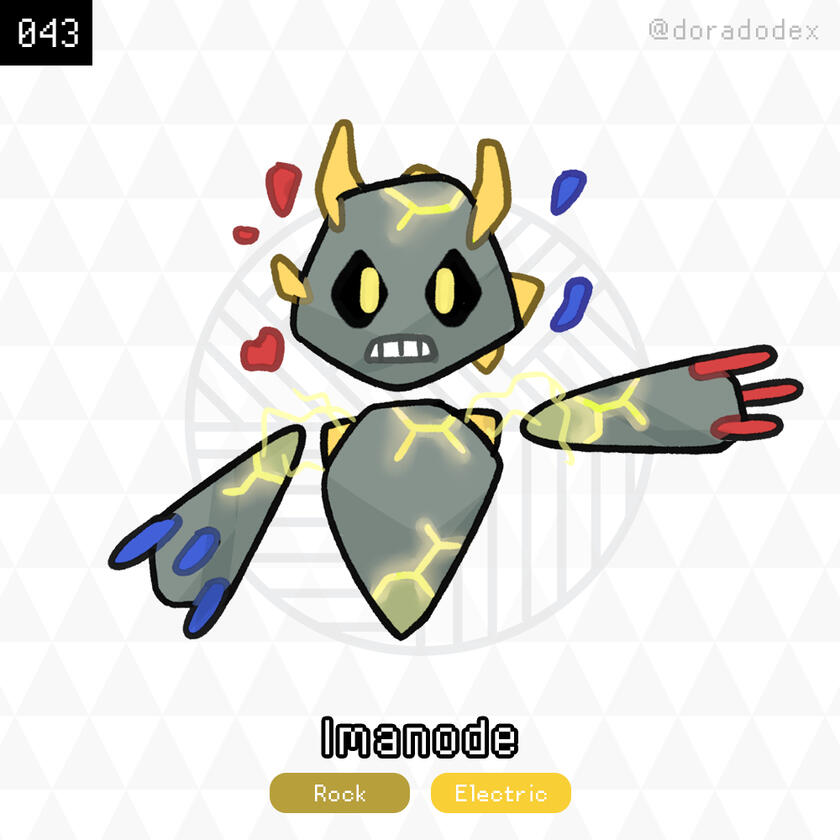
043
IMANODE
Rock/ElectricImanode is used in rural areas to power up electronic devices and appliances. It levitates using the electromagnetic currents flowing through its body.EVOLUTION
Imanode evolves when a Prismore is exposed to a Thunder Stone.ORIGIN + ETYMOLOGY
Imanode is based on magnets and electromagnetism.
“Imanode” is a combination of ‘imán’ (magnet) and the suffix ‘-ode’ meaning 'like', making its name "magnet-like".
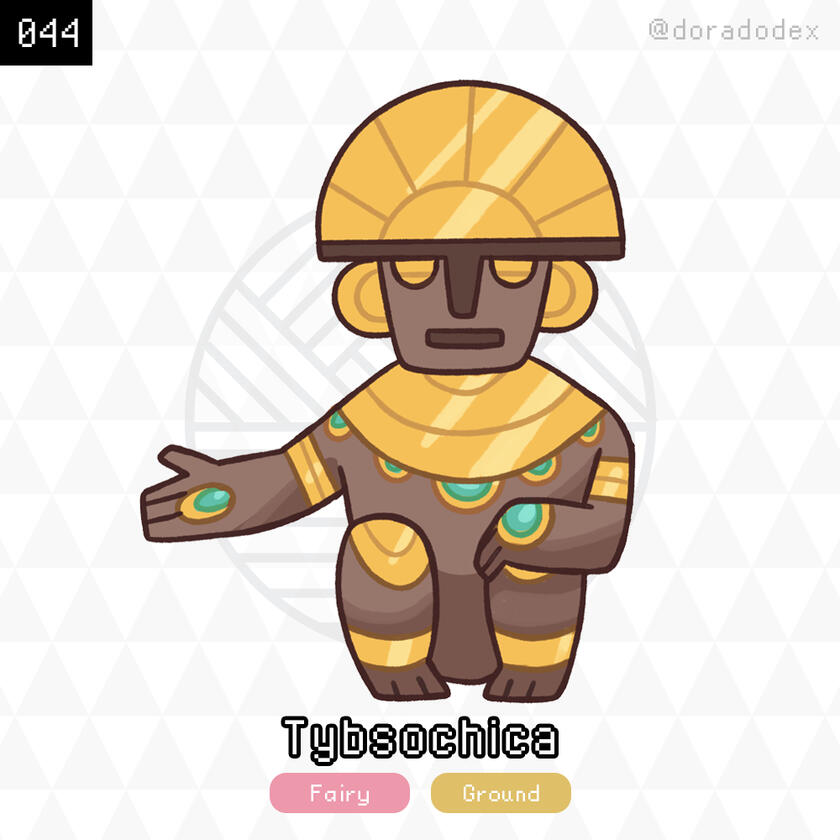
044
TYBSOCHICA
Fairy/GroundThey observe civilization from afar, coming to mankind’s aid in times of need. They’re said to serve as messengers for the legendary pokémon of light Zihitagagua.ORIGIN + ETYMOLOGY
Tybsochica is based on various pre-Columbian pottery made by the Muisca people and their legend of Bochica, a man from the East who taught them agriculture, metalworking and other crafts.
“Tybsochica” is a combination of ‘tybso’ (clay in the Muisca language) and “Bochica”.
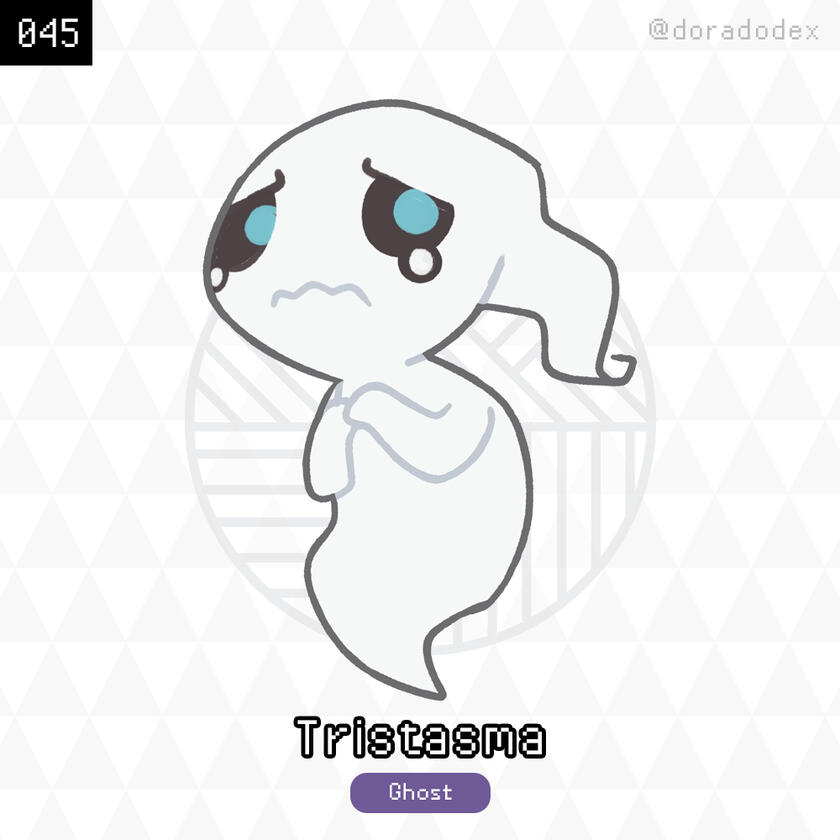
045
TRISTASMA
GhostTristasma is seen wandering around at night, its cries sound like a lost child looking for help. Once someone offers to help it, it never separates from them, following them around until the day of their death.ORIGIN + ETYMOLOGY
Tristasma is inspired by traditional depictions of white ghost and various ghost stories from the Salto de Tequendama area. “Tristasma” is a combination of ‘tristeza’ (sadness) and ‘fantasma’ (ghost).
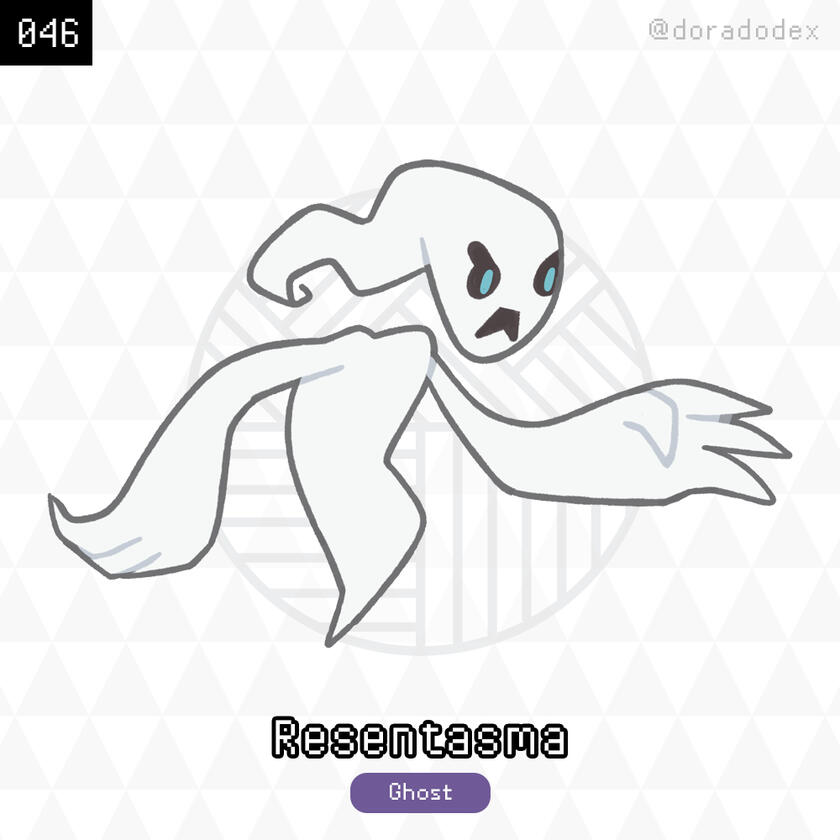
046
RESENTASMA
GhostResentasma haunts the streets outside Santafé, scaring people who drive along at night. People say Resentasma presents itself as someone they had wronged in the past.ORIGIN + ETYMOLOGY
Resentasma is inspired by traditional depictions of white ghost and various ghost stories from the Salto de Tequendama area. “Resentasma” is a combination of ‘resentimiento’ (resentment) and ‘fantasma’ (ghost).
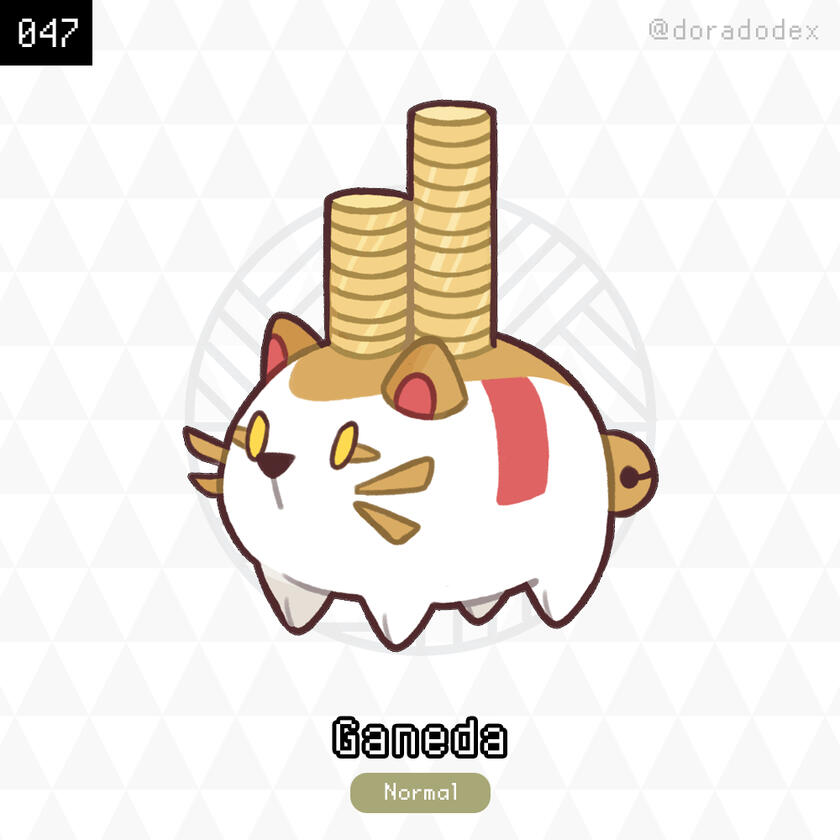
047
GANEDA
NormalGaneda grows stronger with every coin out on its back by its trainer. Once a coin has been placed it can't be removed.ORIGIN + ETYMOLOGY
Ganeda is based on cats and various ceramic animal banks.
“Ganeda” is a combination of ‘gato’ (cat) and 'moneda' (coin).
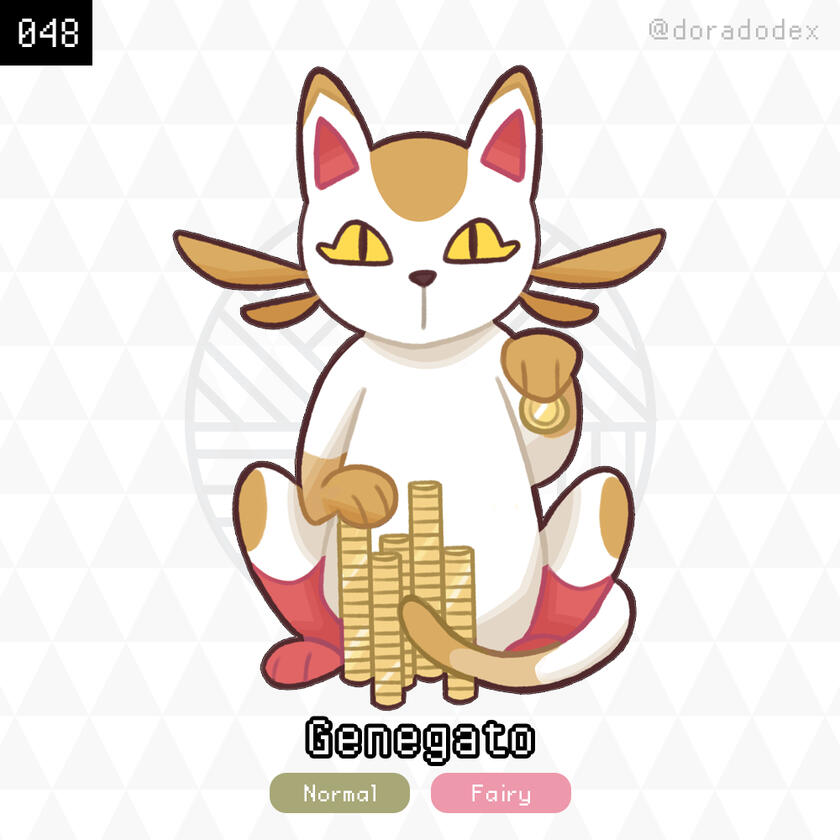
048
GENEGATO
Normal/FairyGenegato is known to multiply its trainer's earnings in battle. It loves to share the coins it accumulated as a Ganeda with everyone it meets.ORIGIN + ETYMOLOGY
Genegato is based on lucky cats.
“Genegato” is a combination of ‘generous’ and 'gato' (cat).
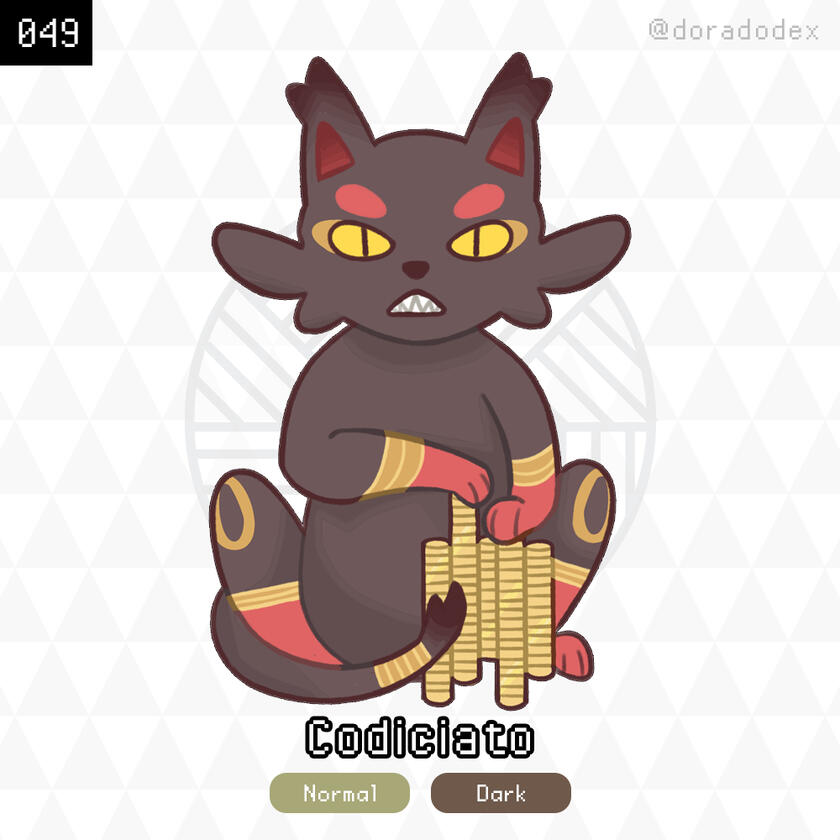
049
CODICIATO
Normal/DarkCodiciato takes money from its trainer when they’re not looking. They sometimes take the earnings from a battle all to themselves, only to make it’s pile of coins bigger.ORIGIN + ETYMOLOGY
Codiciato is based on lucky cats.
“Codiciato” is a combination of ‘codicia’ (greed) and ‘gato (cat).
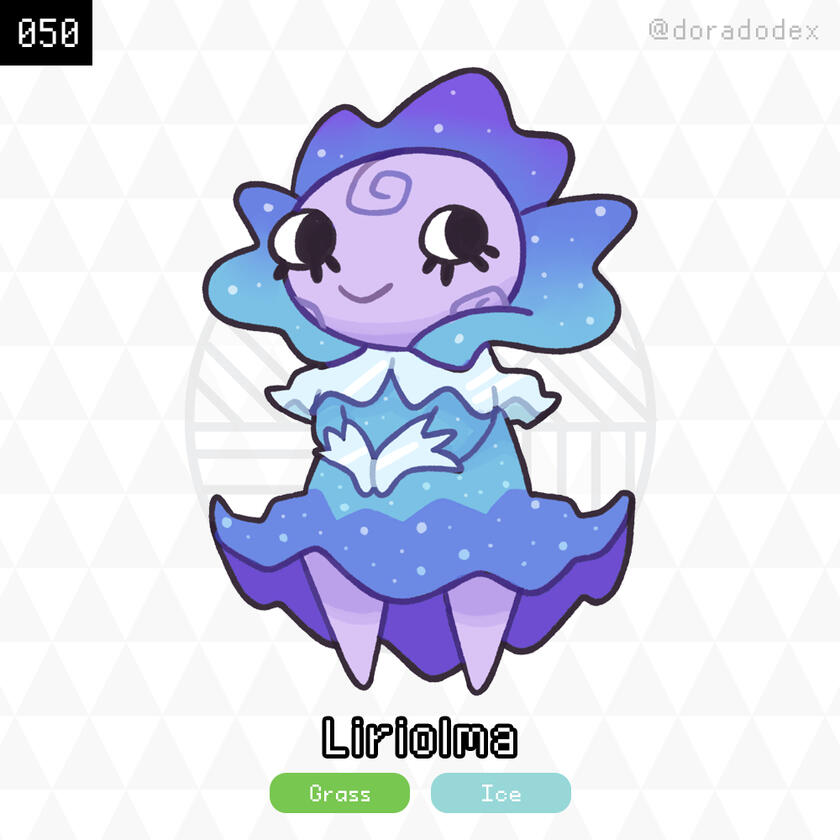
050
LIRIOLMA
Grass/IceLiriolma is able to plant and make flowers bloom in places where they normally wouldn’t such as tundras, deserts and caves. They sometimes roam graveyards planting flowers around tombstones.ORIGIN + ETYMOLOGY
Liriolma is based on a lirio de mayo (may flower), an orchid endemic to Colombia.
“Liriolma” is a combination of ‘lirio’ (iris flower, from 'lirio de mayo') and ‘alma’ (soul).
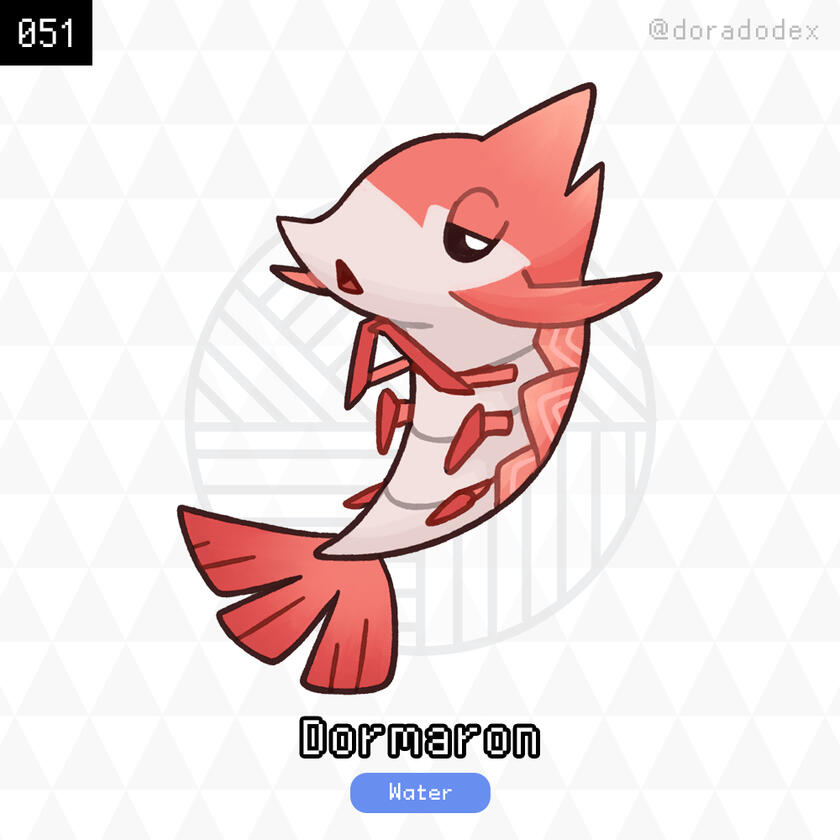
051
DORMARON
WaterIt is very difficult for Dormaron to fall asleep, but when it does, it’s taken miles away by the strong river current. It’s said they take the powerful energy of the current to evolve.ORIGIN + ETYMOLOGY
Dormaron is inspired by the Spanish idiom “camarón que se duerme se lo lleva la corriente” (the shrimp that falls asleep is taken away by the current, the equivalent of ‘you snooze, you lose’). “Dormaron” is a combination of ‘dormir’ (to sleep) and ‘camarón (shrimp).
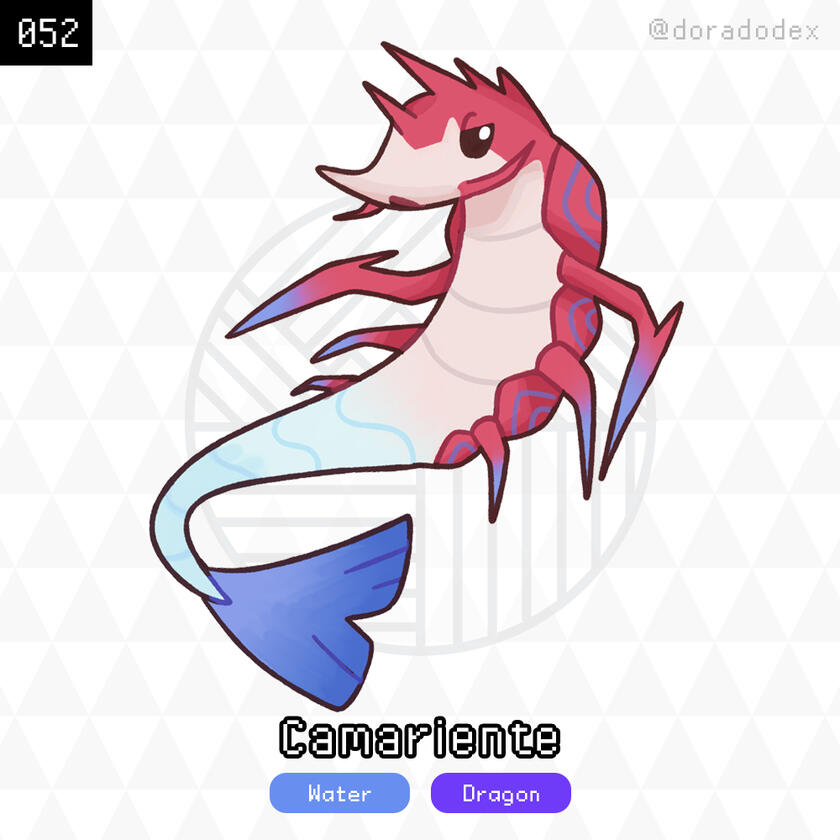
052
CAMARIENTE
Water/DragonCamariente evolves from a Dormaron that fell asleep and was taken away by the current. It's an incredibly fast swimmer, it's said that it makes the currents stronger with it's powerful tail.ORIGIN + ETYMOLOGY
Dormaron is inspired by the Spanish idiom “camarón que se duerme se lo lleva la corriente” (the shrimp that falls asleep is taken away by the current, the equivalent of ‘you snooze, you lose’).
“Camariente” is a combination of ‘camarón’ (shrimp) and 'corriente' (current).
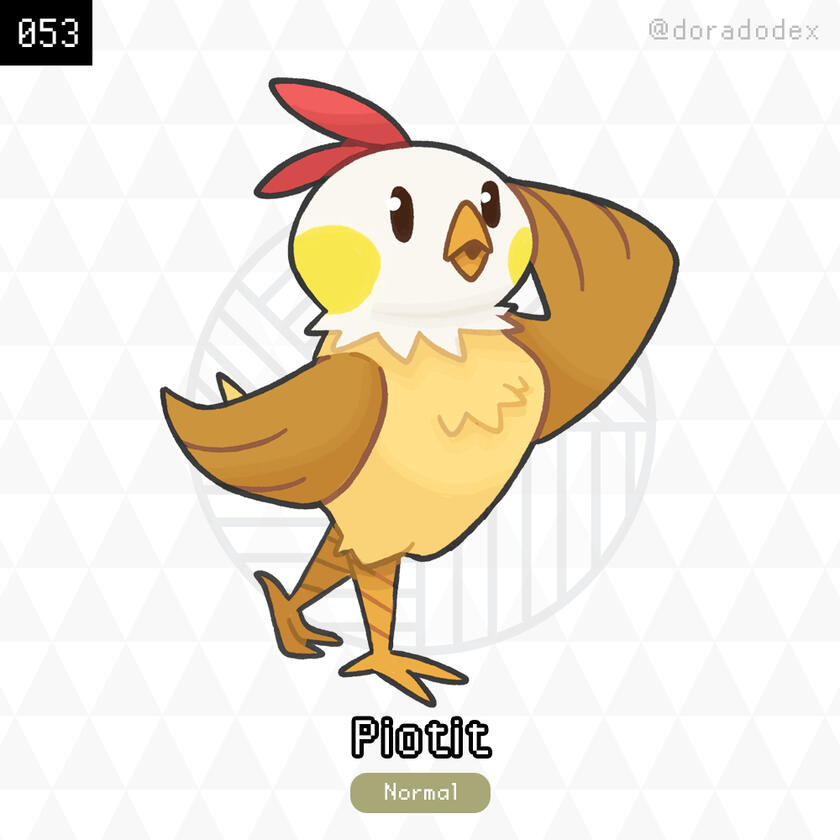
053
PIOTIT
NormalPiotit are great companions for children, they grow up alongside them and usually evolve when their child companion reaches 12-14 years.EVOLUTION
They have different evolutions depending on their gender.ORIGIN + ETYMOLOGY
Piotit is inspired by chicks.
“Piotit” is a combination of ‘pio (the Spanish onomatopoeia for the sound a chick makes) and ‘petit’ (French for small).
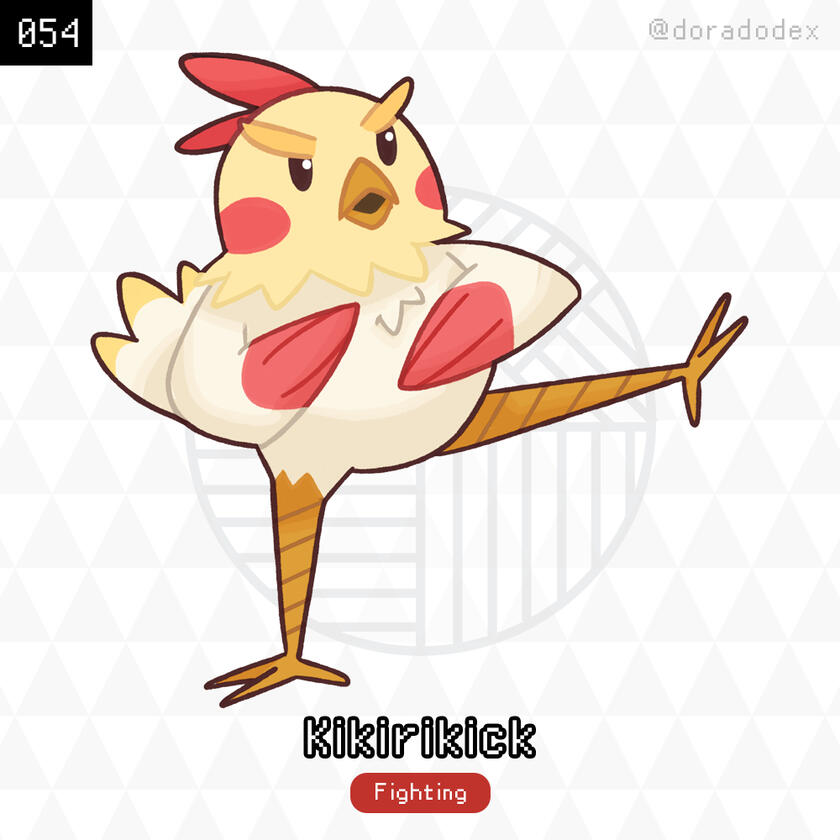
054
KIKIRIKICK
FightingKikirikick protects the eggs it lays by kicking farmers. Their legs are very strong and they can stretch to reach their target.ORIGIN + ETYMOLOGY
Kikirikick inspired by chickens.
“Kikirikick” is a combination of ‘kikiriki’ (the Spanish onomatopoeia for the sound a chicken makes) and ‘kick’.
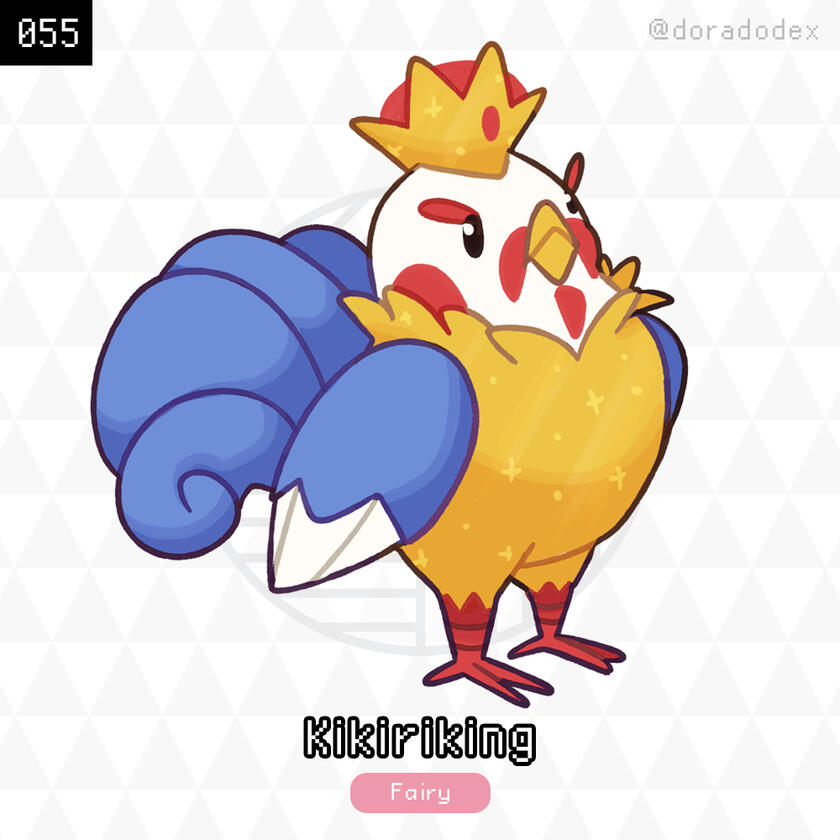
055
KIKIRIKING
FairyKikiriking wakes up before sunrise to position itself and absorb the first sun beams of the day. They use their sparkly feathers to woo Kikirikicks.ORIGIN + ETYMOLOGY
Kikiriking inspired by roosters.
“Kikiriking” is a combination of ‘kikiriki’ (the Spanish onomatopoeia for the sound a chicken makes) and ‘king’.
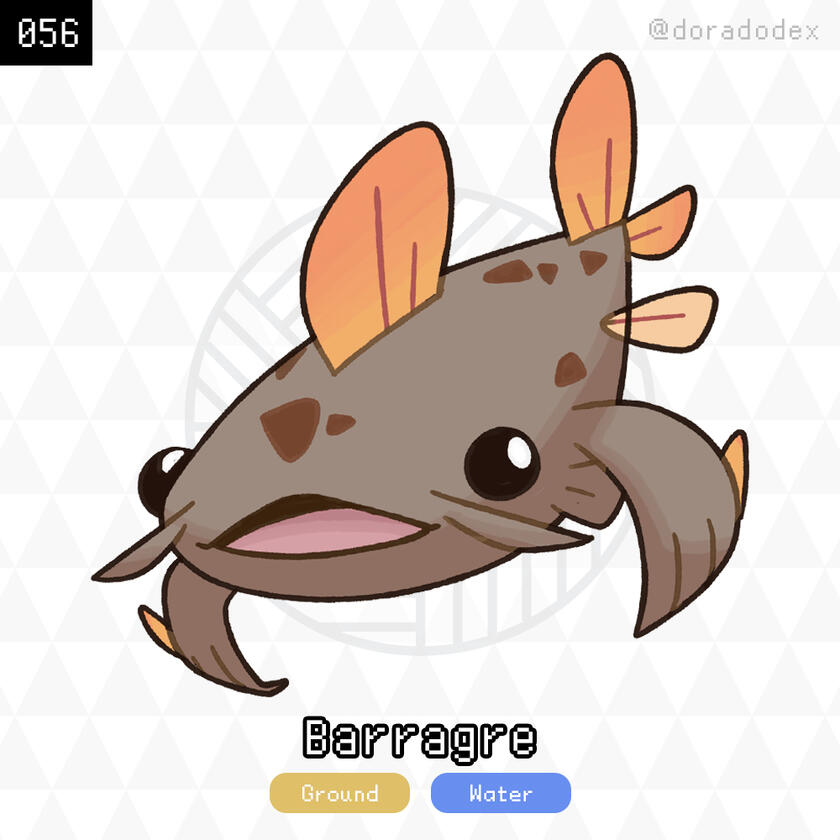
056
BARRAGRE
Ground/WaterDespite looking like a fish, Barragre can be described better as an amphibian. It thrives in the mangrove marsh of the Dorado coastal region where it and its evolution line, rule the waters.ORIGIN + ETYMOLOGY
Barragre is inspired by catfishes.“Barragre” is a combination of ‘barro’ (mud) and ‘bagre’ (catfish).
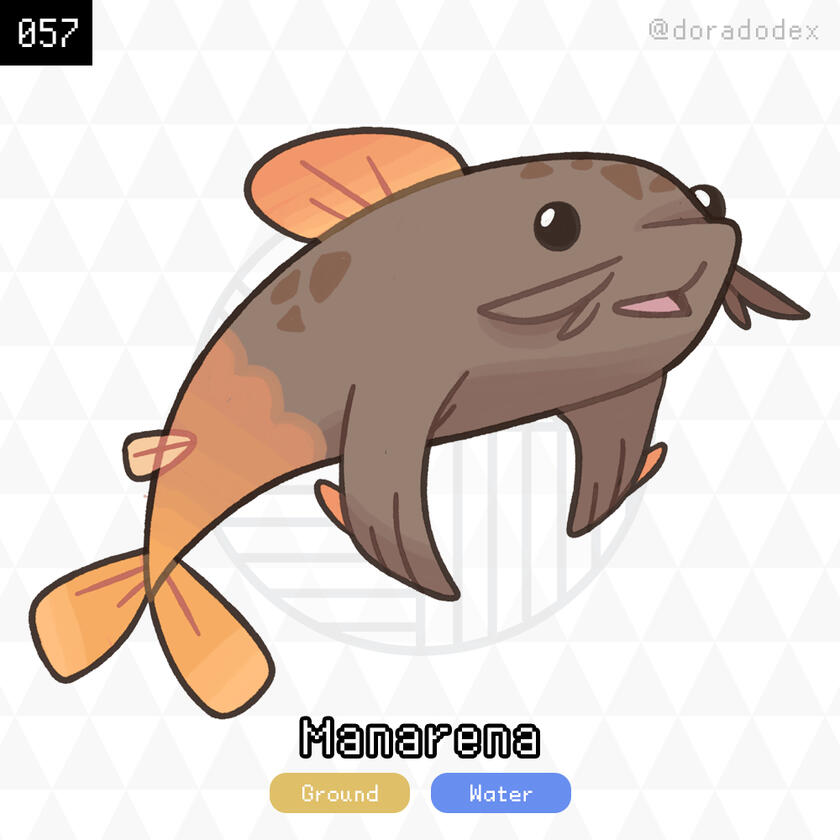
057
MANARENA
Ground/WaterManarena’s voice is melodic and powerful, they were often confused for mermaids by sailors. They are often seen playing in beaches with children and other pokémon.ORIGIN + ETYMOLOGY
Manarena is inspired by catfishes, manatees and mermaids.
“Manarena” is a combination of ‘manatee’, ‘sirena’ (mermaid) and ‘arena’ (sand).
.
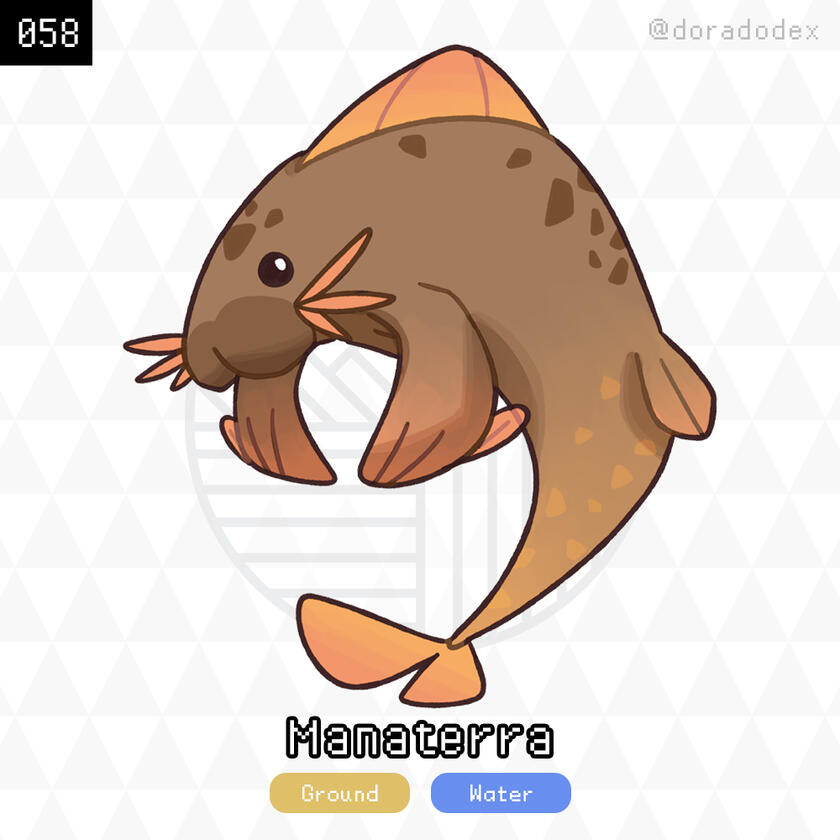
058
MANATERRA
Ground/WaterManaterra often spend their days sunbathing in beaches all around Dorado. They find it difficult to swim because of their heavy weight.ORIGIN + ETYMOLOGY
Manaterra is inspired by manatees and mermaids.
“Manaterra” is a combination of ‘manatee’ and ‘terra’.
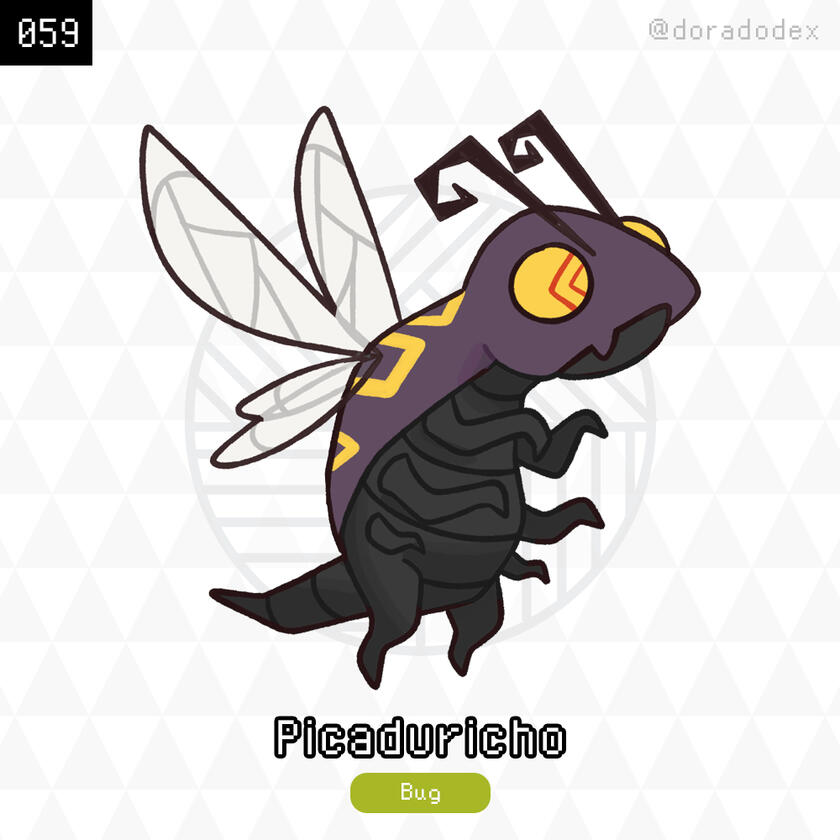
059
PICADURICHO
BugPicaduricho’s sting is very powerful and can cause a variety of effects, from burning to paralysis. They’re often seen around the coastal towns of Dorado.ORIGIN + ETYMOLOGY
Picaduricho is inspired by the Paederus Irritans, an ant-like creature with a very strong sting that causes the skin to burn.
“Picaduricho” is a combination of ‘picadura’ (sting) and ‘bicho’ (bug).
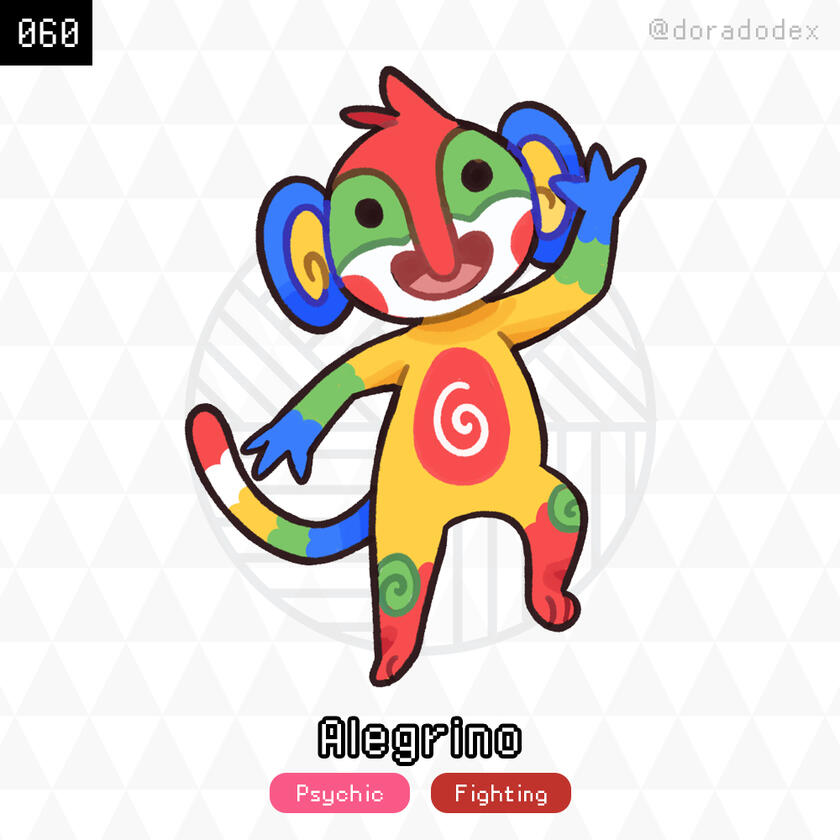
060
ALEGRINO
Psychic/FightingOne of the stars of the Grand Carnival parade of Arenas city. This joyful pokémon loves to play pranks on everyone and it’s said it has mood-affecting powers.ORIGIN + ETYMOLOGY
Alegrino is inspired by various carnival characters, specifically a marimonda and a garabato, it also takes from brown spider monkeys.
“Alegrino” comes from ‘alegria’ (joy/happiness).
.
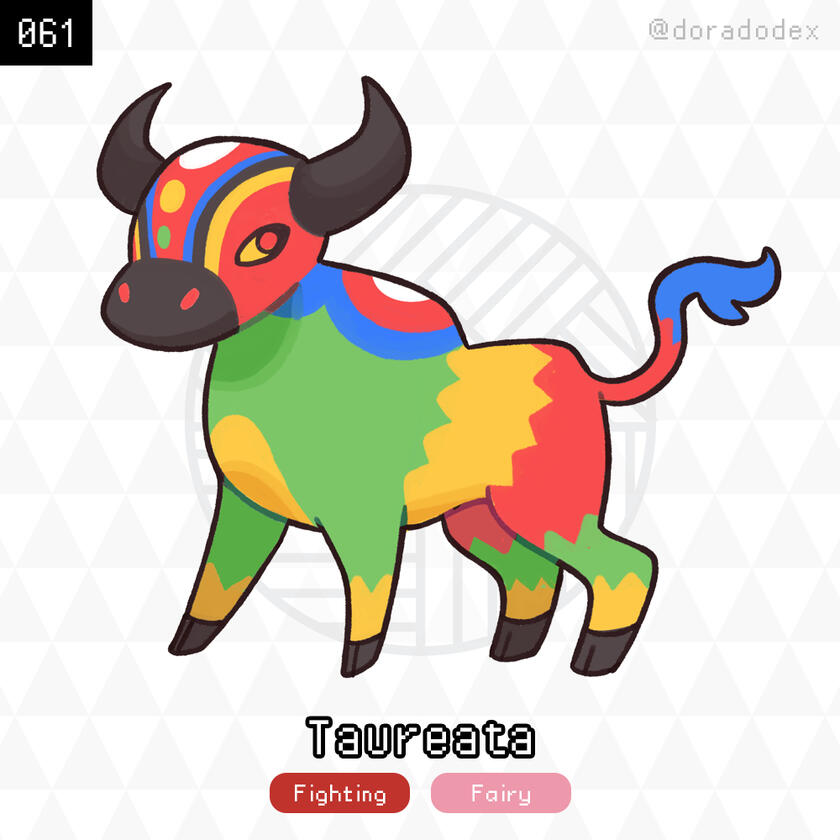
061
TAUREATA
Fighting/FairyOne of the stars of the Grand Carnival parade of Arenas city. The color pattern on Taureata’s back is different for every pokémon, scientists have found 4,294,967,297 variations in patterns.
This stubborn pokémon is used in races during the carnival.ORIGIN + ETYMOLOGY
Taureata is inspired by various carnival characters, specifically a miura bull (or Spanish fighting bull) and piñatas.
“Taureata” comes from ‘toro’ (bull) and ‘piñata’.
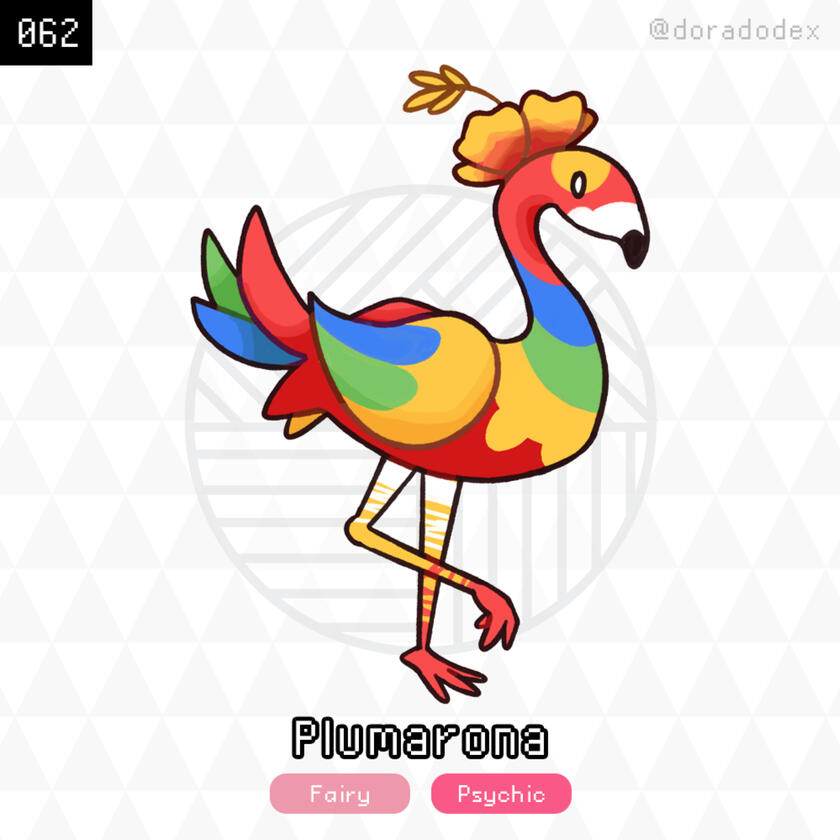
062
PLUMARONA
Fairy/PsychicOne of the stars of the Grand Carnival parade of Arenas city. Plumarona is known as the queen of the carnival, where a large group of them lead the main parade. This elegant pokémon loves to dance around.ORIGIN + ETYMOLOGY
Plumarona is inspired by Colombia’s prominent pageant culture, the flower on its head is based on the flower headdress of the queen of the Carnival. It also based on a flamingo.
“Plumarona” is a play on ‘primadonna’ combining the words ‘pluma’ (feather) and ‘corona’ (crown).
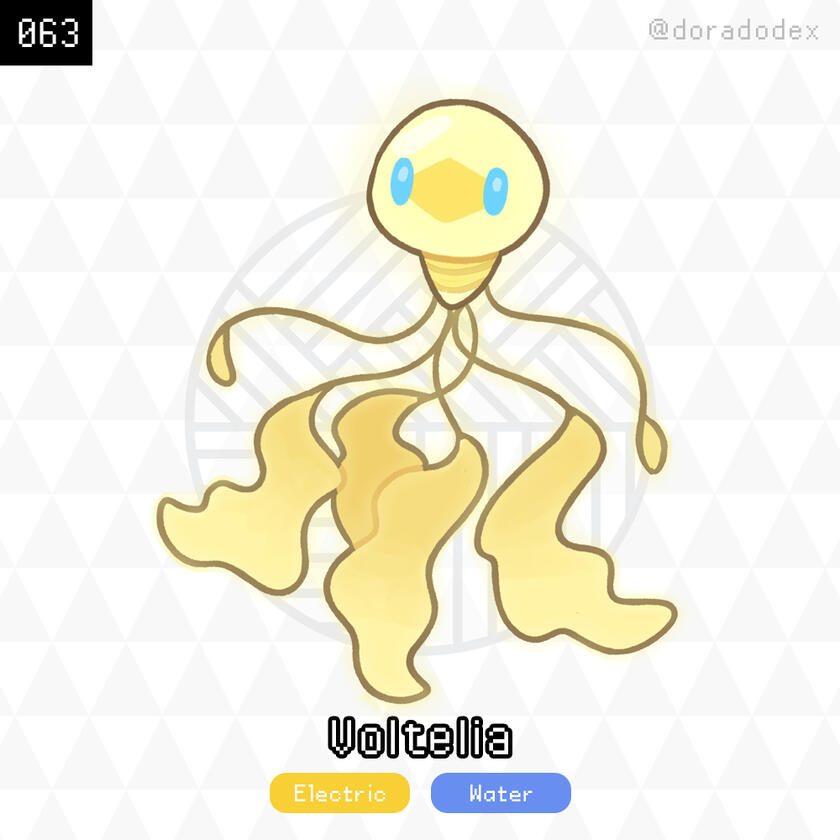
063
VOLTELIA
Electric/WaterGroups of Voltelia iluminate the deep waters of the Dorado oceans. Their sting is very powerful and can cause paralysis.ORIGIN + ETYMOLOGY
Voltelia is based on a moon jellyfish and lightbulbs.
“Voltelia” is a combination of ‘volt' and 'aurelia aurita' (genus of jellyfish).
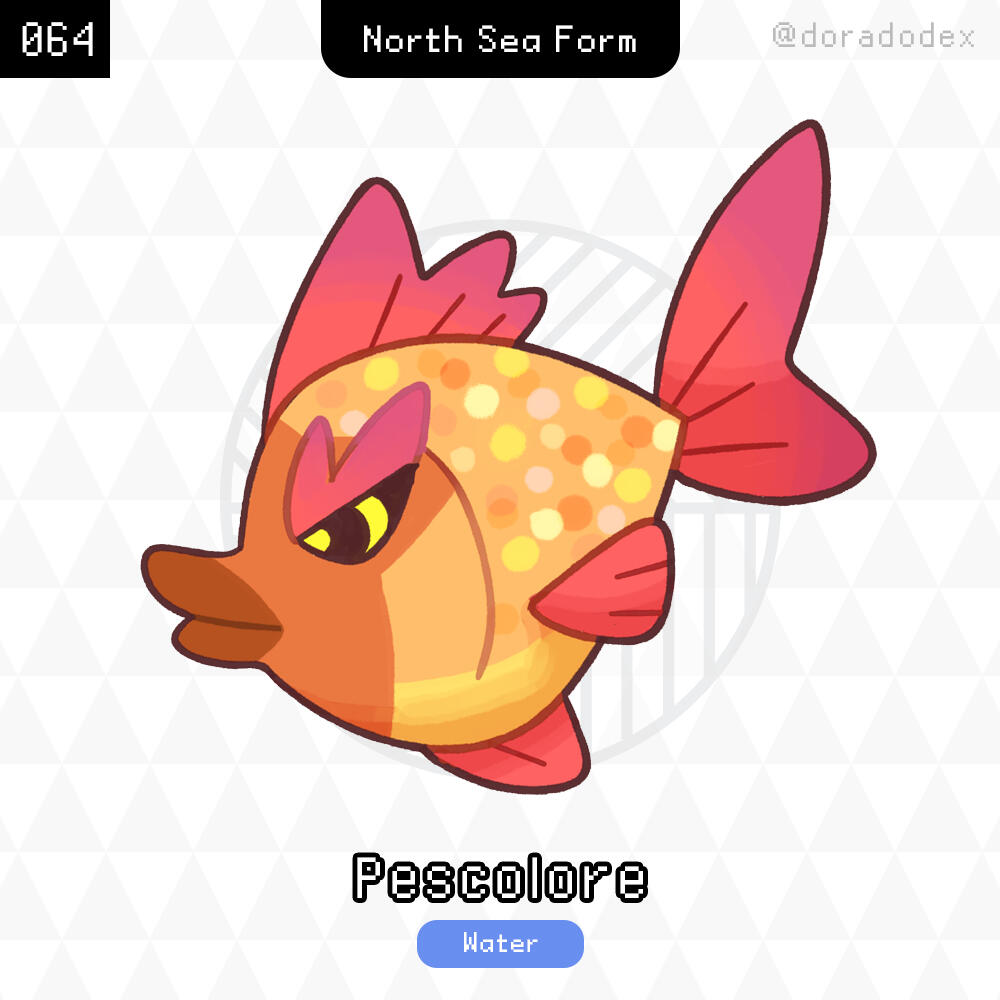
064
PESCOLORE (North Sea Form)
WaterPescolore are common fish pokémon that inhabit both of Dorado’s oceans. They usually travel in large groups.The warmer waters of the North Sea make it a perfect environment for all kinds of tropical creatures, including Pescolore. The warmer tones help them blend in with the coral reefs of this sea.ORIGIN + ETYMOLOGY
Pescolore is inspired by various tropical fish. The idea of the two different forms is based on Colombia’s access to both the Atlantic and Pacific oceans; being the only country in South America with access to more than one ocean.
“Pescolore” is a combination/corruption of ‘pez’ (fish) and ‘color’.
064
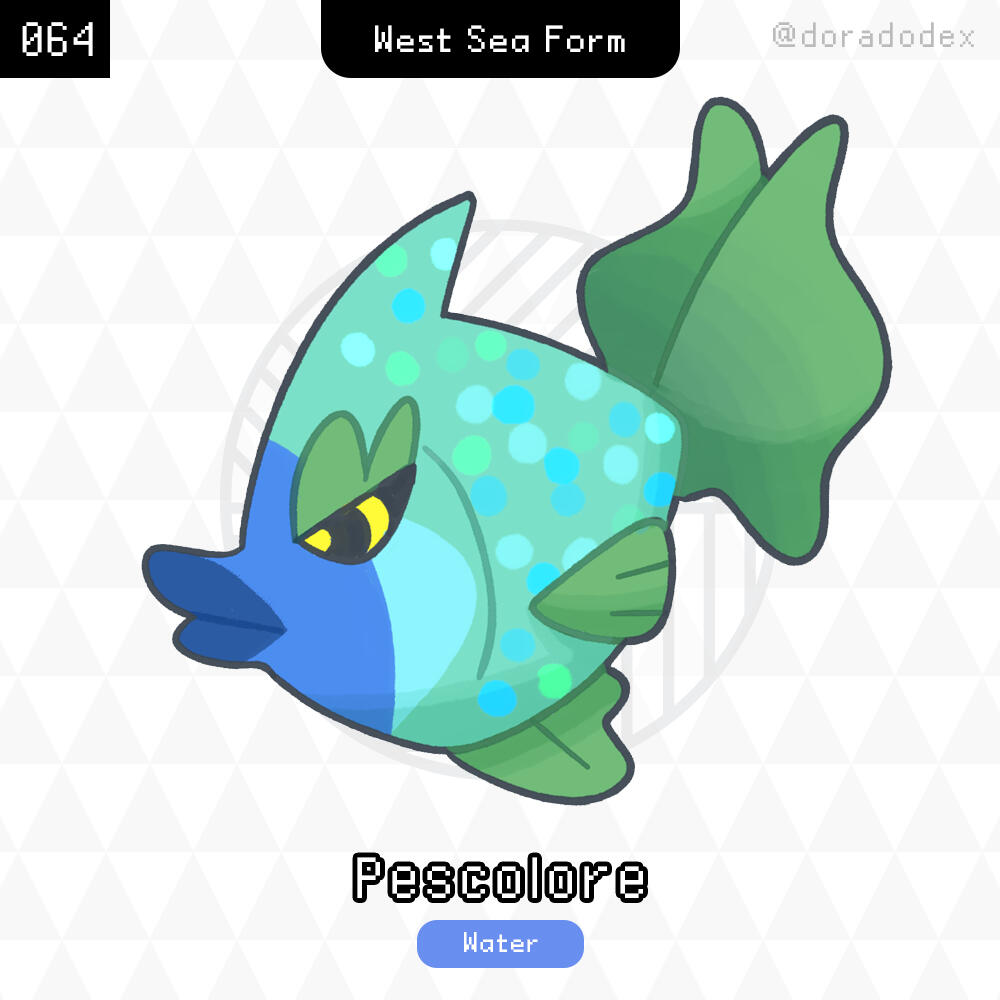
PESCOLORE (West Sea Form)
WaterPescolore are common fish pokémon that inhabit both of Dorado’s oceans. They usually travel in large groups.The West Sea has colder and more dangerous waters, Pescolore uses its colder tones and seaweed-like fins to blend in with the environment.ORIGIN + ETYMOLOGY
Pescolore is inspired by various tropical fish. The idea of the two different forms is based on Colombia’s access to both the Atlantic and Pacific oceans; being the only country in South America with access to more than one ocean.
“Pescolore” is a combination/corruption of ‘pez’ (fish) and ‘color’.
065
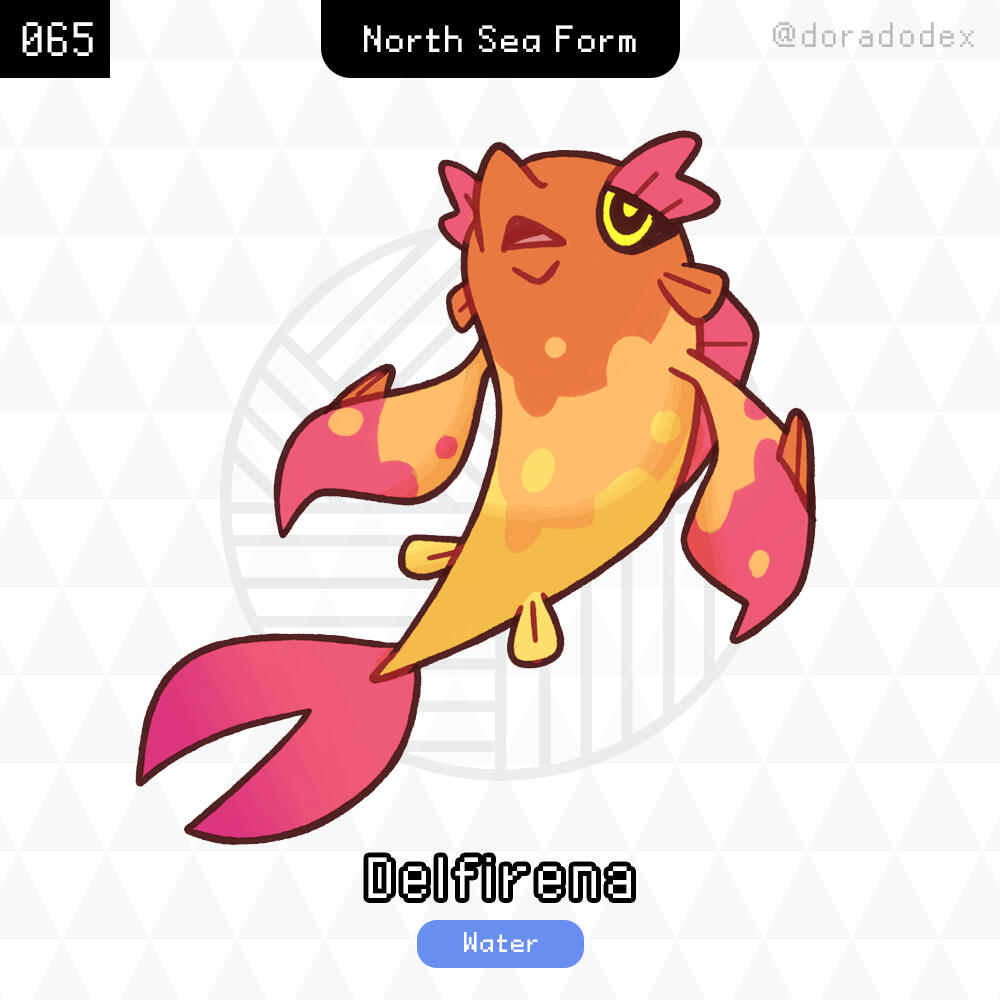
DELFIRENA (North Sea Form)
WaterDelfirena often travel alongside ships, swimming next to them from port to port. They also tend to lead schools of Pescolore and protect them from predators.ORIGIN + ETYMOLOGY
Delfirena is inspired by various tropical fishes, dolphins and mermaids. The idea of the two different forms is based on Colombia’s access to both the Atlantic and Pacific oceans; being the only country in South America with access to more than one ocean.
“Delfirena” is a combination of ‘delfín (dolphin) and ‘sirena’ (mermaid).
065
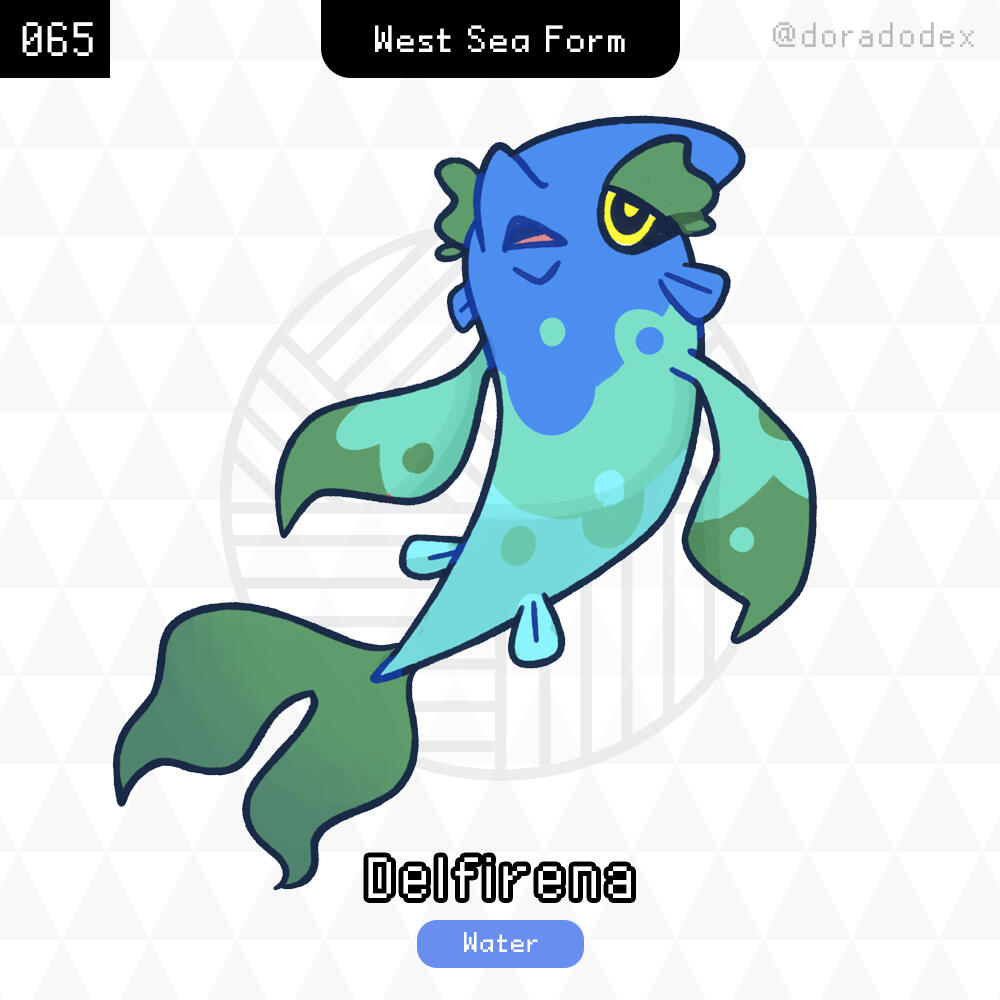
DELFIRENA (West Sea Form)
WaterDelfirena often travel alongside ships, swimming next to them from port to port. They also tend to lead schools of Pescolore and protect them from predators.ORIGIN + ETYMOLOGY
Delfirena is inspired by various tropical fishes, dolphins and mermaids. The idea of the two different forms is based on Colombia’s access to both the Atlantic and Pacific oceans; being the only country in South America with access to more than one ocean.
“Delfirena” is a combination of ‘delfín (dolphin) and ‘sirena’ (mermaid).
066
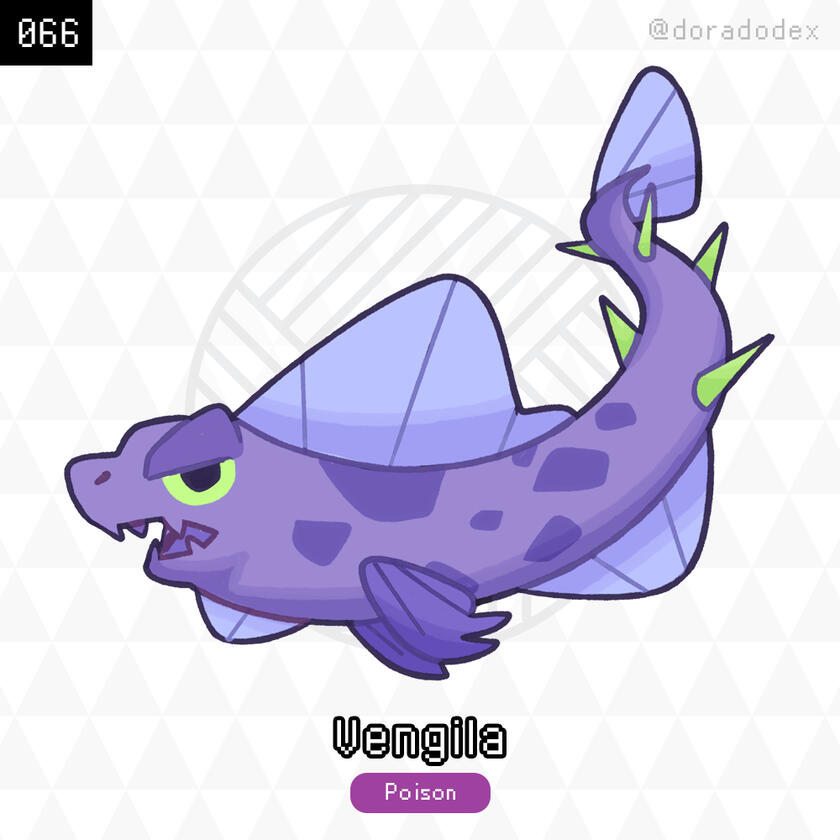
VENGILA
PoisonVengila’s scales are extremely toxic and the poison stored on the stings of its body is lethal to humans. They inhabit the deep waters of the Dorado oceans.ORIGIN + ETYMOLOGY
Vengila is inspired by eels.
“Vengila” is a combination of ‘venganza’ (revenge), ‘veneno’ (poison) and ‘anguila’ (eel).
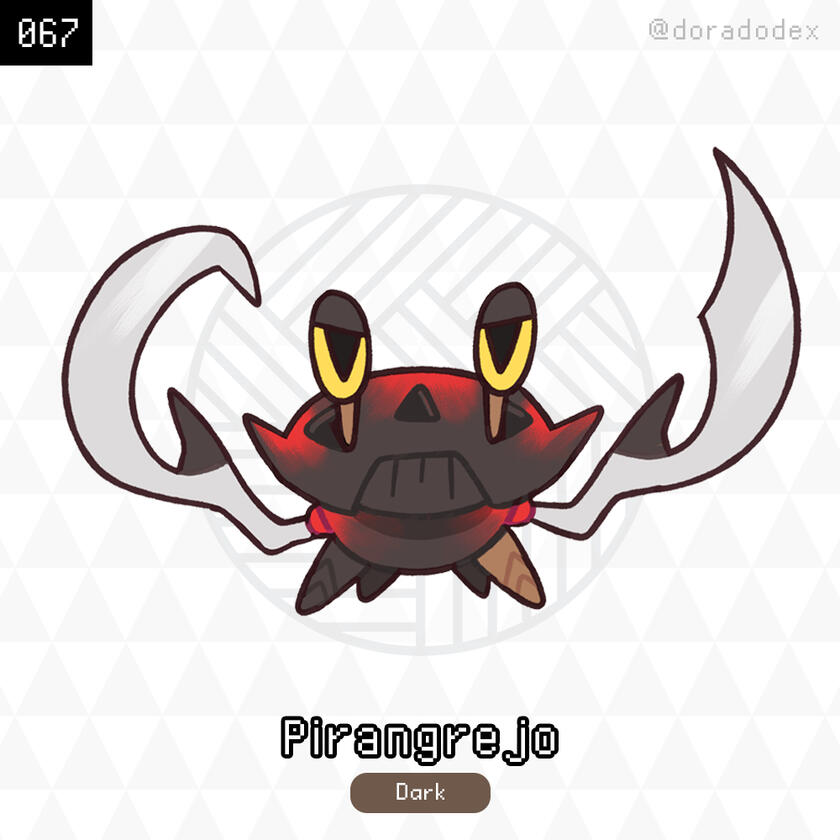
067
PIRANGREJO
DarkPirangrejo’s pincers resemble a hook and a scimitar, because of this they were common companions for pirates.ORIGIN + ETYMOLOGY
Pirangrejo is inspired by pirates and based on the zombie crab (gecarcinus ruricola).
“Pirangrejo” is a combination of ‘pirate’ and ‘cangrejo’ (crab).
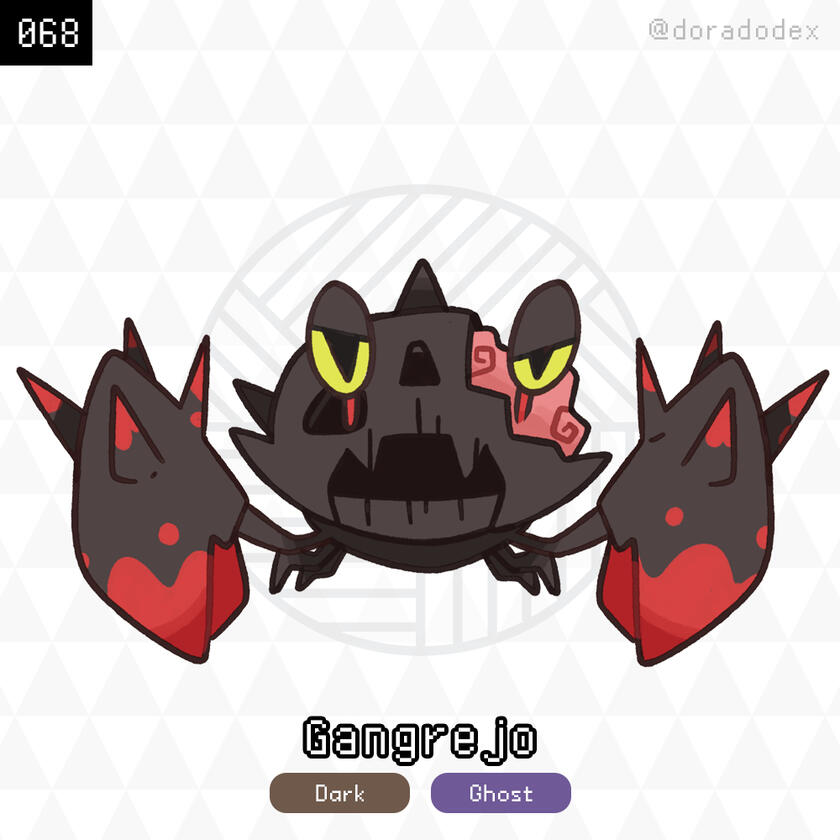
068
GANGREJO
Dark/GhostLegends say that when a pirate died, their soul attached itself to their Pirangrejo companion. Gangrejo’s exposed flesh reeks of sea salt and blood.ORIGIN + ETYMOLOGY
Gangrejo is based on the zombie crab (gecarcinus ruricola).
“Gangrejo” is a combination of ‘gangrene’ and ‘cangrejo’ (crab).
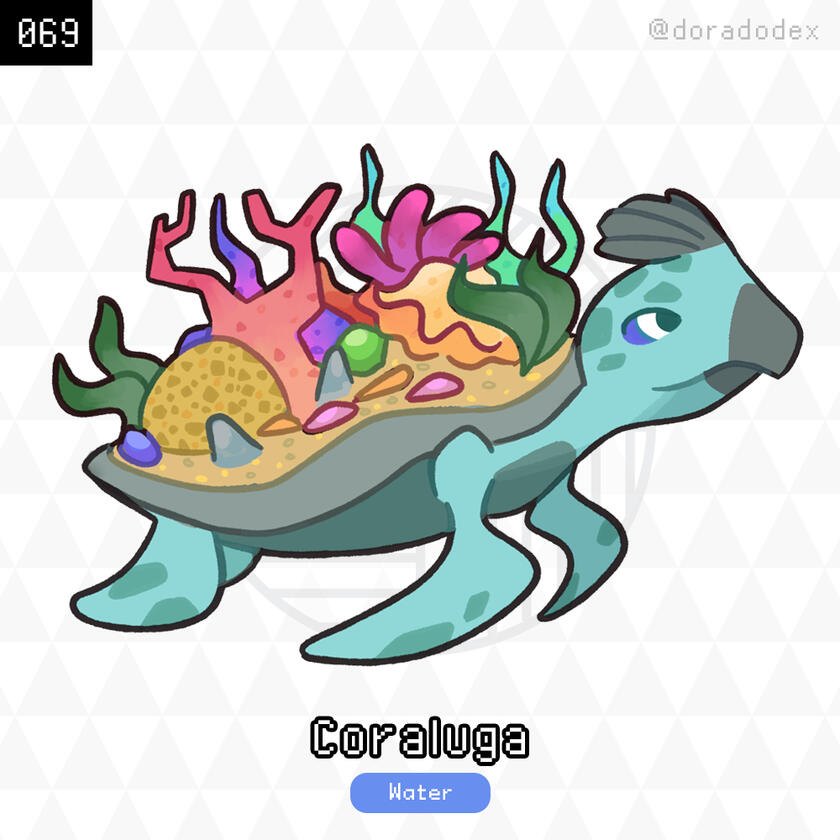
069
CORALUGA
WaterCoraluga is constantly swimming across the world’s ocean looking for warmer waters. The coral reef on their shell serves as a home for smaller pokémon that travel the same waters as them.ORIGIN + ETYMOLOGY
Coraluga is based on a sea turtle and coral reefs.
“Coraluga” is a combination of ‘coral’ and ‘tortuga’ (turtle).
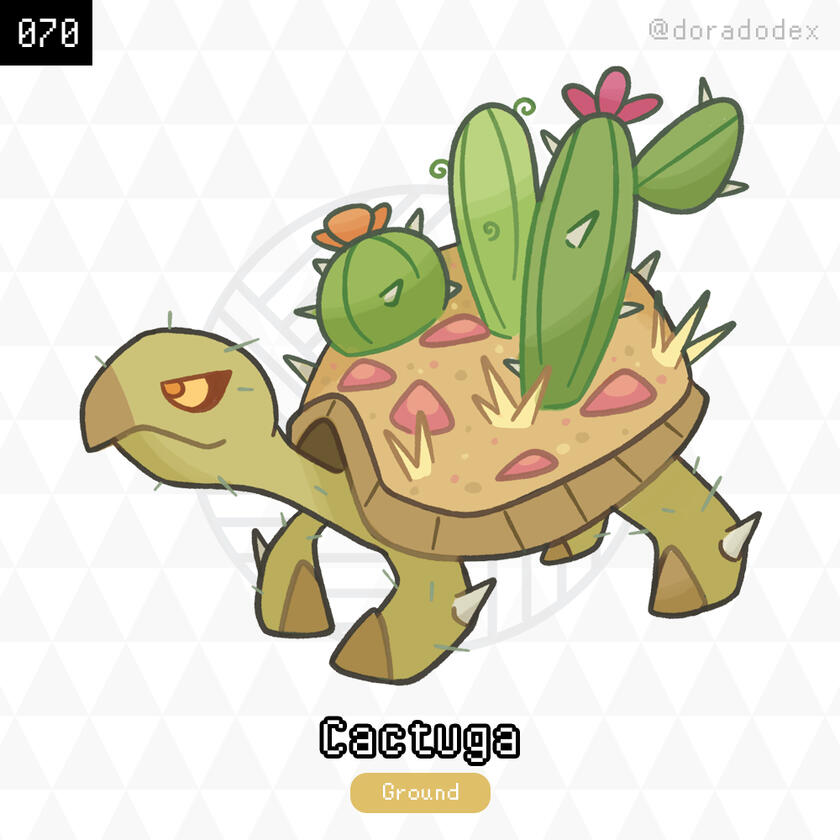
070
CACTUGA
GroundCactuga endlessly wander around deserts looking for colder areas. Sometimes smaller creatures hitch rides on its back, using the shade from the fake cactus to protect themselves from heat.ORIGIN + ETYMOLOGY
Cactuga is based on a turtles and desert environments.
“Cactuga” is a combination of ‘cactus’ and ‘tortuga’ (turtle).
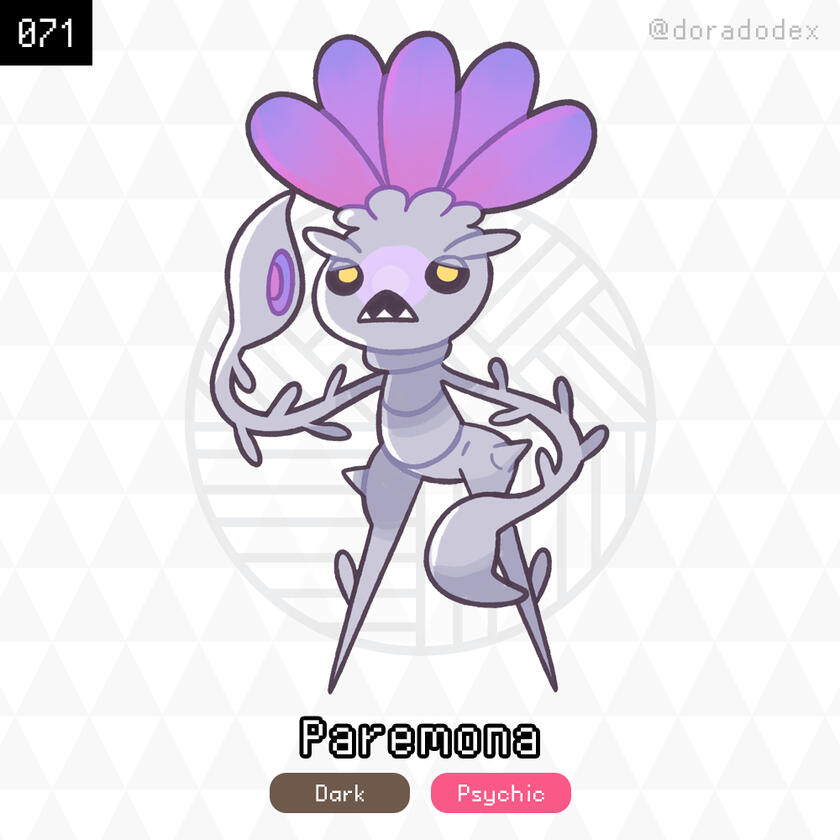
071
PAREMONA
Dark/PsychicThis small creature uses other bigger Pokémon such as Coraluga and Cactuga to travel big distances. Paremona uses its tentacles to take control of the mind of a host pokémon and increase its own power.ORIGIN + ETYMOLOGY
Paremona is based on parasites.
“Paremona” is a combination of ‘parasite’ and ‘anemona’ (anemone).
.
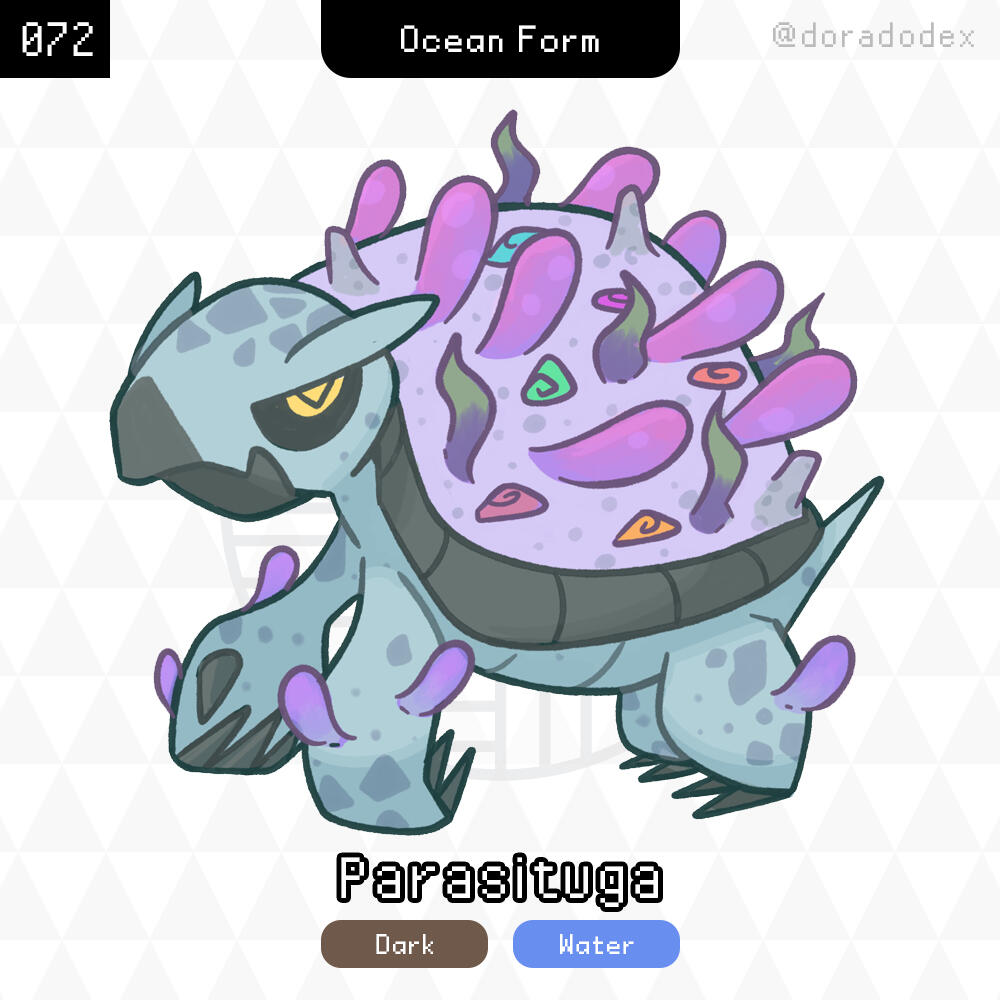
072
PARASITUGA (Ocean Form)
Dark/WaterWhen a Paremona takes full control of its host’s brain, it fuses its own parasitic DNA with the host’s, effectively using the combined power of both creatures to evolve.ORIGIN + ETYMOLOGY
Parasituga is based on parasitic relationships in nature. Its designs are combinations of Coraluga and Paremona’s designs.“Parasituga” is a combination of ‘parasite’ and ‘tortuga’ (turtle).
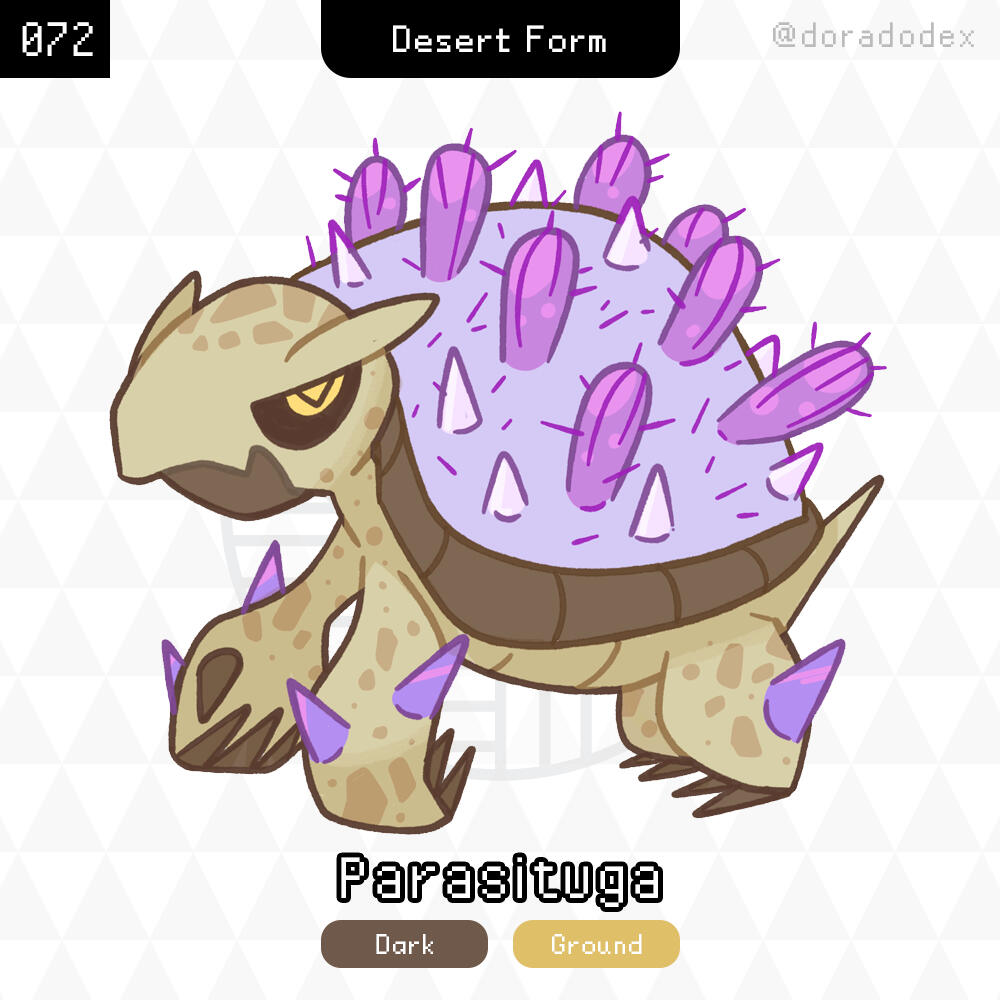
072
PARASITUGA (Desert Form)
Dark/GroundWhen a Paremona takes full control of its host’s brain, it fuses its own parasitic DNA with the host’s, effectively using the combined power of both creatures to evolve.ORIGIN + ETYMOLOGY
Parasituga is based on parasitic relationships in nature. Its designs are combinations of Cactuga and Paremona’s designs.“Parasituga” is a combination of ‘parasite’ and ‘tortuga’ (turtle).
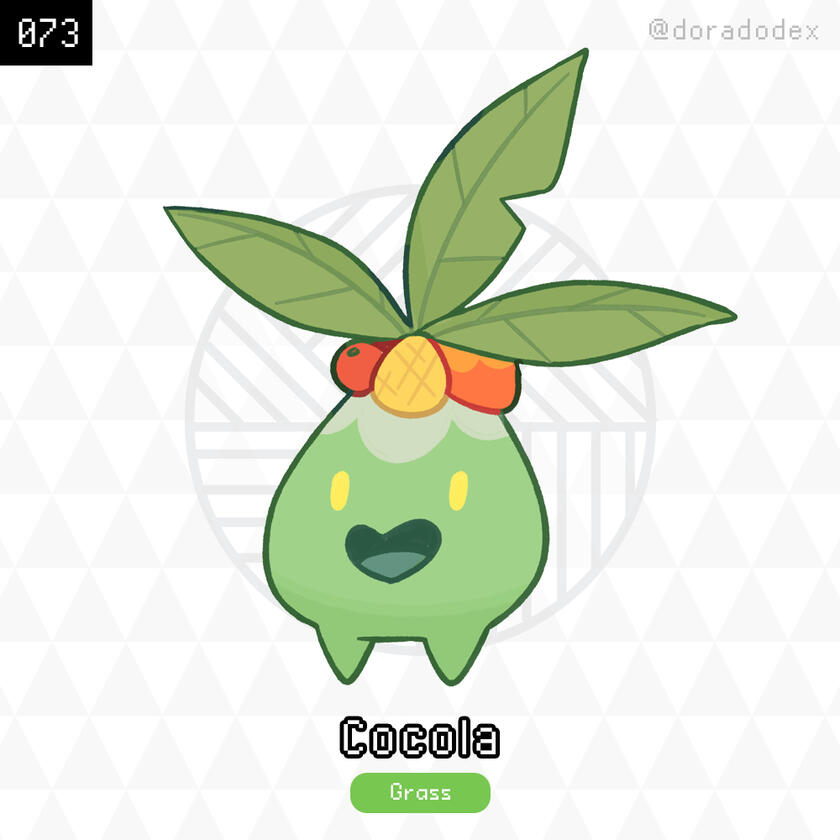
073
COCOLA
GrassWhen Cocola hop around they exude various fruity smells. They are commonly seen playing around in groups around beaches.ORIGIN + ETYMOLOGY
Cocola is based on coconut and palm trees.
“Cocola” comes from ‘coco’ (coconut).
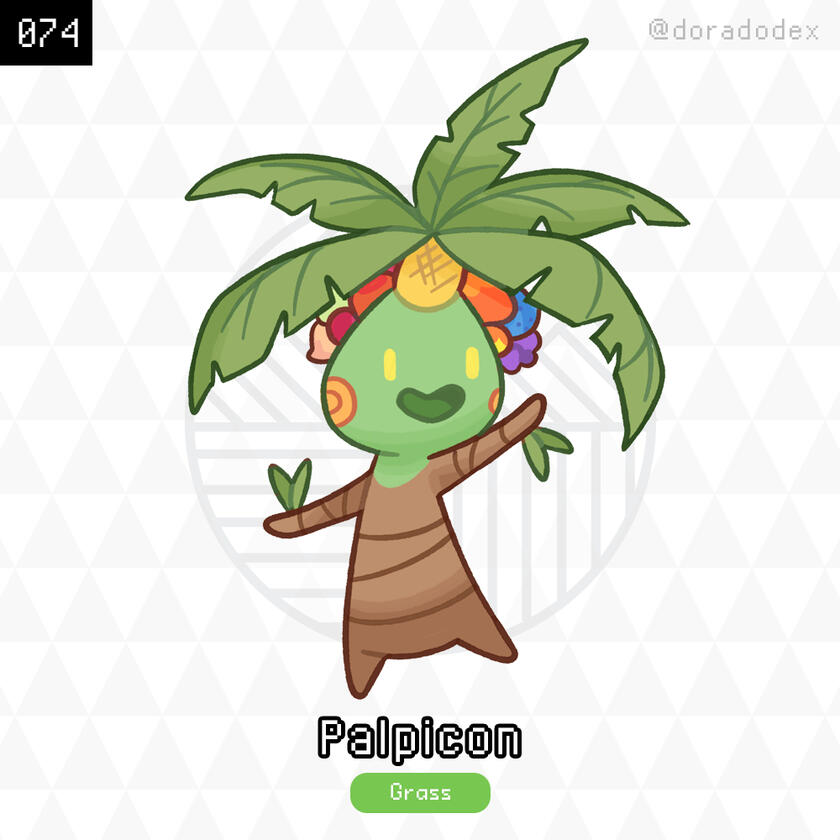
074
PALPICON
GrassPalpicon can be seen gathered around popular tourist spots of Coastal Dorado, where they offer their fruits to help tourists deal with the heat.ORIGIN + ETYMOLOGY
Palpicon is based on palm trees and various tropical fruits.
“Palpicon” is a combination of ‘palmera’ (palm tree) and ‘salpicón’ (a mixed fruit-based drink).
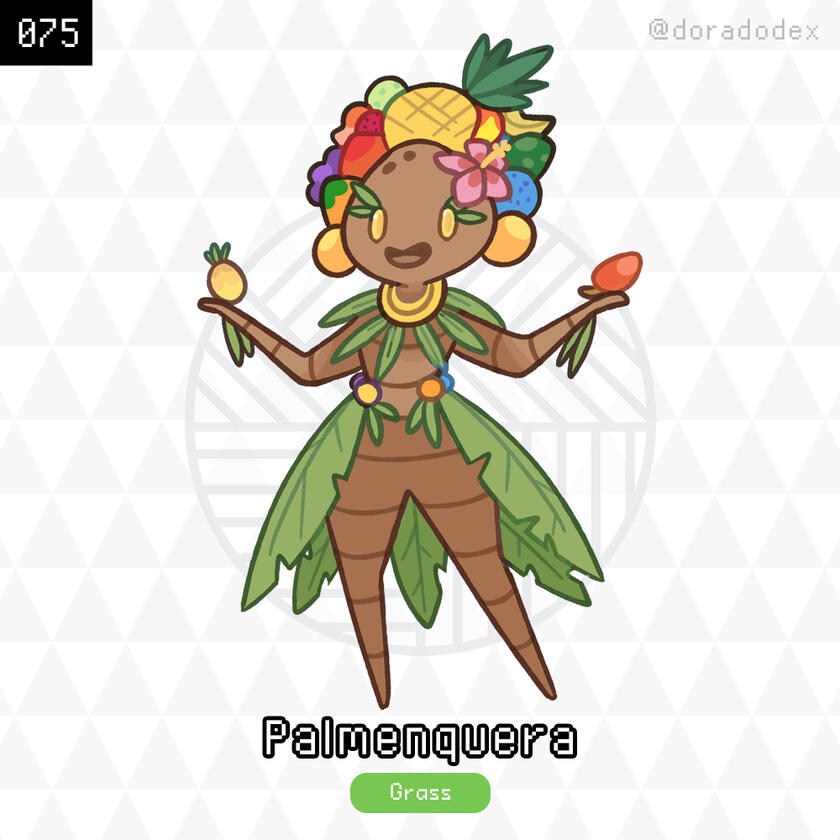
075
PALMENQUERA
GrassGroups of Palmenquera can be found in the historical side of Independencia City, were they dance around and hand fruits and berries to curious tourists.ORIGIN + ETYMOLOGY
Palmenquera is based on palm trees and various tropical fruits, as well as a Palenquera (a woman from the Palenque peoples who dresses in a colorful dress and sells fruit that she balances on a basket on top of her head. They’ve become a national symbol associated with the city of Cartagena). “Palmenquera” is a combination of ‘palmera’ (palm tree) and ‘palenquera’.
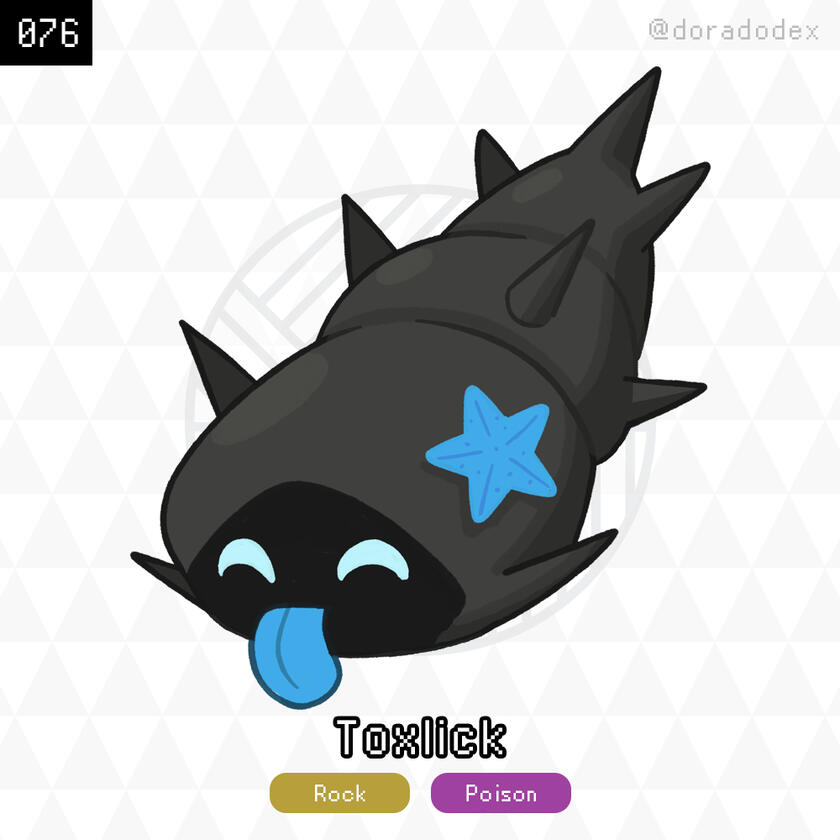
076
TOXLICK
Rock/PoisonToxlick produces a strong poison that it releases through its tongue. Any contact with this poison can be incredibly dangerous since it burns through the skin in a matter of seconds.ORIGIN + ETYMOLOGY
“Toxlick” is a combination of ‘toxic’ and ‘lick’.
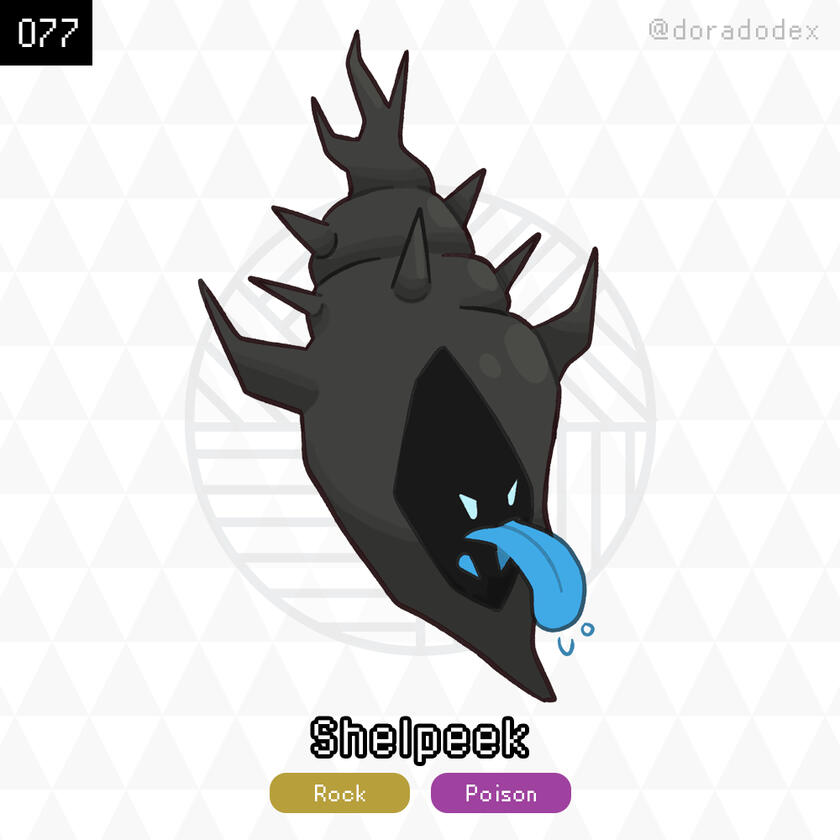
077
SHELPEEK
Rock/PoisonIt’s a mystery how Shelpeek's body looks when not in its shell. Every inch of Shelpeek’s body is toxic and can produce severe burns on the skin.ORIGIN + ETYMOLOGY
“Shelpeek” is a combination of ‘shell’ and ‘peek’.
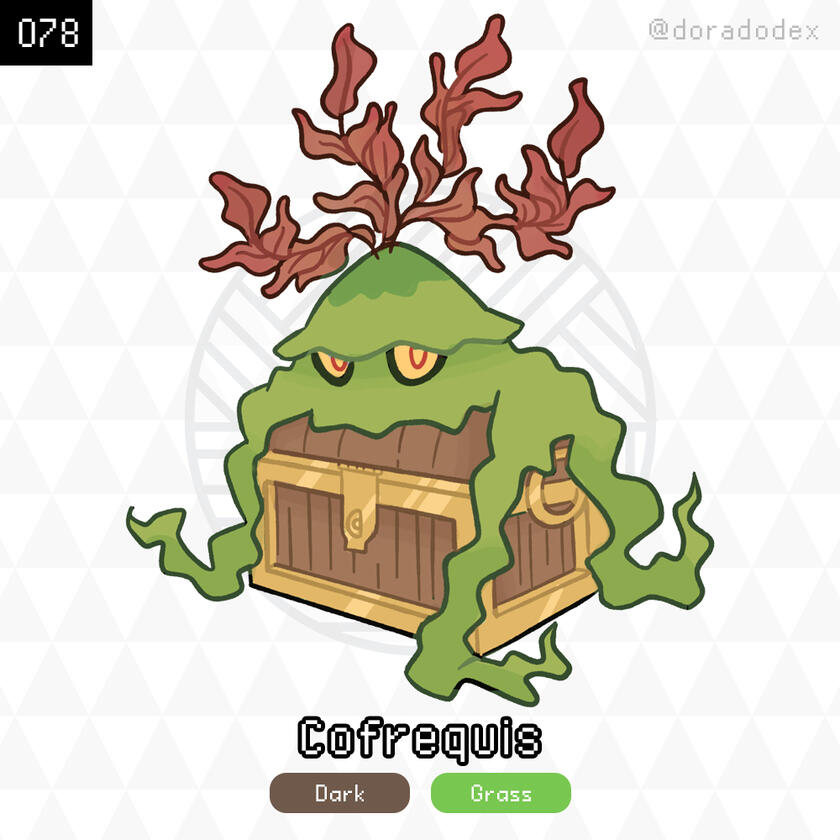
078
COFREQUIS
Dark/GrassCofrequis attaches itself to buried pirate treasure on both land and sea, marking an X with the algae-like tentacles on top of its head.ORIGIN + ETYMOLOGY
“Cofrequis” is a combination of ‘cofre’ (Spanish for chest) and ‘equis’ (Spanish for X). .
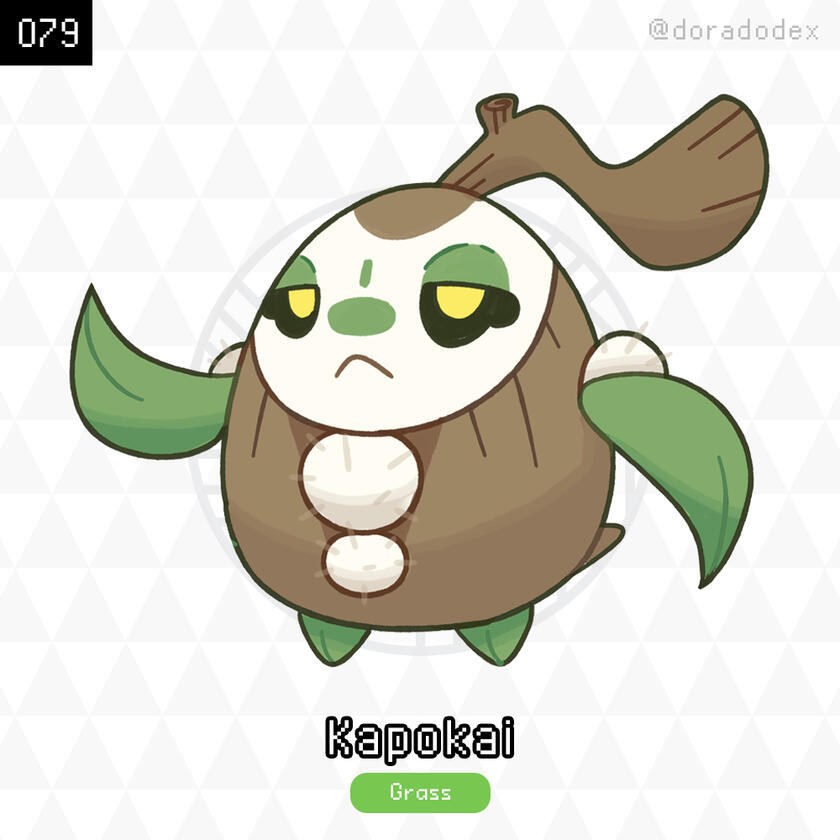
079
KAPOKAI
GrassKapokai lives on the dense jungles of Dorado on top of tall kapok trees. They sleep for most of the day, sometimes falling to the ground slowly due to how light their bodies are.ORIGIN + ETYMOLOGY
Kapokai is based on a seed of the kapok tree (ceiba pentandra) and a pale-throated sloth (bradypus tridactylus), also known as an Aí-aí. “Kapokai” is a combination of ‘kapok’ (from kapok tree) and ‘aí-aí’.
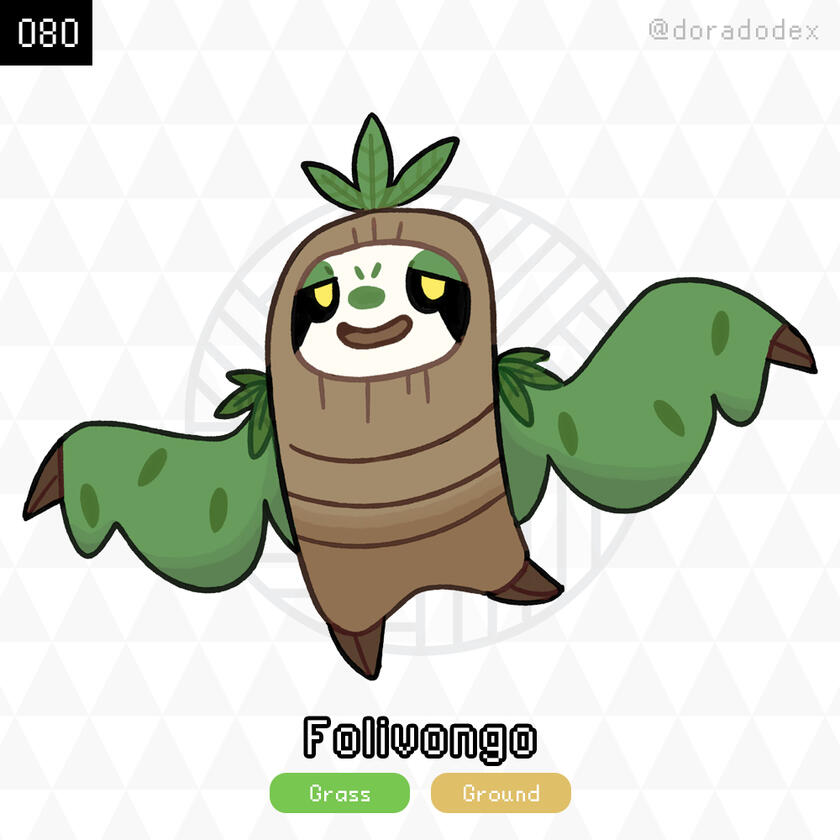
080
FOLIVONGO
Grass/GroundFolivongo evolves from a Kapokai that fell to the ground, taking the characteristics of the tree it used to inhabit. Since they are terrible climbers and can’t reach the top of most trees, they feed themselves with the leaves that grow out of their arms.ORIGIN + ETYMOLOGY
Folivongo is based on a kapok tree (ceiba pentandra) and a sloth (bradypus tridactylus), the ground typing comes from a play on words based on the extinct ground sloths that lived in South America.
“Folivongo” is a combination of ‘folivora’ (suborder of the sloth), ‘foliage’ and ‘bongo’ (Spanish for Kapok tree).
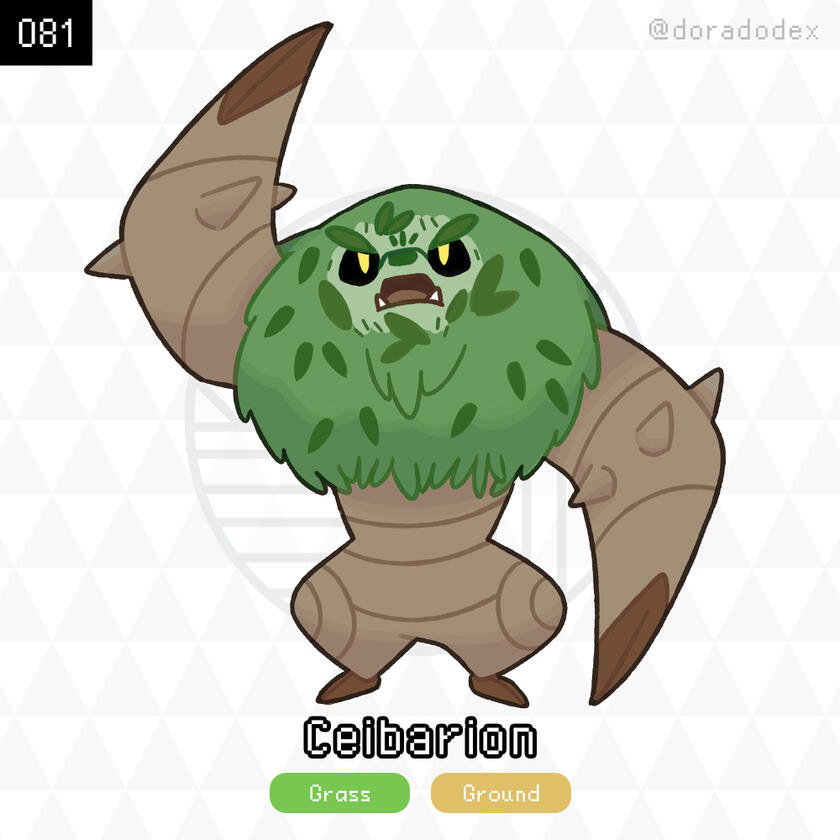
081
CEIBARION
Grass/GroundCeibarion is never seen in the wild, it’s said that it became extinct a couple centuries ago. Recent studies say it lives secluded deep in the jungles of Dorado, disguising itself as just another kapok tree.EVOLUTION
Ceibarion evolves from a Folivongo that levels up while knowing the move Ancient Power.ORIGIN + ETYMOLOGY
Ceibarion is based on a kapok tree (ceiba pentandra) and a megatherium (a species of extinct giant ground sloths).
“Ceibarion” comes from ‘ceiba’ (from ceiba pentandra).
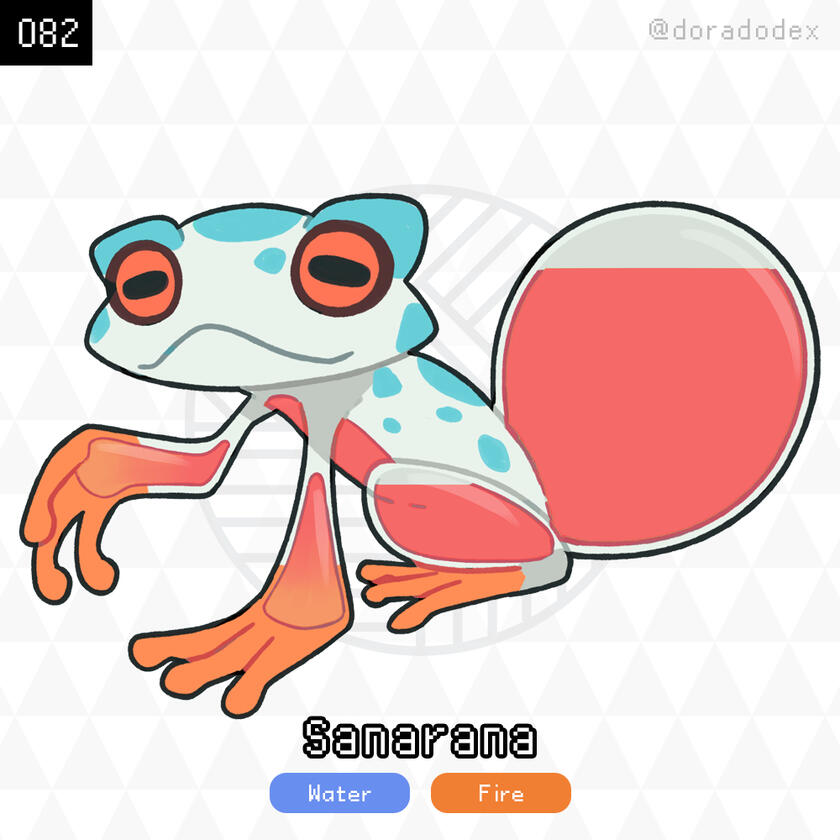
082
SANARANA
Water/FireThe warm liquid in Sanarana’s tail is used in Pokémon Centers all around Dorado to heal all kinds of illnesses. It’s also a main ingredient in the potions sold at Pokémarts.ORIGIN + ETYMOLOGY
Sanarana is based on a glass frog (centrolenidae) and the Spanish idiom “Sana, sana, colita de rana” (Heal, heal, little tail of a frog), often said to children when they get hurt.
“Sanarana” is a portmanteau of ‘sana’ (heal) and ‘rana’ (frog), derived from the idiom.
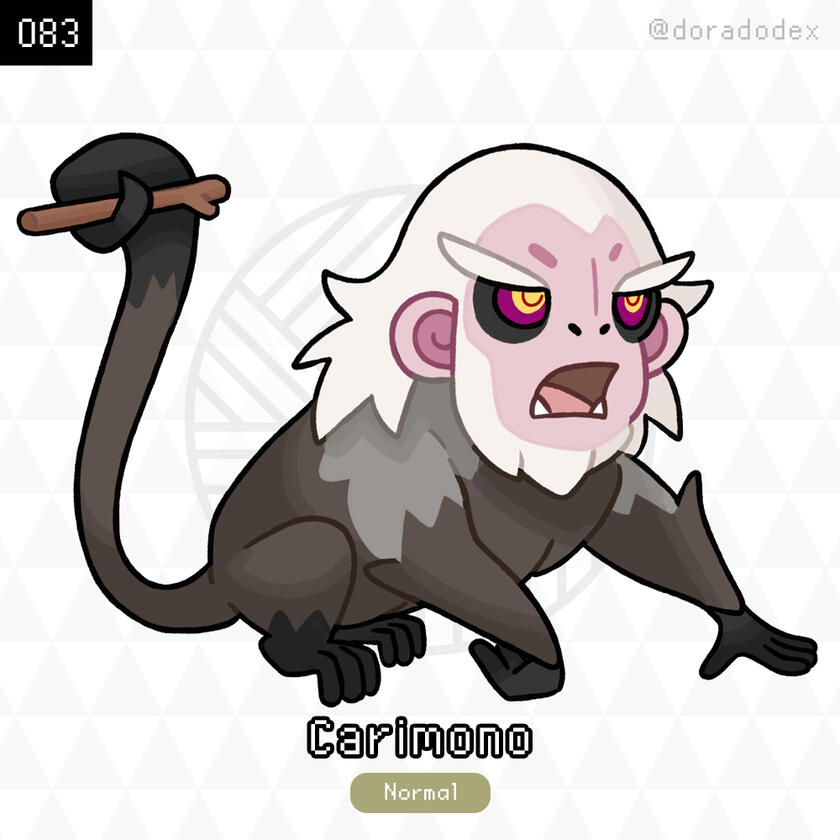
083
CARIMONO
NormalGroups of Carimono communicate by screaming at each other, their screams are sometimes confused with human speech. Adventurers in search of El Dorado often get lost because they understand Carimono’s screams as directions to the mythical city.ORIGIN + ETYMOLOGY
Carimono is based on various small primates from the Americas, specially the white-faced capuchin (cebus capucinus) and a howler monkey (alouatta).
“Carimono” is a derived of ‘cara’ (face) and ‘mono’ (monkey).
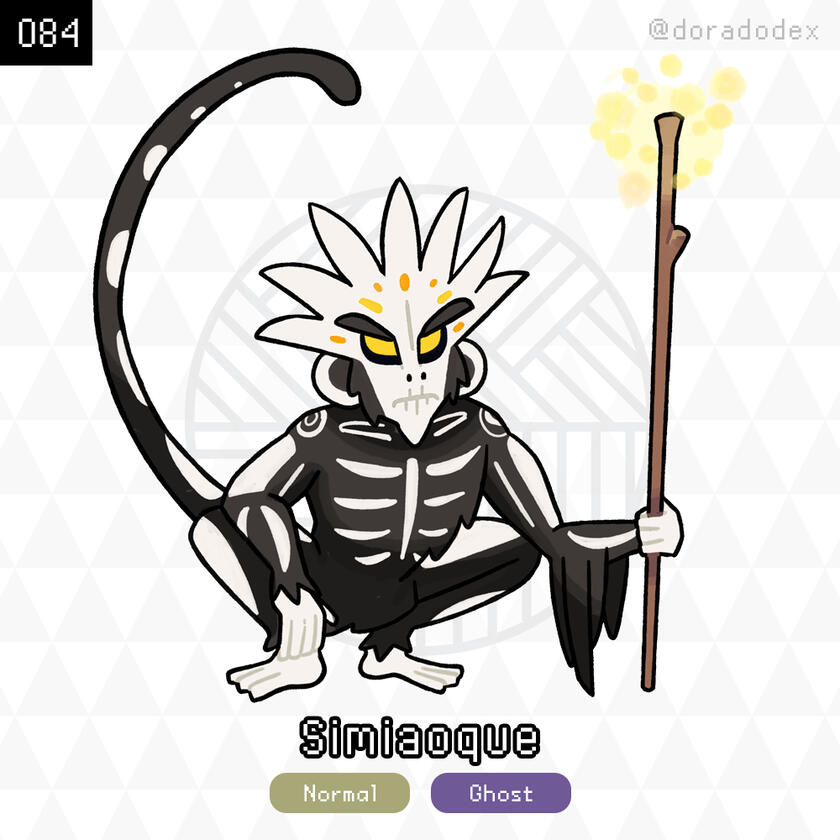
084
SIMIAOQUE
Normal/GhostSimiaoque wanders at night, where its fur becomes almost invisible due to the deep darkness of the forests and jungles it lives in, because of this people often confuse it with a walking skeleton.ORIGIN + ETYMOLOGY
Simiaoque is based on the De Loy’s ape, a cryptid uncovered as a hoax in the early 20th century, and Guahaioque, a minor deity of evil and death in the Muisca religion.
“Simiaoque” is a combination of ‘simian’ and ‘Guahaoique’ (lit. figure of the deceased).
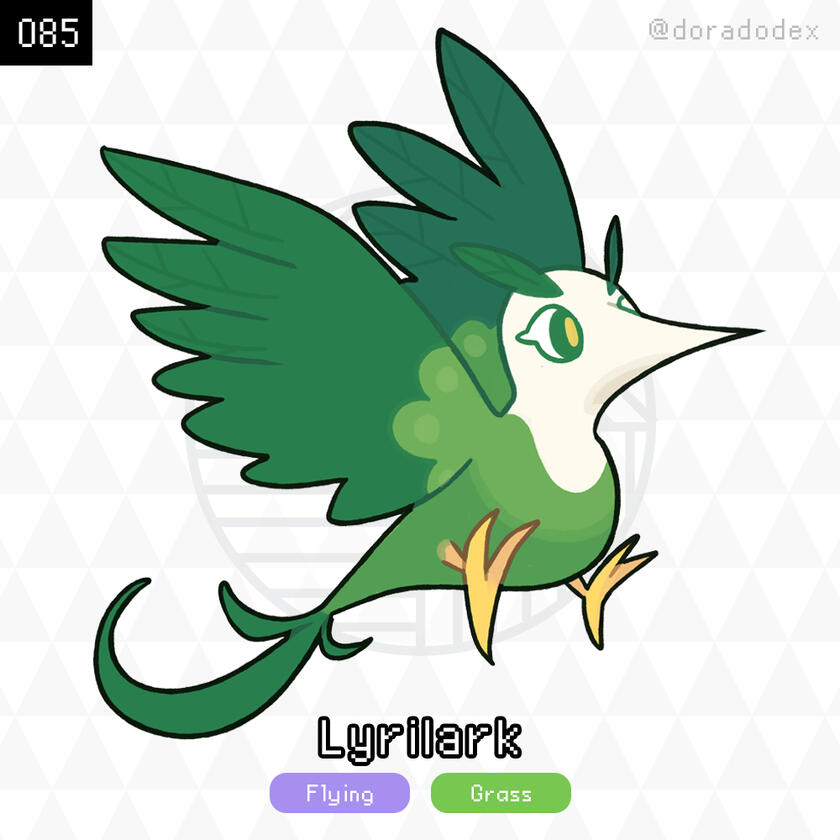
085
LYRILARK
Flying/GrassLyrilark fight each other by hitting their beaks together in a style that is very similar to sword fighting.ORIGIN + ETYMOLOGY
Lyrilark is inspired by a hummingbird, specially a sword-billed hummingbird (ensifera ensifera).
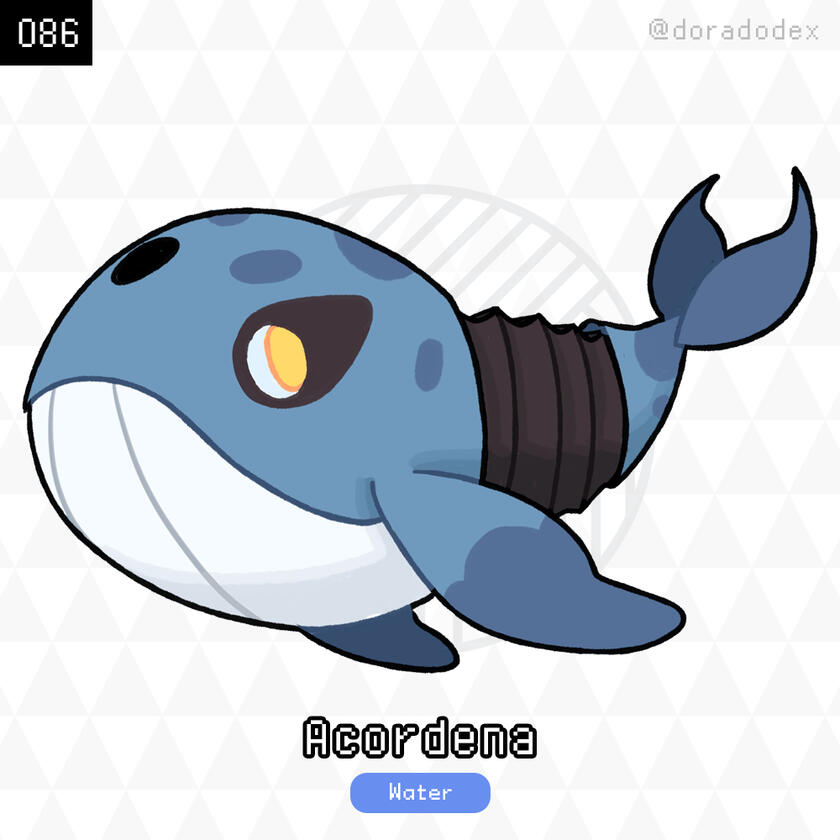
086
ACORDENA
WaterAcordena’s body makes beautiful sounds as they swim. Each Acordena makes a different sound and when they swim together it sounds like a melody.ORIGIN + ETYMOLOGY
Acordena is based on a calf (whale) and a button accordion.
“Acordena” is a combination of ‘accordion’ and ‘ballena’ (whale).
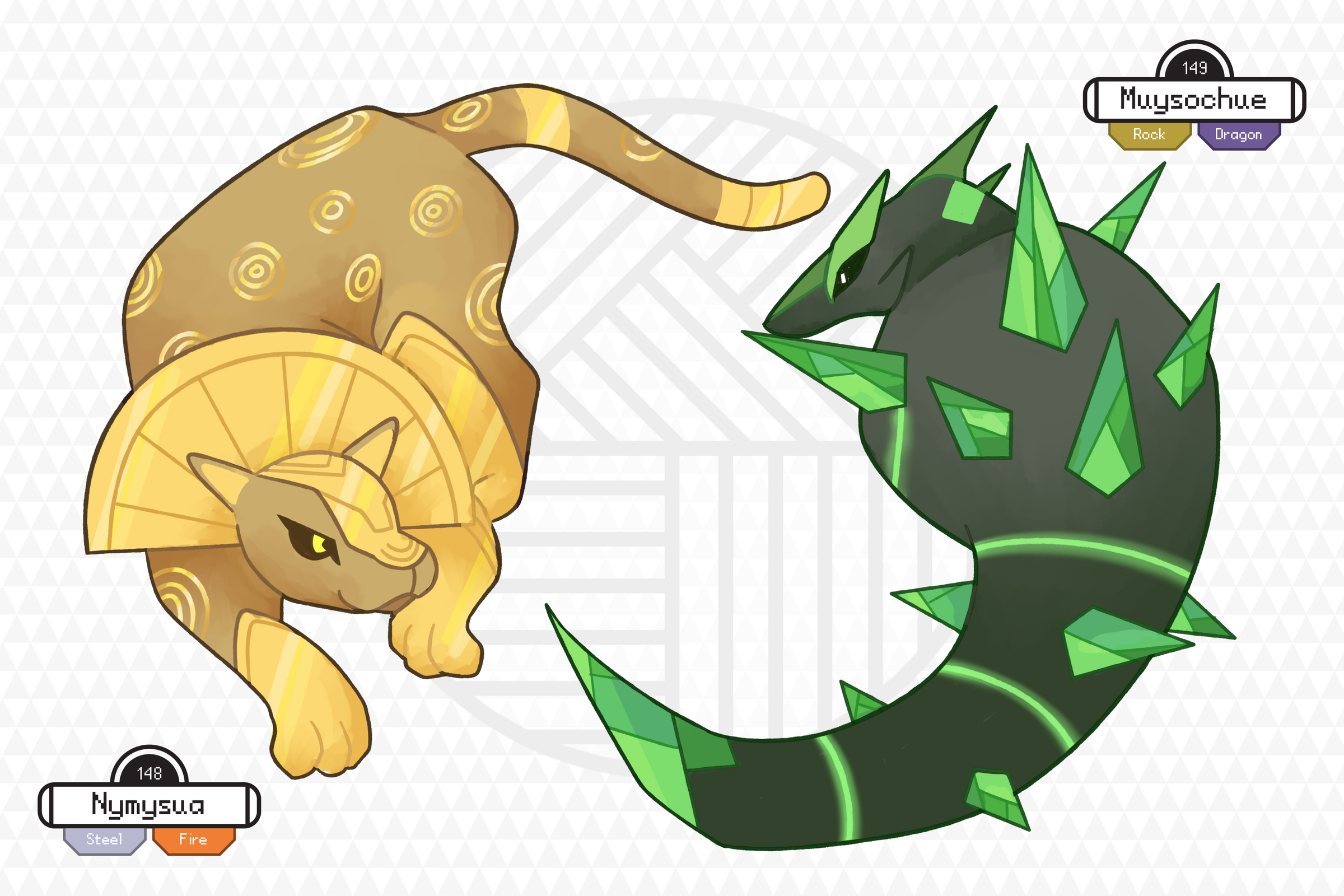
148
NYMYSUA
Steel/FireThe golden jaguar Nymysua, or Doramidas as the Paldean Settlers named it, is known to the native people of Dorado as the keeper of order. It’s said it can turn anything to gold just by touching it.Legends say it’s resting on the lost mythical place of El Dorado alongside a massive treasure of millions of pieces of gold.
149
MUYSOCHUE
Rock/DragonThe emerald serpent Muysochue, or Emeralisk as the Paldean Settlers named it, is known to the native people of Dorado as the bringer of chaos. It’s said its eyes can petrify anything into a raw emerald-like stone.Legends say it went into a five hundred years slumber at the mythical Lost Ruins after helping the Paldean Settlers bring chaos to the Dorado Region.